Technical Field
The invention relates to a vehicle performance parameter test Technical Field, in particular to a method of measuring the coefficient of rolling resistance.
Background Art
At present, measuring vehicle rolling resistance coefficient (rolls anti- coefficient for short), there are two main methods of, that is, by GBT-18861 automobile tire rolling resistance measurement method is the representative method for measuring the bench, this method is currently recognized more accurate method of measuring rolls anti- coefficient; the other is a path measuring method, the method using a slide test (such as GBT-12536 automobile sliding experiment) running resistance-speed curve is obtained, and then calculates a coefficient rolls anti-. In the latter method, the permanent rolls anti- coefficient is calculated according to the following method: the assumption that slide on a road when the vehicle running resistance includes only the rolling resistance and air resistance of two parts, its running resistance is shown in formula (1):
F (v) = k 0 +k 2 v 2 (1)
In aboving, k 0 as the rolling resistance, for the vehicle speed v, k 2 v 2 to air resistance. Through the sliding test was running resistance-speed curve, the curve according to the formula (1) to fit k 0 and k 2. Use of rolling resistance and the relationship between the quality of the vehicle, that is, rolling resistance coefficient of formula (2) f is obtained:
(2)
In the above formula: the quality of the vehicle m, g is the gravity acceleration. (2) type rolling resistance and also reflects the relationship between the coefficient rolls anti- general formula.
The shortcoming of the above-mentioned method is to ignore the transmission system and a braking system into internal friction resistance of the total resistance of the wheel edge (hereinafter referred to as internal friction resistance), and then the rolling resistance coefficient large measurement error. Under the conditions of sliding of the vehicle, in general the internal friction resistance 10-50N between, and with the vehicle speed and not changing much che Zhong , can be approximately considered to be a constant value. According to the above-mentioned calculation method to obtain rolling resistance k 0 in fact comprises two part component force: the actual rolling resistance and internal friction resistance. Obviously k 0 large rolling resistance than the actual, so according to formula (2) will also be obtained by a large rolls anti- coefficient.
The quality of a vehicle, for example, 1500 kilogram, internal friction resistance into 40N car, known rolls anti- coefficient of 0.01. Theoretically, obtained through the above-mentioned 2nd method for rolling resistance 187N, rolls anti- coefficient is 0.0127, the coefficient error rolls anti- 27%. The reason for this is that the error of the rolling resistance of the rolling resistance than the actual internal friction resistance comprising more 40N this a component force, shall be true rolling resistance 147N (obtained according to the formula (2)).
Content of the invention
The purpose of this invention is to provide a can eliminate the internal frictional resistance of the vehicle on the measurement results of the method of measuring the coefficient of rolling resistance.
Technical solution of this invention is:a method of measuring the coefficient of rolling resistance, comprising the following steps:
(1), the quality of the vehicle m 1 under the condition of, reference GBT-12536 automobile sliding test method, to as a group at a time, carrying out a plurality of groups of sliding test, and recording each of the speed-time curve;
(2), the load of the vehicle is changed, the quality of the vehicle m 2 under the condition of, reference GBT-12536 automobile sliding test method, to as a group at a time, once again carrying out a plurality of groups of sliding test, and recording each of the speed-time curve;
(3), the step (3) according to the formula (1) recording each in the speed-time curve by the conversion, to obtain the same number of running resistance-speed curve, then the running resistance-speed curve and the running resistance of the arithmetic average value of the velocity, the average running resistance-speed curve F m1 (v); according to the formula (3) in step (2) recording each in the speed-time curve by the conversion, to obtain the same number of running resistance-speed curve, then the running resistance-speed curve and the running resistance of the arithmetic average value of the velocity, the average running resistance-speed curve F m2 (v);
F m (v) =δma (v) (3)
In the above formula: the quality of the vehicle m, to consider δ vehicle wheel moment of inertia rotating quality conversion factor, a (v) for vehicle sliding speed reducing;
![]() wherein, ∑I w of inertia for the wheel, the wheel radius r, the quality of the vehicle m;
wherein, ∑I w of inertia for the wheel, the wheel radius r, the quality of the vehicle m;
![]() Wherein, the speed increment Δv, (v+Δv) Δt (v-Δv) for the vehicle speed from the time to.
Wherein, the speed increment Δv, (v+Δv) Δt (v-Δv) for the vehicle speed from the time to.
(4), the two average driving resistance-speed curve F m1 (v) and F m2 (v) obtained by subtracting the running resistance increment-speed curve Δ F (v), then the curve the arithmetic mean of the ![]()
(5), (4) according to the following formula f obtain the vehicle rolling resistance coefficient,
(4)
![]() Is calculated taking into consideration the wheel moment of inertia rotating vehicle δ the quality of the well known formula for the conversion coefficient, the it does not repeat. In this formula, taking generally δ 1.03-1.05.
Is calculated taking into consideration the wheel moment of inertia rotating vehicle δ the quality of the well known formula for the conversion coefficient, the it does not repeat. In this formula, taking generally δ 1.03-1.05.
![]() The instantaneous acceleration of the is to calculate the well known formula, the it does not repeat. In this formula, taking generally Δv 1-2.5km/h.
The instantaneous acceleration of the is to calculate the well known formula, the it does not repeat. In this formula, taking generally Δv 1-2.5km/h.
Detailed description of the derivation process formula (4).
Under the conditions of sliding of the vehicle, the incremental running resistance of the vehicle and is proportional to the increment of the quality of the vehicle. When the vehicle mass is m 1 running resistance model shown in formula (5):
F m1 (v) =fm 1 g+F internal resistance +k 2 v 2 (5)
In aboving: fm 1 g as the rolling resistance, internal resistance F for internal friction resistance, k 2 v 2 to air resistance.
The load of the vehicle is changed, the vehicle mass is m 2 running resistance is shown in formula (6):
F m2 (v) =fm 2 g+F internal resistance +k 2 v 2 (6)
In aboving: fm 2 g as the rolling resistance, internal resistance F for internal friction resistance, k 2 v 2 to air resistance. (5) type-(6) type can be running resistance increment-speed curve Δ F (v), as shown in the formula (7):
Δ F (v) = F m1 (v)-F m2 (v) =f (m 1-m 2) g (7)
The formula (7) incremental running resistance Δ F yi Zhi (v) not change with vehicle speed.
Further finishing the formula (7), of formula (8) can be obtained:
(8)
According to formula (8) as long as the know that any one of the vehicle speed v 0 running resistance increment ΔF (v 0) can be obtained f rolls anti- coefficient. Although in theory the incremental running resistance does not vary with speed change, however, due to the impact of the condition of the road surface and the natural wind, there is fluctuation of the incremental running resistance, should therefore be in the whole vehicle speed in the variation range of the average value of the calculated running resistance increment ![]() In order to reduce the measuring error. Finally according to the following formula (4) f obtain the vehicle rolling resistance coefficient.
In order to reduce the measuring error. Finally according to the following formula (4) f obtain the vehicle rolling resistance coefficient.
(4)
Obtaining by the method of the invention the high precision of the rolling resistance coefficient, and the measuring apparatus is simple, the cost is low.
As a preferred embodiment, step (1) of in m 1 the maximum design total mass of the vehicle, step (2) of the in m 2 by the vehicle to save the quality of a driver. As can be seen from formula (7), the incremental increase quality incremental running resistance can be increased, and then the driving resistance can weaken the influence of the error on the measurement results. The preferred embodiment is that the availability of most large mass increment.
In the method provided by the invention, steps (1) and (2) sliding test the number of groups can be the same also can be different. According to experience, in order to reduce the error, the quality with a vehicle slide test the number of groups is preferably not less than 5 group.
Slide test is carried out, in order to reduce the error, preferably ambient temperature fluctuation is not greater than 1 the test is conducted under conditions of [...].
In addition it also includes the steps of (6:)of the step (5) in the vehicle rolling resistance coefficient obtained by GBT 18861 to empirical formula of the standard environment temperature (the 25 [...]) state of the vehicle under rolling friction coefficient. Empirical formula as shown in formula (9):
f 25 = f [1 + 0.01 (T-25)] (9)
In the above formula: T temperature of the environment for the actual measurement, when the temperature of T f the measured coefficient rolls anti- , f 25 to the 25 the [...]rolls anti- coefficient. Existing research has shown that the ambient air temperature has a greater impact on rolls anti- coefficient, and the temperature of the environment affecting the test result in the test method, the test is generally converted into the environmental temperature of the standard environment temperature of the 25 [...] , so as to make the test method more has universality, has better comparability test results. Therefore, preferably the formula (9) will not be in accordance with the 25 [...] ambient temperature to the rolling resistance coefficient of 25 the rolling resistance coefficient under [...].
Slide test is carried out, the ambient temperature is preferably the 20-30 between [...] , in order to use empirical formula (9) correction coefficient rolls anti- more accurately.
The advantage of this invention is to: GBT-18861 compared with automobile tire rolling resistance measuring method, the method provided by the invention in that on the premise of precision test results, has simple measuring device, the cost is low; GBT-12536 for comparing with the running resistance of the automobile sliding experiment-speed curve is obtained, and then calculates a coefficient rolls anti- method, the present invention provides a method for high precision.
Description of drawings
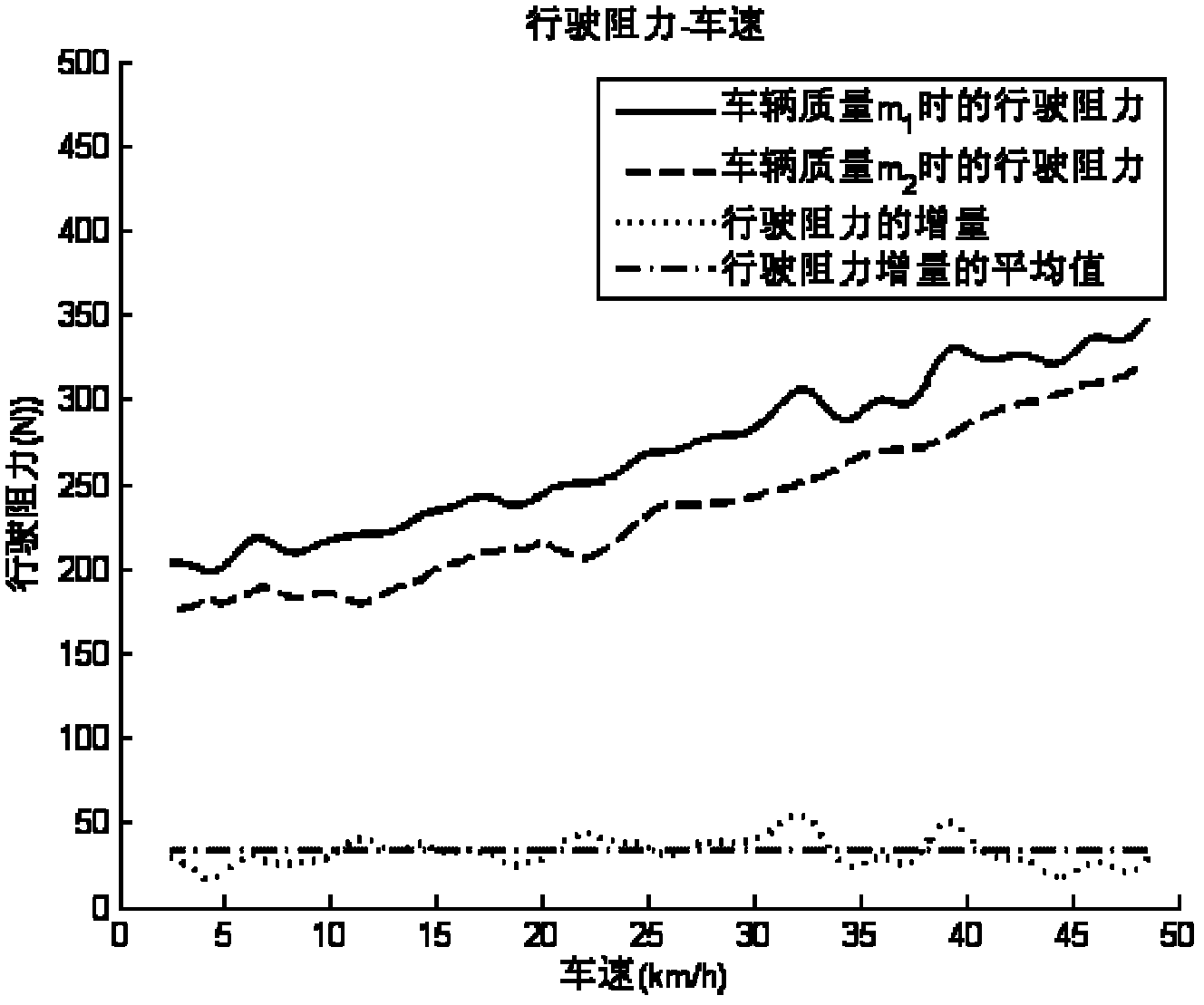
Figure 1 of the shown embodiment of the invention two of the curve of the average of the driving resistance, the running resistance curve and the increment of the average value of the increment of the running resistance.
Mode of execution
Embodiment:
1, weather conditions, such as measuring temperature: test temperature of 30 the [...] , breeze (<2m/s).
2, adjusting tire pressure: under cold conditions in the tire air pressure is adjusted to the vehicle manufacturers recommendation value 220kPa.
3, configuration vehicle quality to m 1: a driver bedstand maximum, then loading of the sandbag the quality of the vehicle of the vehicle reach the maximum design total mass 2050 kilogram.
4, the quality of the vehicle m 1 carried out under the condition of slide test and record data: in the horizontal, dry asphalt road surface of 5 group (back-and-forth as a group), slide test, the initial vehicle speed 50 kilometer per hour, using a portable GPS device (sampling frequency 10Hz) recording each slide speed-time curve and sliding distance, to obtain 10 of the speed-time curve.
5, configuration vehicle quality to m 2: unloading all the sandbag, there is only one remaining drivers, unloading of the sandbag the quality of the vehicle after 1676 kilogram.
6, the quality of the vehicle m 2 carried out under the condition of slide test and record data: with the steps 4 on the road is the same as 5 set of sliding test, the initial vehicle speed 50 kilometer per hour, using a portable GPS device records each slide speed-time curve and sliding distance, to obtain 10 of the speed-time curve.
7, the driving resistance-speed curve to: the step (3) according to the formula 4 is recorded in each of the speed-time curve by the conversion, to obtain 10-speed curve of the running resistance, then the this 10, running resistance-speed curve and the running resistance of the arithmetic average value of the velocity, the average running resistance-speed curve F m1 (v); according to the formula (3) in step 6 of the recording in 10 of the conversion of the speed-time curve, to obtain 10-speed curve of the running resistance, then the this 10, running resistance-speed curve and the running resistance of the arithmetic average value of the velocity, the average running resistance-speed curve F m2 (v).
8, to the average value of the increment of the running resistance of: the two average driving resistance-speed curve F m1 (v) and F m2 (v) obtained by subtracting the running resistance increment-speed curve Δ F (v), then the curve the arithmetic mean of the ![]() As shown in Figure 1. The calculated average value of the driving resistance increment
As shown in Figure 1. The calculated average value of the driving resistance increment ![]()
9, in accordance with formula (4) rolling resistance coefficient f calculated:
10, in accordance with formula (9) to the 25 of the rolling resistance coefficient under [...] :
f 25 = 0.00903 [1 + 0.01 (30-25)] = 0.00948
Note:
1, slide test is carried out, in order to reduce the error, selecting environmental temperature fluctuation is not greater than 1 the test is conducted under conditions of [...]
2, test at a temperature, preferably the 20-30 between [...] , in order to use empirical formula (9) correction coefficient rolls anti- more accurately.
3, the vehicle should be before the test to 50-80km/h running average speed of at least 30 minutes, in order to make the tire fully preheated (i.e. preheating running). Tire sufficient preheating is criteria for the judgment of no increase in the sliding distance. If several consecutive groups of experiment sliding distance of increasing preheating it indicates that there is not full, from the non-incremental trend should be begun the recording data of the experimental group.
4, in order to reduce the temperature, wind speed and other environmental factors the impact of the changes on the test, each group of slide test should be in the same condition of the road surface and ambient temperatures. Step 4 if the immediately preceding step 6 to, test vehicle is not specialized preheating running, but the sliding distance needs to observe the existence of increment trend, if there are incremental trend-illustrating preheating not fully, from the non-incremental trend should be begun the recording data of the experimental group.
In order to further illustrate the beneficial effect of the method of the invention, the rolling resistance coefficient the more the precision:
GBT-18861 in accordance with test method for measuring on the rack rolls anti- coefficient, tire pressure 220kPa, the temperature the 25 [...] , the measured rolls anti- coefficient is 0.00936. In accordance with the GBT-12536 automobile sliding experiment measuring, and according to the following formula (1), (2) and formula (9) to the calculated rolls anti- coefficient is 0.01105, and GBT-18861 rolls anti- coefficient of the obtained error is compared to 18.1%, large error.
F (v) = k 0 +k 2 v 2 (1)
(2)
f 25 = f [1 + 0.01 (T-25)] (9)
The present invention is measured by the coefficient rolls anti- 0.00948, and GBT-18861 compared with the deviation of the test result of only 1.3%, we can see that the present invention has high measurement accuracy is good, and having measuring equipment is simple, low cost. GBT-12536 the automobile sliding experiment measuring, and according to (1), (2) and formula (9) compared with the calculated rolls anti- coefficient, higher measurement accuracy of this invention.
The above detailed description is directed to the invention feasible specific description of the embodiment, this embodiment is not in order to limit the Patent scope of the present invention, where the disengaging this invention or change the equivalent implementation, should be included in the present case in the Patent scope.
Method for measuring rolling resistance coefficient of vehicle




 400-4929-0909
 contact@catarc.com.cn

