Contents of the invention
The purpose of the application is to provide a multiple safety control method, device, electronic equipment and storage medium of the robot to realize multiple safety protection for the robot to avoid the occurrence of safety accidents.
First, the application provides a plurality of safety control methods for the robot, and the shutdown operation that the robot can perform comprises a forced stop, a deceleration stop and a non-destructive stop;
The multiple safety control methods of the robot comprise the following steps:
monitoring the operation of the microcontrol unit based on the watchdog timer, and when the microcontrol unit is running abnormally, the robot is triggered to perform a forced stop based on the watchdog timer;
when the microcontrol unit is operating normally and equipment failure occurs, the robot is controlled to perform a forced stop, a deceleration stop or a lossless stop based on the microcontrol unit software;
When the software control response times out, the hardware controls the robot to perform a forced stop.
The multiple safety control method of the robot in the present application realizes triple safety protection for the robot based on the watchdog timer, software control and hardware control, and can perform shutdown operation according to the faults that occur in different situations during the operation of the robot, and can effectively avoid the occurrence of safety accidents and protect the user.
the multiple safety control method of the robot, wherein the watchdog timer triggers a reset based on the microcontrol unit at regular intervals to monitor the operation of the microcontrol unit.
In this example, the microcontroller periodically resets the count value of the watchdog timer to avoid the watchdog timer from generating a timeout signal, and the monitoring logic is simple and effective, which can timely and accurately reflect whether the microcontroller is operating abnormally.
The multiple safety control methods of the robot, wherein the steps of controlling the robot to perform forced stop, deceleration stop or non-destructive stop based on the microcontrol unit software comprise:
obtain the safety level of the equipment failure;
The software of the microcontrol unit controls the robot to perform a shutdown operation corresponding to the safety level in a forced stop, a deceleration stop and a non-destructive stop.
The multiple safety control methods of the robot in the present application need to distinguish the equipment fault, select the appropriate shutdown operation mode based on the safety level of the equipment failure, and select the appropriate shutdown operation under the premise of balancing the safety and the degree of damage of the robot.
The multiple safety control method of the robot, wherein the steps of obtaining the safety level of the equipment fault comprise:
Obtain the stated level of safety based on the type of fault and/or the state of the environment of the equipment failure.
the plurality of safety control methods of the robot, wherein the safety level comprises a first level, a second level and a third level that are respectively applied to triggering the forced stop, the deceleration stop and the non-destructive stop;
The first level corresponds to equipment failures that endanger the safety of the user;
The second level corresponds to equipment failures that do not endanger the safety of the user and the shutdown is uncontrollable;
The third level corresponds to equipment failures that do not endanger the safety of the user and have controllable shutdowns.
The multiple safety control method of the robot, wherein the microcontrol unit sends a stop signal based on the pin to carry out software control to the robot.
The multiple safety control methods of the robot, wherein when the software control response times out, the hardware controls the robot to perform a forced stop step comprising:
judging whether the software control has a response timeout according to the time threshold corresponding to the shutdown operation, and when the response times out, the hardware controls the robot to perform a forced stop.
secondly, the application also provides a plurality of safety control devices for the robot, and the shutdown operations that the robot can perform comprise a forced stop, a deceleration stop and a non-destructive stop;
The multiple safety controls of the robot comprise:
the first stop module is used for monitoring the operation of the micro-control unit based on the watchdog timer, and when the micro-control unit runs abnormally, the robot is triggered to perform a forced stop based on the watchdog timer;
the second stop module is used for controlling the robot to perform forced stop, deceleration stop or lossless stop based on the microcontrol unit software when the microcontrol unit is running normally and equipment failure occurs;
the third stop module is used for hardware controlling the robot to perform a forced stop when the software control response times out.
The multiple safety control devices of the robot in the present application are based on the watchdog timer, software control and hardware control to realize triple safety protection for the robot, and can perform shutdown operation according to the faults that occur in different situations in the operation process of the robot, and can effectively avoid the occurrence of safety accidents and protect the user.
Third, the application also provides an electronic device, comprising a processor and a memory in which a computer-readable instruction is stored, and when the computer-readable instruction is executed by the processor, a step in the method provided in the first aspect is run.
Fourth, the application also provides a computer-readable storage medium on which a computer program is stored, and when the computer program is executed by a processor, it runs the steps in the method provided in the first aspect.
It can be seen from the above that the application provides a plurality of safety control methods, devices, electronic equipment and storage media of the robot, wherein the multiple safety control methods of the robot of the present application are based on a watchdog timer, software control and hardware control to realize triple safety protection for the robot, and can perform shutdown operation according to the faults that occur in different situations in the operation process of the robot, so as to effectively avoid the occurrence of safety accidents and protect users.
The specific embodiment
The technical solutions in the embodiments of the present application will be clearly and completely described below in conjunction with the accompanying drawings in the embodiments of the present application, and it is obvious that the described embodiments are only part of the embodiments of the present application, not all embodiments. The components of the embodiment of the present application, which are normally described and shown in the drawings herein, may be arranged and designed in a variety of different configurations. Therefore, the following detailed description of the embodiments of the present application provided in the drawings is not intended to limit the scope of the claimed application, but merely indicates the selected embodiments of the present application. Based on the embodiments of the present application, all other embodiments obtained by a person skilled in the art without creative work fall within the scope of protection of the present application.
It should be noted that similar designations and letters indicate similar terms in the drawings below, so that once an item is defined in a drawing, it does not need to be further defined and explained in subsequent drawings. At the same time, in the description of the present application, the terms "first", "second", etc., are only used to distinguish the description and cannot be construed as indicating or implying relative importance.
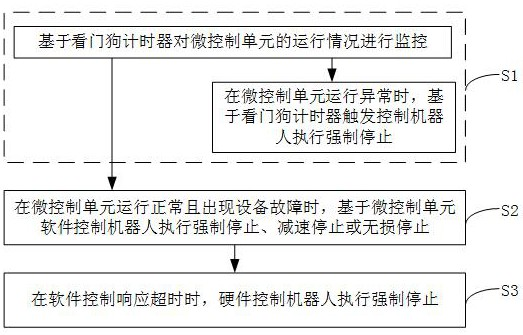
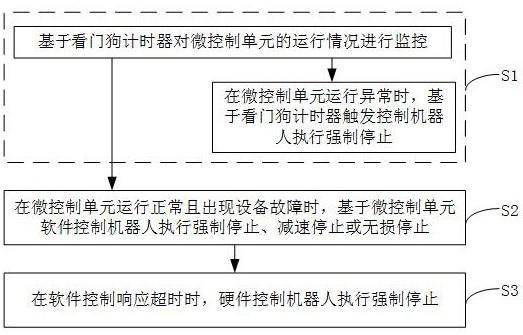
First, please refer to Figure 1, some embodiments of the present application provide a plurality of safety control methods of the robot, and the shutdown operation that the robot can perform comprises forced stop, deceleration stop and non-destructive stop;
The multiple safety control methods of the robot in the embodiment of the present application comprise the following steps:
S1. Monitor the operation of the micro-control unit based on the watchdog timer, and when the micro-control unit runs abnormally, the control robot is triggered to perform a forced stop based on the watchdog timer;
S2. When the microcontroller unit is running normally and the equipment fails, the robot is controlled to perform forced stop, deceleration stop or lossless stop based on the microcontrol unit software;
S3. When the software control response times out, the hardware controls the robot to perform a forced stop.
Specifically, the microcontroller unit (MCU) is the execution control end of the robot, which is used for controlling the operation of each component of the robot to cooperate with the operation to complete a specific production task, and the multiple safety control methods of the robot in the embodiment of the present application are designed to trigger the shutdown operation from multiple levels according to the fault generated during the actual operation of the robot, so as to ensure that the shutdown operation can be successfully completed when the robot fails, so as to improve the safety of equipment operation.
More specifically, forced stop, deceleration stop and non-destructive stop belong to three different stop operations, and the damage caused to the robot equipment decreases sequentially and the degree of safety guarantee decreases sequentially; in the embodiment of the present application, the above three stop operations are preferably designed corresponding to the three stop categories in the "EN60204-1 standard" respectively, that is, the forced stop, the deceleration stop and the non-destructive stop are respectively designed corresponding to the stop category 0, the stop category 1 and the stop category 2, wherein, in the EN60204-1 standard》 , stop category 0 is defined as: stop is achieved by immediately cutting off the power supply of machinery and equipment; stop category 1 is defined as: controlled stop, the power supply to the actuator of the machinery and equipment has been maintained, so that the machinery and equipment gradually stop; stop category 2 is: controlled stop, the power supply to the driving device of the machinery and equipment has been maintained; it can be seen that the forced stop is the shutdown operation that is performed based on the immediate power failure, can complete the shutdown most quickly, and will cause damage to the robot, and the deceleration stop is the shutdown operation of stopping and power-off based on a certain period of time deceleration, and the shutdown can be completed relatively quickly, and the damage caused to the robot is small, non-destructive stop is a shutdown operation that stops based on system control and does not damage the robot.
More specifically, the watchdog timer is the first safety protection layer of the multiple safety control method of the robot in the embodiment of the present application, and it is used for monitoring and judging whether the microcontrol unit is out of control due to fault (whether the operation situation is normal), and the out-of-control situation can be caused by the error of robot hardware execution or the software execution error of microcontrol unit, In this case, the microcontrol unit can not trigger normally or feedback to trigger the watchdog timer, and the loss of control of the microcontrol unit as the main control end of the robot may cause various major accidents, so it is necessary to immediately implement a forced stop to avoid accidents.
More specifically, the software control is the second safety protection layer of the multiple safety control method of the robot in the embodiment of the present application; under the condition that the watchdog timer detects that the microcontrol unit is running normally, the microcontrol unit does not lose control, and it can analyze whether the robot has various equipment faults according to the actual operation of the robot, such as receiving various electrical signals based on sensors to comprehensively analyze whether there is an operation fault (such as overheating, In the case of equipment failure, the microcontrol unit can control the robot to perform shutdown operations to avoid accidents or damage to the equipment due to the continued operation of the robot in the event of equipment failure, and the software control can set the type of shutdown operation performed by the robot according to the needs of the scene, and can also adaptively select the appropriate shutdown operation according to the actual operation situation.
More specifically, the hardware control is the third safety protection layer of the multiple safety control method of the robot in the embodiment of the present application; the hardware control is based on the hardware control structure implementation, such as a hardware circuit such as a relay; when the software control is actually used to shut down, the software control may be due to program execution error, signal loss, Reasons such as voltage fluctuation or crash cause the shutdown operation cannot be carried out smoothly, therefore, the multiple safety control method of the robot in the embodiment of the present application is designed with hardware control as a remedial measure when the software control fails, so as to judge whether the software control fails based on the response time, and when the software control fails at a timeout, the robot is controlled to perform the forced stop with the highest degree of safety based on the hardware control.
The multiple safety control method of the robot in the embodiment of the present application is based on the watchdog timer, software control and hardware control to realize triple safety protection for the robot, and can perform shutdown operation according to the faults that occur in different situations during the operation of the robot, and can effectively avoid the occurrence of safety accidents and protect the user.
It should be noted that the forced stop in step S1, step S2 and step S3 refers to the same type of stop mode (such as a shutdown operation performed based on an immediate power failure), and is not limited to being performed based on the same kind of means.
In some preferred embodiments, a watchdog timer is based on the microcontrol unit and timed trigger resets to monitor the operation of the microcontrol unit.
Specifically, in this embodiment, the watchdog timer continuously counts to monitor whether the microcontrol unit has abnormal operation, generates a timeout signal when the counting value of the watchdog timer reaches the preset value, and the timeout signal is used for triggering the control robot to perform a forced stop; the microcontrol unit periodically resets the counting value of the watchdog timer to avoid the watchdog timer from generating a timeout signal; the monitoring logic is simple and effective, and can timely and accurately reflect whether the microcontrol unit has abnormal operation.
More specifically, the watchdog counter is monitored based on the count value, so it is not possible to know and evaluate the type and severity of the fault occurring in the microcontrol unit, and the loss of control of the microcontrol unit is a system-level error that can cause a serious accident, so the most safe forced stop needs to be performed in this case.
In some preferred embodiments, the steps of controlling the robot to perform a forced stop, a deceleration stop or a non-destructive stop based on the microcontrol unit software include:
S21. obtaining the safety level of equipment failure;
S22, based on the micro-control unit software, the robot is controlled to perform the shutdown operation corresponding to the safety level in forced stop, deceleration stop and non-destructive stop.
Specifically, the micro-control unit can collect various operating parameters and state parameters of the robot to control the complete specific production tasks of the robot, and can also analyze whether the robot has equipment failures based on various operating parameters and state parameters, so the severity of the fault can be analyzed to determine the safety level of the fault.
More specifically, different types of faults may cause production accidents of different severity, and different shutdown operation modes can also cause different degrees of damage to the robot, therefore, the multiple safety control methods of the robot in the embodiment of the present application need to distinguish the equipment faults, select the appropriate shutdown operation mode based on the safety level of the equipment failure, and select the appropriate shutdown operation on the premise of balancing the safety and the degree of damage of the robot.
In some preferred embodiments, the steps to obtain the safety level of a device failure include:
S211, obtain a security level based on the fault type and/or environmental state of the device failure.
Specifically, different fault types of equipment faults can cause different problems to determine that the robot will produce different fault actions, so the multiple safety control methods of the robot in the embodiment of the present application can obtain safety levels based on fault types.
More specifically, the environmental state can be the environmental parameters near the robot, and can also be the distribution characteristics of people and things near the robot; different environmental states will affect the probability of different production accidents triggered by the robot with equipment failure, such as when there are multiple users near the robot, it is more likely to have an accident that endangers personal safety, and when there are flammable materials around the robot and the air humidity is low, it is more likely to occur a fire accident, so the multiple safety control methods of the robot in the embodiment of the present application can obtain a safety level based on the environmental state.
More specifically, the security level can be selected based on a preset classification table, and in the embodiment of the present application, it is preferable to filter out the corresponding level from the classification based on the fault type and the environmental state.
More specifically, the environmental state can be determined based on the relevant data information obtained by various sensors mounted on the robot, such as judging whether there is a user near the robot based on the image sensor or human body sensor switch, and obtaining temperature and humidity data based on the temperature and humidity sensor.
In some preferred embodiments, the safety level comprises a first, second, and third level applied to triggering a forced stop, a deceleration stop, and a non-destructive stop, respectively;
The first level corresponds to equipment failures that endanger the safety of the user;
The second level corresponds to equipment failures that do not endanger the safety of the user and the shutdown is uncontrollable;
The third level corresponds to equipment failures that do not endanger the safety of the user and have controllable downtime.
Specifically, when a first-level equipment failure occurs, the multiple safety control method of the robot in the embodiment of the present application is based on the microcontrol unit software to control the robot to perform a forced stop, which can quickly stop the operation of the robot and cut off power, avoid the robot from continuing to run and endanger the user's safety, and effectively protect the user's personal safety.
More specifically, uncontrollable shutdown refers to the state that the robot cannot perform shutdown based on the shutdown process during normal operation; when a second-level equipment failure occurs, the multiple safety control method of the robot in the embodiment of the present application controls the robot to perform deceleration and stop based on the microcontrol unit software, so that the robot can carry out deceleration shutdown and power outage with less damage to the internal structure, and the mechanical structure of the robot is protected.
More specifically, the shutdown controllable refers to the state that the robot can perform the shutdown based on the shutdown process during normal operation; when a third-level equipment failure occurs, the multiple safety control methods of the robot in the embodiment of the present application control robot are based on the microcontrol unit software to control the robot to perform non-destructive stopping, so that the robot can be shut down based on the shutdown process during normal operation, and the internal structure of the robot is avoided as much as possible.
In some preferred embodiments, the microcontrol unit sends a stop signal based on the pin for software control of the robot.
Specifically, the microcontrol unit sends the stop signal of the corresponding shutdown operation to each equipment module in the controlled robot based on the transmitting pin, so that the robot can perform the corresponding shutdown operation in whole or part of the equipment module.
More specifically, forced-stop, deceleration-stop, and lossless stop configurations have different stop signals.
In some preferred embodiments, the steps for the hardware-controlled robot to perform a forced stop when the software control response times out include:
S31. Judge whether the software control has a response timeout according to the time threshold corresponding to the shutdown operation, and when the response times out, the hardware controls the robot to perform a forced stop.
Specifically, the embodiment method judges whether the software control responds to a timeout based on a time threshold, and can trigger the robot to perform a forced stop in a timely and accurate manner; wherein, because in the software control, different types of shutdown operations require different durations to complete the shutdown, the step S31 preferably judges whether the software control has a response timeout based on the time thresholds of different sizes configured for different shutdown operations, so as to trigger the robot to perform a forced stop in a more timely and accurate manner.
In some preferred embodiments, the software control of the microcontrol unit comprises a manual control stop mode and an automatic control stop mode, wherein the control mode of step S2 belongs to the automatic control stop mode; under the condition that the software control of the micro control unit is switched to the manual control stop mode, when the micro control unit runs normally and equipment failure occurs, the system generates fault prompt information for the user to select a suitable shutdown operation to stop the robot operation.
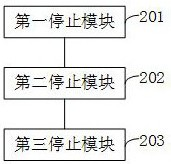
Second, please refer to Figure 2, some embodiments of the present application also provide a plurality of safety control devices of a robot, and the shutdown operation that the robot can perform comprises a forced stop, a deceleration stop and a non-destructive stop;
The multiple safety controls of the robot in the embodiment of the present application comprise:
the first stop module 201 is used for monitoring the operation of the microcontroller based on the watchdog timer, and when the microcontroller runs abnormally, the control robot is triggered to perform a forced stop based on the watchdog timer;
the second stop module 202 is used for controlling the robot to perform forced stop, deceleration stop or lossless stop based on the microcontrol unit software when the microcontrol unit is running normally and equipment failure occurs;
the third stop module 203 is used for hardware control robot to perform a forced stop when the software control response times out.
The multiple safety control device of the robot in the embodiment of the present application realizes triple safety protection to the robot based on the watchdog timer, software control and hardware control, and can perform shutdown operation according to the faults that occur in different situations in the operation process of the robot, and can effectively avoid the occurrence of safety accidents and protect the user.
It should be noted that the multiple safety control device of the robot is preferably the upper computer that is electrically connected with the microcontrol unit.
In some preferred embodiments, the plurality of safety control devices of the robot in the embodiment of the present application are used for performing the plurality of safety control methods of the robot provided in the first aspemblication.
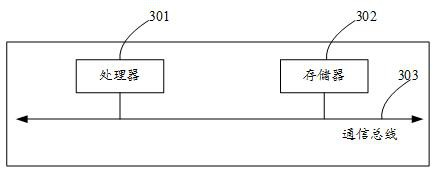
Thirdly, please refer to Figure 3, some embodiments of the present application also provide a schematic diagram of the structure of an electronic device, the present application provides an electronic device, comprising: a processor 301 and a memory 302, a processor 301 and a memory 302 through a communication bus 303 and/ or other forms of connecting mechanisms (not indicated) are interconnected and communicate with each other, the memory 302 stores executable computer-readable instructions of the processor 301, and when the electronic device is running, the processor 301 executes the computer-readable instructions to execute the method in any of the optional embodiments of the above embodiment when executed.
Fourth, the embodiment of the present application provides a computer-readable storage medium on which a computer program is stored, and when the computer program is executed by a processor, executes a method in any of the optional embodiments of the above embodiment. Among them, computer-readable storage media can be implemented by any type of volatile or non-volatile storage device or a combination thereof, such as Static Random Access Memory (SRAM), Electrically Erasable Programmable Read-Only Memory, EEPROM), Erasable Programmable Read Only Memory (EPROM), Programmable Red-Only Memory (PROM), Read-Only Memory (ROM), magnetic memory, flash memory, disk or optical disc.
In summary, the embodiment of the present application provides a plurality of safety control methods, devices, electronic equipment and storage medium of the robot, wherein the multiple safety control method of the robot of the embodiment of the present application realizes triple safety protection to the robot based on the watchdog timer, software control and hardware control, can perform shutdown operation according to the faults that occur in different situations in the operation process of the robot, can effectively avoid the occurrence of safety accidents and protect the user.
In the embodiments provided in the present application, it should be understood that the disclosed apparatus and method may be realized by other means. The device embodiments described above are only schematic, for example, the division of the units is only a logical function division, and there may be another division mode when the actual implementation is realized, and for example, a plurality of units or components can be combined or can be integrated into another system, or some features can be ignored, or not executed. On the other hand, the coupling or direct coupling or communication connection between each other shown or discussed may be indirect coupling or communication connection through some communication interface, device or unit, which may be in electrical, mechanical or other form.
In addition, the cells described as detached parts may or may not be physically separated, and the parts shown as units may or may not be physical units, i.e., they may be located in one place, or they can be distributed across multiple network units. Some or all of these units can be selected according to actual needs to realize the purpose of the present embodiment.
Furthermore, each functional module in each embodiment of the present application may be integrated together to form an independent part, or each module may exist independently, or two or more modules may be integrated to form an independent part.
For the purposes of this article, relational terms such as first and second, etc., are used solely to distinguish one entity or operation from another, and do not necessarily require or imply any such actual relationship or sequence between those entities or operations.
The foregoing is only an embodiment of the present application and is not intended to limit the scope of protection of the present application, which is subject to various changes and variations for those skilled in the art. Any amendments, equivalent replacements, improvements, etc., made within the spirit and principles of this application shall be included in the scope of protection of this application.






 400-4929-0909
 contact@catarc.com.cn

