The specific embodiment
In order to enable persons in the art to better understand the embodiments of the present invention, the technical solutions in the embodiments of the present invention will be clearly and completely described below in conjunction with the accompanying drawings in the embodiments of the present invention. Based on the embodiments in the embodiments of the present invention, all other embodiments obtained by a person skilled in the art without making creative work shall fall within the scope of protection of the embodiments of the present invention.
It should be noted that the terms "first", "second", etc. in the description and claims of the embodiments of the present invention and the above-mentioned drawings are used to distinguish similar objects, and do not need to be used to describe a specific order or sequence. It should be understood that the data so used are interchangeable where appropriate so that the embodiments of the embodiments of the present invention described here can be implemented in a order other than those illustrated or described here. In addition, the terms "including" and "having" and any variation thereof are intended to cover non-exclusive inclusions, e.g., a process, method, system, product or apparatus comprising a series of steps or elements need not be limited to those steps or elements that are clearly listed, but may include other steps or elements that are not clearly listed or are inherent to those processes, methods, products or equipment.
Embodiment one
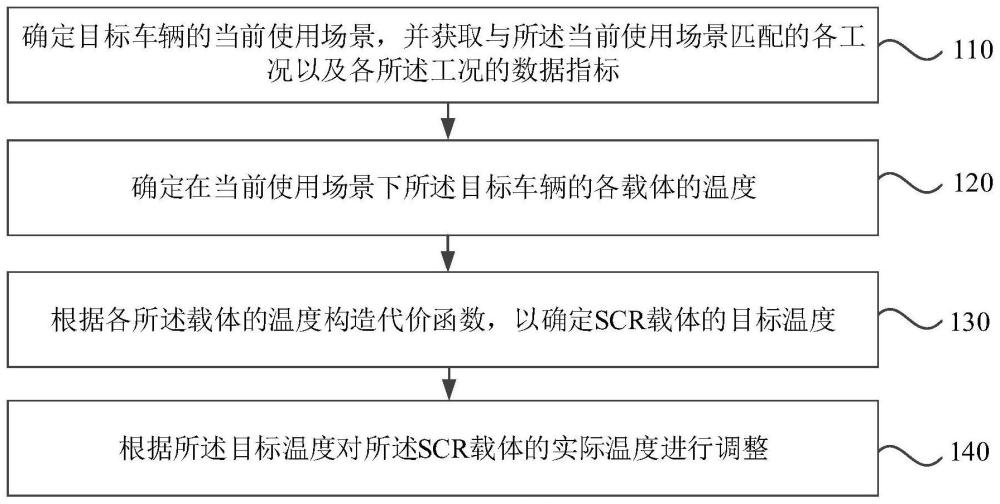
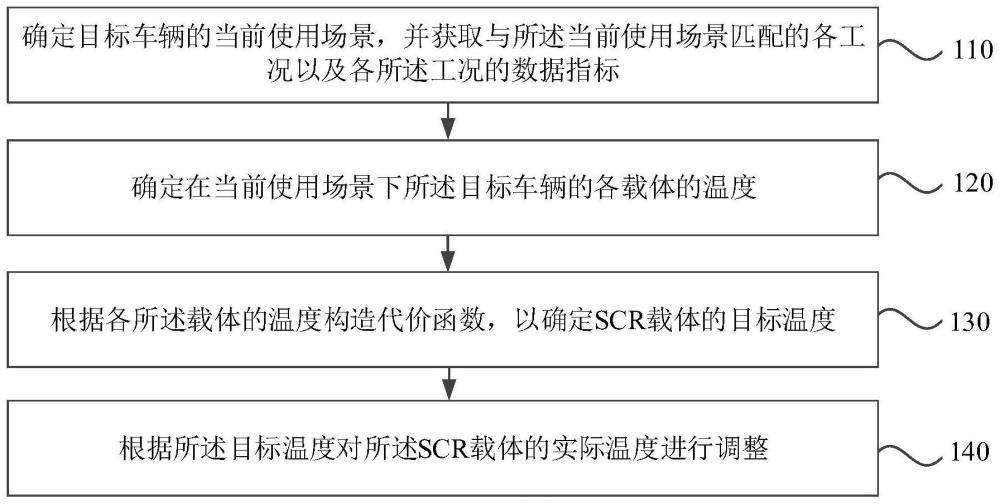
Fig. 1 is a flow chart of a temperature control method of SCR provided according to the embodiment of the present invention, the present embodiment can be applied to the situation that the temperature of SCR is adjusted based on each working condition in different use scenarios of vehicle, this method can be carried out by the temperature control device of SCR, the temperature control device of SCR can be realized in the form of hardware and/or software, and the temperature control device of SCR can be configured in electronic equipment such as computer, server or tablet computer. Specifically, referring to Figure 1, the method specifically comprises the following steps:
step 110, determine the current use scenario of target vehicle, and obtain each working condition and the data index of each described working condition matched with described current use scene.
wherein, the target vehicle may be any driving vehicle, and it is not limited in this embodiment,
In this embodiment, the current use scenario may include at least one of the following: an urban, a congested road section, a suburban area, a highway, an expressway, a mountainous area, and a factory area; Each working condition can include: reverse dragging, low idling, low-speed driving, medium-speed driving, high-speed low-torque driving, high-speed high-torque driving or high idling; The data indicators for each working condition can include at least one of the following: maximum exhaust temperature, minimum exhaust temperature, and the relationship between exhaust temperature and fuel consumption.
Optionally, in this embodiment, a large amount of vehicle data can be mobile phones in advance, and then modeling between vehicle information and use scenarios, that is, determining the relationship between different vehicle data and different use scenarios, so that in the driving process of the vehicle, the use scenarios of the vehicle can be determined by obtaining vehicle information; Among them, the vehicle information can include vehicle parameters, such as speed, torque, and gear; It can also include environmental parameters such as ambient temperature or pressure; It is not limited in this embodiment.
In an optional embodiment of the present embodiment, determining the current use scenario of the target vehicle and obtaining each working condition and the data index of each working condition matched with the current use scenario may comprise: obtaining the current vehicle parameters and current environmental parameters of the target vehicle; The current vehicle parameters may include at least one of the following: vehicle speed, torque and gear; The current environmental parameters may include ambient temperature and/or ambient pressure; and determining the current use scenario according to the current vehicle parameters and the current environmental parameters; each working condition matching the current use scenario is determined through a pre-established probability chart of each working condition; According to the range delineation of each described working condition that is predetermined, determine the maximum exhaust temperature, the minimum exhaust temperature and the exhaust temperature fuel consumption relationship of each described working condition.
In the present embodiment, the distribution characteristics of working conditions under different use scenarios can be summarized in advance, and exemplatively, for urban use scenarios, it may include the following working conditions, reverse dragging, low idling, low-speed driving, medium-speed driving, high-speed low-torque driving, high-speed high-torque driving and high idling, and the probability of occurrence of each working condition can be 10%, 16%, 20%, 10%, 0%, 44% and 0% respectively.
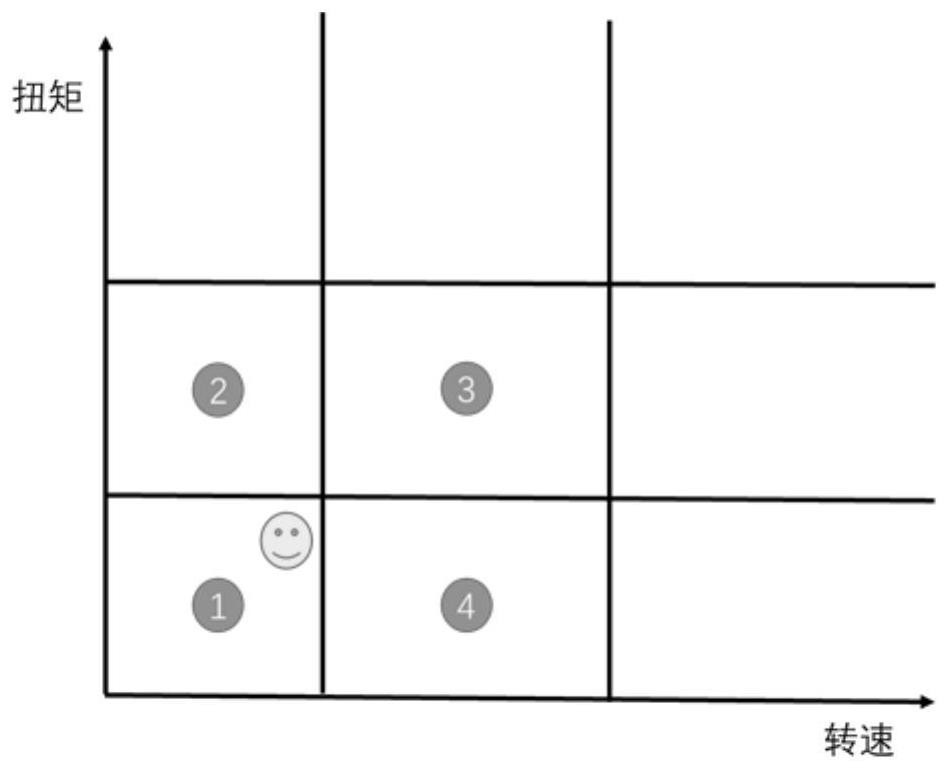
In the present embodiment, the scope can also be delineated for each working condition under different use scenarios, exemplification, Fig. 2 is a schematic diagram of the delineation of a working condition range provided according to the embodiment of the present invention first, in Fig. 2, the low idle working condition is delineated as 1 area, the maximum exhaust temperature, the minimum exhaust temperature, and the exhaust temperature and fuel consumption relationship of the central working condition point of the area can be recorded; In the present embodiment, the maximum exhaust temperature, the minimum exhaust temperature and the exhaust temperature fuel consumption relationship of any point in the area can be determined by the method of linear interpolation; For example, for the position of the smiley face in region 1, the relationship between the center position (central working condition point) and the point can be linearly interpolated through the center position of the four regions 1-4, so as to obtain the relationship between the maximum exhaust temperature, the minimum exhaust temperature and the exhaust temperature and fuel consumption of the point.
step 120, determine the temperature of each carrier of the target vehicle in the current use scenario.
In an optional embodiment of the present embodiment, after determining the current use scenario of the target vehicle and obtaining each working condition and the data index of each working condition matched with the current use scenario, the temperature of each carrier of the target vehicle in the current use scenario can be further determined.
Wherein, each carrier of the target vehicle may include a diesel oxidation catalyst (DOC) carrier, a particle trap (Diesel Particulate Filter, DPF) carrier, a mixer carrier and an SCR carrier, which are not limited in this embodiment.
Optionally, in this embodiment, determining the temperature of each carrier of the target vehicle in the current use scenario may comprise: establishing a recursive equation for the target vehicle's post-processing system in the current use scenario; determining the temperature of each carrier according to the recursive equation of the post-processing system; Among them, the aftertreatment system includes at least one of the following: turbine, exhaust pipe, diesel oxidation catalyst DOC support, particle trap DPF support, mixer carrier and SCR support.
In the specific implementation, the heat transfer process of the carrier can be regarded as the convective heat transfer between the exhaust gas and the carrier and the temperature dissipation between the carrier and the environment.
![]()
x(k+1)=Ax(k)+Bu(k);
![]()
if![]() y(k)=[0 0 1]x(k);
y(k)=[0 0 1]x(k);
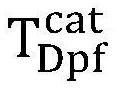
Among them, the DOC carrier temperature, the DPF carrier temperature, the SCR carrier temperature,![]()
![]()
![]() the DOC inlet gas temperature,
the DOC inlet gas temperature,![]() and the others are calibrable parameters.
and the others are calibrable parameters.
In the present embodiment, the recursive equation can be divided into two parts, 0~m step and m+1~m+k step, each part is aimed at a constant DOC inlet temperature, 0~m step is recursive in the current state, and from the m+1 step, the possibility of the change of the working condition point is according to the working condition distribution probability in this scenario.
Specifically, the 0~m step prediction iteration equation is:
x(m)=Amx(0)+(I-A)-1(Am-A)Bu(0); ...; x(1)=Ax(0)+Bu(0);
where x(0) is the estimate of the temperature of each carrier from the sensor:
![]()
![]()
![]()
T1, T2, T3 and T4 are the measured values of the temperature sensor.
The prediction iterative equation of m+1~m+k steps is:
x(m+k)=Am+kx(0)+Ak(I-A)-1(Am-A)Bu(0)+(I-
A)-1(Ak-A)Bu(1); ...。
step 130, construct a cost function according to the temperature of each carrier to determine the target temperature of the SCR carrier.
In an optional embodiment of the present embodiment, after determining the temperature of each carrier of the target vehicle, a cost function can be further constructed according to the temperature of each carrier, so that the target temperature of the SCR carrier in the current use scenario can be determined according to the cost function obtained.
Optionally, in the present embodiment, the cost function constructed may include three items, namely: the optimal expected exhaust temperature calculation to meet the target post-treatment temperature when the temperature is higher than the reference limit; Calculation of the optimal expected discharge temperature below the reference limit temperature; Exhaust temperature calculation to meet the minimum fuel consumption.
Optionally, in the present embodiment, determining the target temperature of the SCR carrier may include: solving the cost function to obtain the target temperature of the SCR carrier.
In an optional embodiment of the present embodiment, after the cost function is constructed, the cost function obtained by the construction can be further solved by the least squares method, so as to obtain the target temperature of the SCR carrier.
It is understood that the target temperature of the SCR carrier is the catalytic temperature that can completely convert the emissions of the engine into harmless nitrogen and water, and its size is not limited in this embodiment.
Exemplary, the resulting cost function can be:
![]()
E~Ak(I-A)-1(Am-A)B;
F~(I-A)-1(Ak-A)B;
G~[0 0 1][Am+kx(0)];
min
Among them, Tref is the reference exhaust temperature, which can be obtained according to the engine speed and fuel injection volume, the others are the calibration fitting parameters, score is the corresponding score, Fre is the corresponding frequency, r is the temperature of the target SCR carrier, α is the ratio of the increase in exhaust temperature to the increase in fuel consumption at the corresponding working point, max and min can be the maximum and minimum temperature of the smiley working point in Figure 2 respectively, and find Min (CF).
exemplary, in a specific example of the present embodiment, the target vehicle accounts for 44% of the high torque at high speed in the current use scenario, and the minimum average exhaust temperature (without thermal management) under this working condition is 300 °C; Low idle speed 16%, minimum average exhaust temperature of 120°C; The others are medium-speed driving, accounting for 40%, with a minimum average temperature of 250°C. The reference limit temperature is 260°C, at high speed and high torque, 300°C>260°C, u(1)=300°C, at low idle, 120°C<260°C, u(1) is unknown, and at medium speed, u(1) is also unknown; therefore
![]()
In the above example, the first term accounts for 44% of the probability to calculate the expected optimal exhaust temperature u (0) at high speed and high torque, the second term accounts for 16+40% probability to calculate the expected optimal exhaust temperature u (0) and u (1) for medium-speed driving and idling, the third term is the minimum fuel consumption time exhaust temperature at medium speed, and calculates the minimum fuel consumption time exhaust temperature of the current working condition, the fourth term is the minimum fuel consumption time exhaust temperature under low idle working conditions, and the fifth term accounts for m/(m+k), so as to obtain the optimal values of u(0) and u(1) under the comprehensive optimal fuel consumption.
step 140, adjusting the actual temperature of the SCR carrier according to the target temperature.
Optionally, in this embodiment, after determining the target temperature of the SCR carrier of the target vehicle in the current use scenario, the SCR carrier may be further adjusted according to the determined target temperature
In an optional embodiment of the present embodiment, the actual temperature of the SCR carrier is adjusted according to the target temperature, which may include: when the actual temperature is equal to the target temperature, normal discharge; when the actual temperature is less than the target temperature, the fuel consumption is increased to increase the actual temperature; When the actual temperature is greater than the target temperature, reduce the fuel consumption to reduce the actual temperature.
the technical scheme of the embodiment, by determining the current use scenario of the target vehicle, and obtaining each working condition and the data index of each described working condition matched with the current use scenario; determining the temperature of each carrier of the target vehicle in the current use scenario; construct a cost function according to the temperature of each carrier to determine the target temperature of the SCR carrier; adjusting the actual temperature of the SCR carrier according to the target temperature solves the problem of more fuel consumption, can accurately control the temperature of the SCR, and reduces the fuel consumption.
In the technical scheme of the embodiment of the present invention, the acquisition, storage and application of the user's personal information (such as face information, voice information, etc.) involved conform to the provisions of relevant laws and regulations, and do not violate public order and good customs.
Embodiment two
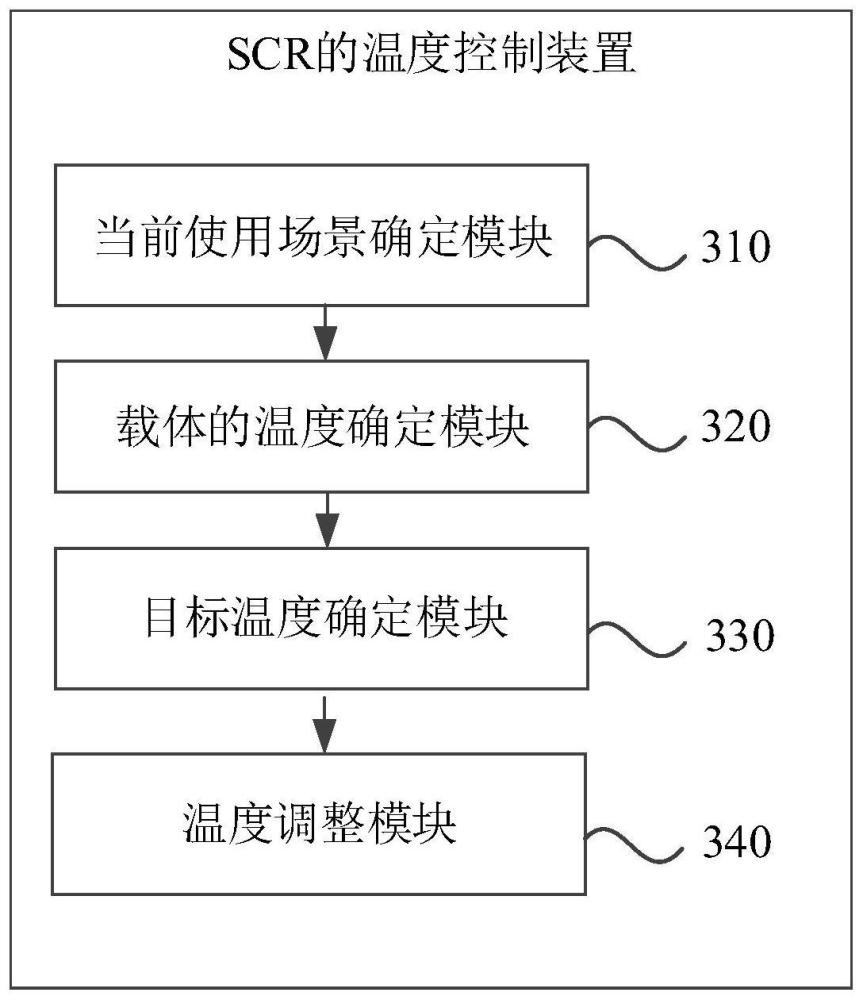
Fig. 3 is a schematic diagram of the structure of a temperature control device of SCR provided according to the embodiment of the present invention third instance. As shown in Figure 3, the device comprises: a current use scene determination module 310, a carrier temperature determination module 320, a target temperature determination module 330 and a temperature adjustment module 340.
the current use scenario determination module 310 is used for determining the current use scenario of the target vehicle and obtaining each working condition and the data index of each working condition matched with the current use scenario;
the temperature determination module 320 of the carrier is used for determining the temperature of each carrier of the target vehicle in the current use scenario;
the target temperature determination module 330 is used for constructing a cost function according to the temperature of each carrier to determine the target temperature of the selective catalytic converter SCR carrier;
the temperature adjustment module 340 is used for adjusting the actual temperature of the SCR carrier according to the target temperature.
the scheme of the present embodiment, determining the current use scenario of the target vehicle through the current use scenario determination module, and obtaining each working condition and the data index of each working condition matched with the current use scenario; determining the temperature of each carrier of the target vehicle in the current use scenario through the temperature determination module of the carrier; through the target temperature determination module to construct a cost function according to the temperature of each carrier to determine the target temperature of the selective catalytic converter SCR carrier; The actual temperature of the SCR carrier is adjusted according to the target temperature through the temperature adjustment module, so that the problem of more fuel consumption is solved, and the temperature of the SCR can be accurately controlled, and the fuel consumption can be reduced.
In an optional embodiment of the present embodiment, the current use scenario comprises at least one of the following:
Cities, congested road sections, suburbs, highways, expressways, mountainous areas and factory areas;
Each of these conditions comprises:
Reverse dragging, low idling, low speed, medium speed, high speed and low torque driving, high-speed high-torque driving or high idling;
The data indicators described include at least one of the following:
The relationship between the maximum exhaust temperature, the minimum exhaust temperature and the exhaust temperature and fuel consumption.
In an optional embodiment of the present embodiment, the current use scenario determines the module 310, specifically for obtaining the current vehicle parameters and the current environmental parameters of the target vehicle; The current vehicle parameter comprises at least one of the following: vehicle speed, torque and gear; Described current environmental parameters comprise ambient temperature and/or ambient pressure;
and determining the current use scenario according to the current vehicle parameters and the current environmental parameters;
each working condition matching the current use scenario is determined through a pre-established probability chart of each working condition;
According to the range delineation of each described working condition that is predetermined, determine the maximum exhaust temperature, the minimum exhaust temperature and the exhaust temperature fuel consumption relationship of each described working condition.
In an optional embodiment of the present embodiment, the temperature determination module 320 of the carrier is specifically used for establishing a recursive equation for the post-processing system of the target vehicle in the current use scenario;
determining the temperature of each carrier according to the recursive equation of the post-processing system;
Among them, the post-processing system includes at least one of the following:
Turbines, exhaust pipes, diesel oxidation catalyst DOC carriers, particle trap DPF carriers, mixer carriers, and SCR carriers.
In an optional embodiment of the present embodiment, the cost function comprises three items, which are as follows:
When the temperature is higher than the reference limit, the optimal expected exhaust temperature calculation to meet the target post-processing temperature is met;
Calculation of the optimal expected discharge temperature below the reference limit temperature;
Exhaust temperature calculation to meet the minimum fuel consumption.
In an optional embodiment of the present embodiment, the target temperature determination module 330 is specifically used for solving the cost function to obtain the target temperature of the SCR carrier.
In an optional embodiment of the present embodiment, the temperature adjustment module 340 is specifically used for normal discharge when the actual temperature is equal to the target temperature;
when the actual temperature is less than the target temperature, the fuel consumption is increased to increase the actual temperature;
When the actual temperature is greater than the target temperature, reduce the fuel consumption to reduce the actual temperature.
The temperature control device of the SCR provided in the embodiment of the present invention can perform the temperature control method of the SCR provided in any embodiment of the present invention in any embodiment, and has a functional module and beneficial effect corresponding to the execution method.
Embodiment three
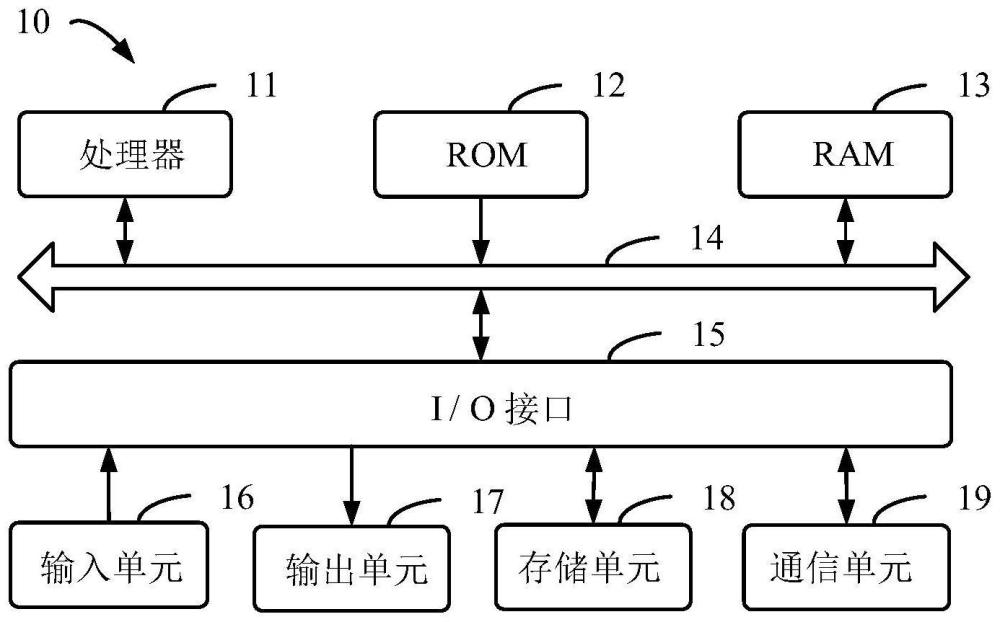
FIG. 4 shows a schematic diagram of the structure of the electronic device 10 that can be used to implement the embodiments of the present invention. Electronic devices are intended to represent various forms of digital computers, such as laptops, desktop computers, workbenches, personal digital assistants, servers, blade servers, mainframe computers, and other appropriate computers. Electronic devices can also represent various forms of mobile devices, such as personal digitization, cellular phones, smartphones, wearable devices (e.g., helmets, glasses, watches, etc.) and other similar computing devices. The parts shown herein, their connections and relationships, and their functions are for example only and are not intended to limit the realization of the embodiments of the present invention described and/or required herein.
As shown in Figure 4, the electronic device 10 comprises at least one processor 11 and the memory that is communicated with at least one processor 11, such as read-only memory (ROM) 12, random access memory (RAM) 13, etc., wherein the memory stores a computer program that can be executed by at least one processor, and the processor 11 can load a computer program into random access memory (RAM) 13 according to a computer program stored in read-only memory (ROM) 12 or from the storage unit 18to perform a variety of appropriate actions and treatments. In RAM 13, various programs and data required for the operation of electronic device 10 can also be stored. Processor 11, ROM 12 and RAM 13 are connected to each other via bus 14. The input/output (I/O) interface 15 is also connected to bus 14.
A plurality of components in the electronic device 10 are connected to the I/O interface 15, comprising: input unit 16, such as keyboard, mouse, etc.; output unit 17, such as various types of displays, speakers, etc.; storage unit 18, such as disk, optical disc, etc.; and communication unit 19, such as network card, modem, wireless communication transceiver, etc. The communication unit 19 allows electronic devices 10 to exchange information/data with other devices through computer networks such as the Internet and/or various telecommunications networks.
Processor11 can be a variety of general-purpose and/or specialized processing components with processing and computing power. Some examples of processors11 include, but are not limited to, central processing units (CPUs), graphics processing units (GPUs), various specialized artificial intelligence (AI) computing chips, various processors running machine learning model algorithms, digital signal processors (DSPs), and any appropriate processors, controllers, microcontrollers, etc. The processor 11 performs the various methods and processes described above, such as the temperature control method of the SCR.
In some embodiments, the temperature control method of the SCR may be implemented as a computer program which is tangibly contained in a computer-readable storage medium, such as a storage unit 18. In some embodiments, part or all of the computer program may be loaded and/or mounted onto the electronic device 10 by means of ROM 12 and/or communication unit 19. When a computer program is loaded into RAM 13 and executed by processor 11, one or more steps of the temperature control method of the SCR described above can be performed. Alternatively, in other embodiments, the processor 11 may be configured to perform a temperature control method for SCR by any other appropriate means (e.g., with the help of firmware).
The various implementations of the systems and technologies described above in this article can be implemented in digital electronic circuit systems, integrated circuit systems, field-programmable gate arrays (FPGAs), application-specific integrated circuits (ASICs), application-specific standard products (ASSPs), system-on-chips (SOCs), load-programmable logic devices (CPLDs), computer hardware, firmware, software, and/or a combination thereof. These various embodiments may include the implementation of one or more computer programs that may be executed and/or interpreted on a programmable system comprising at least one programmable processor, which may be specialized or general-purpose programmable processors that receive data and instructions from a storage system, at least one input device, and at least one output device, and transmit the data and instructions to the storage system, at least one input device, and at least one output device.
A computer program used to implement an embodiment of the present invention may be written in any combination of one or more programming languages. These computer programs may be provided to the processors of general-purpose computers, specialized computers, or other programmable data processing devices so that the computer programs, when executed by the processors, enable the functions/operations specified in the flowcharts and/or block diagrams to be performed. A computer program can be executed entirely on a machine, partially on a machine, partially on a machine and partially on a remote machine as a stand-alone software package, or entirely on a remote machine or server.
In the context of the embodiments of the present invention, a computer-readable storage medium may be a tangible medium that may contain or store a computer program for use by or in combination with an instruction-executing system, apparatus or apparatus. Computer-readable storage media may include, but are not limited to, electronic, magnetic, optical, electromagnetic, infrared, or semiconductor systems, devices, or devices, or any appropriate combination thereof. Alternatively, a computer-readable storage medium may be a machine-readable signal medium. More specific examples of machine-readable storage media would include electrical connections based on one or more wires, laptop disks, hard disks, random access memory (RAM), read-only memory (ROM), erasable programmable read-only memory (EPROM or flash memory), optical fiber, portable compact disk read-only memory (CD-ROM), optical storage devices, magnetic storage devices, or any suitable combination of the above.
In order to provide interaction with the user, the systems and techniques described herein may be implemented on an electronic device that has: a display device (e.g., a CRT (cathode ray tube) or an LCD (liquid crystal display) monitor) for displaying information to the user; and a keyboard and pointing device (e.g., a mouse or trackball) that allows the user to provide input to the electronic device. Other types of devices may also be used to provide interaction with the user; For example, feedback provided to users may be any form of sensory feedback (e.g., visual, auditory, or haptic); and can receive input from the user in any form, including audible, voice, or haptic input.
The systems and technologies described herein may be implemented in a computing system that includes a back-end component (e.g., as a data server), or a computing system that includes a middleware component (e.g., an application server), or a computing system that includes a front-end component (e.g., a user computer with a graphical user interface or a web browser through which the user can interact with the implementation of the systems and technologies described herein), or includes such back-end components, middleware components, or any combination of front-end components in a computing system. The components of a system can be connected to each other by means of digital data communication in any form or medium (e.g., communication networks). Examples of communication networks include: Local Area Networks (LANs), Wide Area Networks (WANs), Blockchain Networks, and the Internet.
A computing system can include both a client and a server. Clients and servers are generally far away from each other and often interact over communication networks. A client-server relationship arises from computer programs that run on the corresponding computer and have a client-server relationship with each other. The server can be a cloud server, also known as a cloud computing server or cloud host, which is a host product in the cloud computing service system, which solves the defects of difficult management and weak business scalability in traditional physical hosting and VPS services.
It should be understood that steps can be reordered, added, or removed using the various forms of processes shown above. For example, the steps described in the embodiments of the present invention may be executed in parallel, sequentially, or in different sequences, and as long as the desired result of the technical solution of the embodiments of the present invention can be achieved, this article is not limited herein.
The above specific embodiments do not constitute a limitation on the scope of protection of the embodiments of the present invention. Those skilled in the art should understand that various modifications, combinations, subcombinations, and substitutions can be made according to design requirements and other factors. Any modifications, equivalent substitutions and improvements made within the spirit and principles of the embodiments of the present invention shall be included in the protection scope of the embodiments of the present invention.















 400-4929-0909
 contact@catarc.com.cn

