当前位置: 首页> 专利交易> 详情页
    待售中

    一种非接触式转角测量系统及方法[ZH]

    专利编号: ZL202602280178

    收藏

    拟转化方式: 转让;普通许可;独占许可;排他许可

    交易价格:面议

    专利类型:发明专利

    法律状态:授权

    技术领域:整车系统

    发布日期:2026-02-28

    发布有效期: 2026-02-28 至 2040-04-17

    专利顾问 — 伍先生

    微信咨询

    扫码微信咨询

    电话咨询

    咨询电话

    18273488208

    专利基本信息
    >
    申请号 CN202010304274.5 公开号 CN113532331A
    申请日 2020-04-17 公开日 2021-10-22
    申请人 广州汽车集团股份有限公司 专利授权日期 2023-08-08
    发明人 罗奕永;梁振辉;谢伟忠;辛运 专利权期限届满日 2040-04-17
    申请人地址 510030 广东省广州市越秀区东风中路448--458号成悦大厦23楼 最新法律状态 授权
    技术领域 整车系统 分类号 G01B11/26
    技术效果 精确性 有效性 有效(授权、部分无效)
    专利代理机构 深圳汇智容达专利商标事务所(普通合伙) 44238 代理人 熊贤卿
    专利技术详情
    >
    01

    专利摘要

    本发明提供一种非接触式转角测量系统,包括标记、相机和图像处理器;标记为待测部件上的三个中心在同一直线上的反光标记点且相邻两点距离不相等;相机与三个反光标记点对准,通过数据线连接图像处理器;图像处理器采集相机拍摄的光斑图像,识别出反光标记点的三个连通区域,然后对三个连通区域重心计算,得到两两连通区域重心间距来确定反光标记点与连通区域的对应关系,最后根据对应关系来计算待测部件的转角大小。实施本发明,达到不接触待测部件测量转角的效果,具有安装精度要求低,且不会对待测部件的转动惯量造成影响。
    展开 >
    02

    专利详情

    技术领域

    本发明涉及汽车技术领域,尤其涉及一种非接触式转角测量系统及方法。

    背景技术

    汽车转向回正测试中需要测量汽车转向部件(如方向盘、车轮等)的转角。目前,有以下几种测量汽车转向回正转角方法,包括:1、通过总线读取车辆内置转角传感器信号,但这种方法要求知道车辆内部通讯协议,对于非自研车型是无法实施的,并且其测量准确度取决于车载传感器;2、使用加装式或替换式的汽车转向部件传感器,但这种方法会改变汽车转向部件本身的惯量特性,从而对自由回正测试结果产生影响。

    因此,亟需一种测量转角方法,能够达到不接触待测部件即可测量转角的效果,具有安装精度要求低,且不会对待测部件的转动惯量造成影响。

    发明内容

    本发明实施例所要解决的技术问题在于,提供一种非接触式转角测量系统及方法,能达到不接触待测部件即可测量转角的效果,具有安装精度要求低,且不会对待测部件的转动惯量造成影响。

    为了解决上述技术问题,本发明实施例提供了一种非接触式转角测量系统,包括标记、相机和图像处理器;其中,所述标记为设置于待测部件上的三个反光标记点,所述三个反光标记点的中心在同一直线上,且相邻两点的距离不相等;所述补光灯位于所述三个反光标记点的上方;所述相机与所述三个反光标记点对准,且其通过数据线与所述图像处理器连接;

    所述图像处理器包括:

    图像采集模块,用于采集所述CMOS相机拍摄的所述补光灯照射在所述三个反光标记点上的光斑图像;

    标记点区域识别模块,用于识别出具有三个反光标记点光斑轮廊的三个连通区域;

    标记点位置判定模块,用于对三个连通区域的重心分别进行计算,并根据每一个连通区域计算的重心,得到两两连通区域重心之间的距离,且进一步根据所计算出的两两连通区域重心之间的距离,确定出三个反光标记点与三个连通区域之间的对应关系;

    转角计算模块,用于根据所述三个反光标记点与三个连通区域之间的对应关系,计算出待测部件的转角大小。

    其中,所述三个反光标记点设置在贴纸上,且均为相同形状的圆点;其中,所述贴纸固定在所述待测部件上。

    其中,还包括补光灯,所述补光灯由环所述相机的外围圆周均匀分布的红外光灯珠组成。

    其中,所述相机接收所述补光灯同波长的红外光,且其光轴与所述补光灯的中心线重合。

    其中,所述相机与所述补光灯通过支架安装固定于所述三个反光标记点的上方,并与所述三个反光标记点对准。

    其中,所述待测部件为方向盘或车轮。

    本发明实施例还提供了一种非接触式转角测量方法,其在前述的非接触式转角测量系统中实现,所述方法包括以下步骤:

    图像处理器采集相机拍摄的补光灯照射在三个反光标记点上的光斑图像;

    所述图像处理器根据所述光斑图像,识别出具有三个反光标记点光斑轮廊的三个连通区域;

    所述图像处理器对三个连通区域的重心分别进行计算,并根据每一个连通区域计算的重心,得到两两连通区域重心之间的距离,且进一步根据所计算出的两两连通区域重心之间的距离,确定出三个反光标记点与三个连通区域之间的对应关系;

    所述图像处理器根据所述三个反光标记点与三个连通区域之间的对应关系,计算出待测部件的转角大小。

    其中,所述根据所述光斑图像,识别出具有三个反光标记点光斑轮廊的三个连通区域的具体步骤包括:

    对采集的光斑图像进行二值化处理,使得二值化处理后的光斑图像中像素点的值为0或1;

    对二值化处理后的光斑图像进行八连通区域查找,得到二值化处理后的光斑图像中所有像素点的八连通区域,且进一步根据预设的连通域面积范围,识别出具有三个反光标记点光斑轮廊的三个连通区域。

    其中,所述图像处理器对三个连通区域的重心分别进行计算,并根据每一个连通区域计算的重心,得到两两连通区域重心之间的距离,且进一步根据所计算出的两两连通区域重心之间的距离,确定出三个反光标记点与三个连通区域之间的对应关系的具体步骤包括:

    设定三个连通区域的标识分别为Y1、Y2和Y3,并计算出连通区域Y1重心和连通区域Y2重心之间的距离为d12、连通区域Y2重心和连通区域Y3重心之间的距离为d23以及连通区域Y1重心和连通区域Y3重心之间的距离为d13;

    若d12>d23>d13,则确定连通区域Y3对应的反光标记点为三个反光标记点的中间点,连通区域Y1对应的反光标记点为三个反光标记点中离中间点距离最近的反光标记点,连通区域Y2对应的反光标记点为三个反光标记点中离中间点距离最远的反光标记点;

    若d12>d13>d23,则确定连通区域Y3对应的反光标记点为三个反光标记点的中间点,连通区域Y1对应的反光标记点为三个反光标记点中离中间点距离最远的反光标记点,连通区域Y2对应的反光标记点为三个反光标记点中离中间点距离最近的反光标记点;

    若d13>d23>d12,则确定连通区域Y2对应的反光标记点为三个反光标记点的中间点,连通区域Y1对应的反光标记点为三个反光标记点中离中间点距离最近的反光标记点,连通区域Y3对应的反光标记点为三个反光标记点中离中间点距离最远的反光标记点;

    若d13>d12>d23,则确定连通区域Y2对应的反光标记点为三个反光标记点的中间点,连通区域Y1对应的反光标记点为三个反光标记点中离中间点距离最远的反光标记点,连通区域Y3对应的反光标记点为三个反光标记点中离中间点距离最近的反光标记点;

    若d23>d12>d13,则确定连通区域Y1对应的反光标记点为三个反光标记点的中间点,连通区域Y3对应的反光标记点为三个反光标记点中离中间点距离最近的反光标记点,连通区域Y2对应的反光标记点为三个反光标记点中离中间点距离最远的反光标记点;

    若d23>d13>d12,则确定连通区域Y1对应的反光标记点为三个反光标记点的中间点,连通区域Y3对应的反光标记点为三个反光标记点中离中间点距离最远的反光标记点,连通区域Y2对应的反光标记点为三个反光标记点中离中间点距离最近的反光标记点。

    其中,所述根据所述三个反光标记点与三个连通区域之间的对应关系,计算出待测部件的转角大小的具体步骤包括:

    确定三个反光标记点中离中间点距离最远和最近的两个反光标记点各自对应连通区域重心的坐标;

    根据所确定的两个反光标记点各自对应连通区域重心的坐标,求解出所确定的两个反光标记点在直角坐标系中的斜率,且进一步根据所求解出的斜率,利用三角公式获得角度值并记为待测部件的转角大小。

    实施本发明实施例,具有如下有益效果:

    1、本发明利用相机拍摄粘贴在待测部件(如汽车转向部件)上的反光标记点,使用特定的处理算法对将反光标记点处于图片中的坐标,并利用坐标求出对应角度大小,从而达到不接触被测物即可测量其转角的效果,可方便应用于各种不便将传感器与被测物相连的场景中,不会对被测物体的转动惯量造成影响;

    2、本发明采用三个在同一直线上且两两间距不相等的圆形反光标记点,由于同一直线上的线段在仿射变换中仍在同一直线上且比例不变,其两两间距的大小关系不会发生改变,因此即使相机的安装位置不能正对标记贴纸,也不会影响对反光标记点顺序的判断,从而降低对相机安装位置的要求,提升测量系统的鲁棒性。

    附图说明

    为了更清楚地说明本发明实施例或现有技术中的技术方案,下面将对实施例或现有技术描述中所需要使用的附图作简单地介绍,显而易见地,下面描述中的附图仅仅是本发明的一些实施例,对于本领域普通技术人员来讲,在不付出创造性劳动性的前提下,根据这些附图获得其他的附图仍属于本发明的范畴。

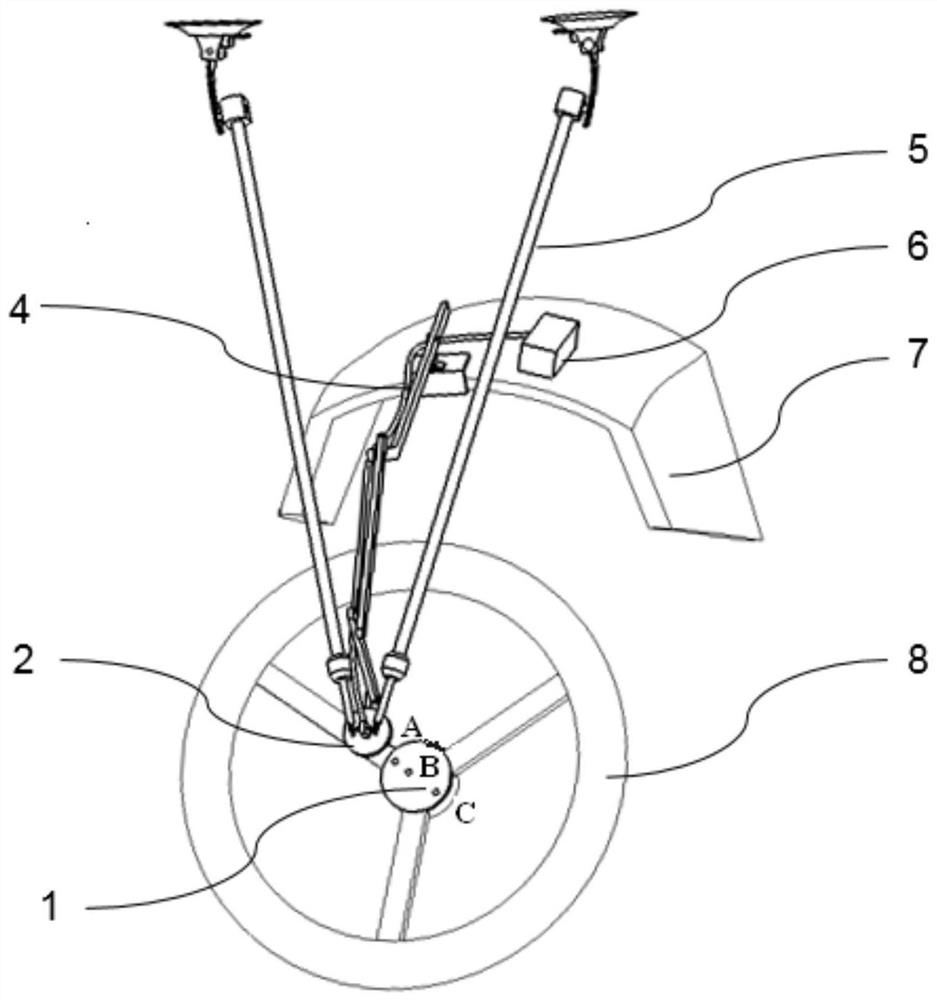
    图1为本发明实施例提供的非接触式转角测量系统的结构示意图;

    图2为本发明实施例提供的非接触式转角测量系统中CMOS相机和补光灯安装位置的放大图;

    图3为本发明实施例提供的非接触式转角测量方法的流程图。

    具体实施方式

    为使本发明的目的、技术方案和优点更加清楚,下面将结合附图对本发明作进一步地详细描述。

    如图1和图2所示,为本发明实施例中,提供的一种非接触式在线转角测量系统,包括标记1、补光灯2、CMOS相机3和图像处理器6;其中,

    标记1为设置于待测部件8(如汽车转向部件,包括方向盘、车轮等)上的三个反光标记点A、B、C,三个反光标记点A、B、C的中心在同一直线上且相邻两点的距离不相等(例如AB

    补光灯2通过支架5安装固定于三个反光标记点A、B、C的上方;其中,补光灯2为环形分布的红外光灯珠,其中间预留有圆孔用于安装CMOS相机3;

    CMOS相机3与三个反光标记点A、B、C对准,且其通过数据线4与图像处理器6连接;其中,CMOS相机3安装在补光灯2预留的圆孔中,使得补光灯2的红外光灯珠环CMOS相机3的外围圆周均匀分布,并让CMOS相机3与补光灯2通过支架5安装固定于三个反光标记点A、B、C的上方,并与三个反光标记点A、B、C对准;此时,CMOS相机3接收补光灯2同波长的红外光进行图像拍摄,且其光轴与补光灯2的中心线重合;

    图像处理器6安装在工作台7上,其包括:

    图像采集模块61,用于采集CMOS相机3拍摄的补光灯2照射在三个反光标记点A、B、C上的光斑图像;

    具体为,利用补光灯2照射在三个反光标记点A、B、C上形成的反射光线被CMOS相机3捕捉并拍摄成光斑图像,且CMOS相机3每拍摄一帧图像都会通过数据线4传送至图像处理器6中图像采集模块61存储。

    标记点区域识别模块62,用于对采集的光斑图像进行二值化处理,并在二值化处理后的光斑图像中,识别出具有三个反光标记点A、B、C光斑轮廊的三个连通区域;

    具体为,标记点区域识别模块62对采集的光斑图像进行二值化处理,使得二值化处理后的光斑图像中像素点的值为0或1;

    对二值化处理后的光斑图像进行八连通区域查找,得到中二值化处理后的光斑图像中所有像素点的八连通区域,且进一步根据预设的连通域面积范围,识别出具有三个反光标记点A、B、C光斑轮廊的三个连通区域。

    应当说明的是,标记点区域识别模块62中光斑图像的二值化处理及八连通区域查找等都属于本领域的常用技术手段,在此不再详述。

    标记点位置判定模块63,用于对三个连通区域Y1、Y2和Y3的重心分别进行计算,并根据每一个连通区域计算的重心,得到两两连通区域重心之间的距离,且进一步根据所计算出的两两连通区域重心之间的距离,确定出三个反光标记点A、B、C与三个连通区域Y1、Y2和Y3之间的对应关系;

    具体为,标记点位置判定模块63设定三个连通区域的标识分别为Y1、Y2和Y3,并对三个连通区域Y1、Y2和Y3的重心分别进行计算,即求解三个反光标记点A、B、C在图像中的坐标;然后,计算出连通区域Y1重心和连通区域Y2重心之间的距离为d12、连通区域Y2重心和连通区域Y3重心之间的距离为d23以及连通区域Y1重心和连通区域Y3重心之间的距离为d13;

    若d12>d23>d13,则确定连通区域Y3对应的反光标记点为三个反光标记点的中间点B,连通区域Y1对应的反光标记点为三个反光标记点中离中间点距离最近的反光标记点A,连通区域Y2对应的反光标记点为三个反光标记点中离中间点距离最远的反光标记点C;即Y1->A、Y2->C、Y3->B;

    若d12>d13>d23,则确定连通区域Y3对应的反光标记点为三个反光标记点的中间点B,连通区域Y1对应的反光标记点为三个反光标记点中离中间点距离最远的反光标记点C,连通区域Y2对应的反光标记点为三个反光标记点中离中间点距离最近的反光标记点A;即Y1->C、Y2->A、Y3->B;

    若d13>d23>d12,则确定连通区域Y2对应的反光标记点为三个反光标记点的中间点B,连通区域Y1对应的反光标记点为三个反光标记点中离中间点距离最近的反光标记点A,连通区域Y3对应的反光标记点为三个反光标记点中离中间点距离最远的反光标记点C;即Y1->A、Y2->B、Y3->C;

    若d13>d12>d23,则确定连通区域Y2对应的反光标记点为三个反光标记点的中间点B,连通区域Y1对应的反光标记点为三个反光标记点中离中间点距离最远的反光标记点C,连通区域Y3对应的反光标记点为三个反光标记点中离中间点距离最近的反光标记点A;即Y1->C、Y2->B、Y3->A;

    若d23>d12>d13,则确定连通区域Y1对应的反光标记点为三个反光标记点的中间点B,连通区域Y3对应的反光标记点为三个反光标记点中离中间点距离最近的反光标记点A,连通区域Y2对应的反光标记点为三个反光标记点中离中间点距离最远的反光标记点C;即Y1->B、Y2->A、Y3->C;

    若d23>d13>d12,则确定连通区域Y1对应的反光标记点为三个反光标记点的中间点B,连通区域Y3对应的反光标记点为三个反光标记点中离中间点距离最远的反光标记点C,连通区域Y2对应的反光标记点为三个反光标记点中离中间点距离最近的反光标记点A;即Y1->B、Y2->A、Y3->C。

    转角计算模块64,用于根据三个反光标记点A、B、C与三个连通区域Y1、Y2和Y3之间的对应关系,计算出待测部件的转角大小。

    具体为,转角计算模块64确定三个反光标记点A、B、C中离中间点B距离最远和最近的两个反光标记点C、A各自对应连通区域重心的坐标;

    根据所确定的两个反光标记点各自对应连通区域重心的坐标,求解出所确定的两个反光标记点在直角坐标系中的斜率,且进一步根据所求解出的斜率,利用三角公式(如反正切函数公式)获得角度值并记为待测部件8的转角大小,即利用AC两点的坐标求得AC连线与图片横轴(即直角坐标系中X轴)的夹角,记为θ。

    可以理解的是,由于CMOS相机3每拍摄一帧图像都会通过数据线4传送至图像处理器6中,若图像处理器6得到CMOS相机3所拍摄的连续帧图像,则可以在连续帧图像中根据三个反光标记点A、B、C的位置变化关系,确定出待测部件8单向转动的圈数,因此若待测部件8单向转动角度超过360°,也能准确计算多圈转角。

    如图3所示,为本发明实施例中,提供的一种非接触式在线转角测量方法,其在前述的非接触式在线转角测量系统中实现,所述方法包括以下步骤:

    步骤S1、图像处理器采集CMOS相机拍摄的补光灯照射在三个反光标记点上的光斑图像;

    具体过程为,图像处理器采集CMOS相机所拍摄的利用补光灯照射在三个反光标记点A、B、C上形成的光斑图像,且CMOS相机每拍摄一帧图像都会通过数据线传送至图像处理器存储。

    步骤S2、所述图像处理器对采集的光斑图像进行二值化处理,并在二值化处理后的光斑图像中,识别出具有三个反光标记点光斑轮廊的三个连通区域;

    具体过程为,首先,对采集的光斑图像进行二值化处理,使得二值化处理后的光斑图像中像素点的值为0或1;

    其次,对值化处理后的光斑图像进行八连通区域查找,得到值化处理后的光斑图像中所有像素点的八连通区域,且进一步根据预设的连通域面积范围,识别出具有三个反光标记点光斑轮廊的三个连通区域。

    步骤S3、所述图像处理器对三个连通区域的重心分别进行计算,并根据每一个连通区域计算的重心,得到两两连通区域重心之间的距离,且进一步根据所计算出的两两连通区域重心之间的距离,确定出三个反光标记点与三个连通区域之间的对应关系;

    具体过程为,设定三个连通区域的标识分别为Y1、Y2和Y3,并设定连通区域Y1重心和连通区域Y2重心之间的距离为d12、连通区域Y2重心和连通区域Y3重心之间的距离为d23以及连通区域Y1重心和连通区域Y3重心之间的距离为d13;

    若d12>d23>d13,则确定连通区域Y3对应的反光标记点为三个反光标记点的中间点,连通区域Y1对应的反光标记点为三个反光标记点中离中间点距离最近的反光标记点,连通区域Y2对应的反光标记点为三个反光标记点中离中间点距离最远的反光标记点;

    若d12>d13>d23,则确定连通区域Y3对应的反光标记点为三个反光标记点的中间点,连通区域Y1对应的反光标记点为三个反光标记点中离中间点距离最远的反光标记点,连通区域Y2对应的反光标记点为三个反光标记点中离中间点距离最近的反光标记点;

    若d13>d23>d12,则确定连通区域Y2对应的反光标记点为三个反光标记点的中间点,连通区域Y1对应的反光标记点为三个反光标记点中离中间点距离最近的反光标记点,连通区域Y3对应的反光标记点为三个反光标记点中离中间点距离最远的反光标记点;

    若d13>d12>d23,则确定连通区域Y2对应的反光标记点为三个反光标记点的中间点,连通区域Y1对应的反光标记点为三个反光标记点中离中间点距离最远的反光标记点,连通区域Y3对应的反光标记点为三个反光标记点中离中间点距离最近的反光标记点;

    若d23>d12>d13,则确定连通区域Y1对应的反光标记点为三个反光标记点的中间点,连通区域Y3对应的反光标记点为三个反光标记点中离中间点距离最近的反光标记点,连通区域Y2对应的反光标记点为三个反光标记点中离中间点距离最远的反光标记点;

    若d23>d13>d12,则确定连通区域Y1对应的反光标记点为三个反光标记点的中间点,连通区域Y3对应的反光标记点为三个反光标记点中离中间点距离最远的反光标记点,连通区域Y2对应的反光标记点为三个反光标记点中离中间点距离最近的反光标记点。

    步骤S4、所述图像处理器根据所述三个反光标记点与三个连通区域之间的对应关系,计算出待测部件的转角大小。

    具体过程为,首先,确定三个反光标记点中离中间点距离最远和最近的两个反光标记点各自对应连通区域重心的坐标;

    其次,根据所确定的两个反光标记点各自对应连通区域重心的坐标,求解出所确定的两个反光标记点在直角坐标系中的斜率,且进一步根据所求解出的斜率,利用三角公式获得角度值并记为待测部件的转角大小。

    实施本发明实施例,具有如下有益效果:

    1、本发明利用CMOS相机拍摄粘贴在待测部件上的反光标记点,使用特定的处理算法对将反光标记点处于图片中的坐标,并利用坐标求出对应角度大小,从而达到不接触被测物即可测量其转角的效果,可方便应用于各种不便将传感器与被测物相连的场景中,不会对被测物体的转动惯量造成影响;

    2、本发明采用三个在同一直线上且两两间距不相等的圆形反光标记点,由于同一直线上的线段在仿射变换中仍在同一直线上且比例不变,其两两间距的大小关系不会发生改变,因此即使CMOS相机的安装位置不能正对标记贴纸,也不会影响对反光标记点顺序的判断,从而降低对CMOS相机安装位置的要求,提升测量系统的鲁棒性。

    本领域普通技术人员可以理解实现上述实施例方法中的全部或部分步骤是可以通过程序来指令相关的硬件来完成,所述的程序可以存储于一计算机可读取存储介质中,所述的存储介质,如ROM/RAM、磁盘、光盘等。

    以上所揭露的仅为本发明较佳实施例而已,当然不能以此来限定本发明之权利范围,因此依本发明权利要求所作的等同变化,仍属本发明所涵盖的范围。

    一种非接触式转角测量系统及方法

    Technical Field

    The invention relates to the technical field of automobiles, in particular to a non-contact corner measuring system and method.

    Background Art

    An automobile steering component (such as a steering wheel) needs to be measured in the automobile steering return test. Corner of a wheel or the like). At present, there are several following measures for measuring the steering angle of the vehicle, including 1, reading the vehicle built-in corner sensor signal through the bus, but this method requires knowledge of the vehicle internal communication protocol, and the measurement accuracy depends on the onboard sensor. 2. Using a retrofitted or alternative automotive steering component sensor, this method will alter the inertia characteristics of the automotive steering component itself, thereby affecting the results of the free repose test.

    , There is a need for a method for measuring the rotation angle, which can measure the rotation angle without contacting a component to be measured and has the advantages of low requirement on installation accuracy and no influence on the moment of inertia of the component to be measured.

    Content of the invention

    The embodiment of the invention provides a non-contact corner measurement system and a non-contact corner measurement method, which can achieve the effect of measuring the rotation angle without contacting a component to be detected.

    In order to solve the technical problems, the embodiment of the invention provides a non-contact corner measuring system which comprises a marker, a camera and an image processor. The marks are three reflection mark points arranged on the part to be detected, the centers of the three reflection mark points are on the same straight line, and the distances between the two adjacent reflection mark points are not equal. The light supplementing lamp is positioned above the three reflecting mark points. The camera is aligned with the three reflective mark points, and is connected with the image processor through a data line.

    The image processor includes:

    The image acquisition module is used for collecting the light spot images shot by CMOS cameras on the three reflection mark points.

    The mark point area identification module is used for identifying three communication areas with three reflective marking point light spot light spots.

    The mark point position determination module is used for calculating the center of gravity of the three communication areas and obtaining the distance between the centers of gravity of the two communication areas according to the calculated center of gravity of each communication area.

    The rotation angle calculation module is used for calculating the rotation angle size of the component to be measured according to the correspondence relationship between the three reflection mark points and the three communication areas.

    The three reflecting mark points are arranged on the sticker, and are all round dots with the same shape. The sticker is fixed on the component to be tested.

    The utility model further comprises a light supplementing lamp which is composed of infrared light lamp beads which are uniformly distributed around the periphery of the camera.

    The camera receives infrared light with the same wavelength, and the optical axis coincides with the center line of the light supplement lamp.

    The camera and the light supplementing lamp are fixed on the top of the three reflecting mark points through a bracket and are aligned with the three reflecting mark points.

    The component to be measured is a steering wheel or a wheel.

    The embodiment of the invention further provides a non-contact corner measuring method which is implemented in the non-contact corner measuring system.

    The image processor gathers the light filling lamp shot by the camera to irradiate the light spot image at the three reflecting mark points.

    To the light spot image, the image processor identifies three communication areas with three reflective marking point facula raceways.

    The image processor calculates the center of gravity of the three communication areas and obtains the distance between the centers of gravity of the two communication areas according to the calculated center of gravity of each communication area, and determines the correspondence between the three reflection mark points and the three communication areas according to the calculated distance between the center of gravity of the two communication areas.

    The image processor calculates the corner size of the component to be measured according to the correspondence relationship between the three reflection mark points and the three communication areas.

    To the light spot image, the specific steps of identifying the three communication areas with three reflective marking point light spots are as follows:

    The acquired light spot image is binarized, so that the value of the pixel point in the light spot image after binarization is 0 or 1.

    The eight communication areas of all pixel points in the light spot image after the binarization processing are obtained, and three communication areas with three reflection mark dot light spots are identified according to the preset communication area area range.

    The image processor calculates the center of gravity of the three communication areas, calculates the distance between the centers of gravity of the two communication areas according to the calculated center of gravity of each communication area, and determines the corresponding relation between the three reflection mark points and the three communication areas according to the calculated distance between the centers of gravity of the two communication areas.

    The identifiers of the three communication areas are set Y1 respectively. Y2 and Y3, and the distance between the center of gravity of the communicating region Y1 and the center of gravity of the communicating region Y2 is d12, the distance between the center of gravity of the communicating region Y2 and the center of gravity of the communicating d13 region Y3 is d23 and, and the distance between the center of gravity of the communicating region Y1 Y3 and the center of gravity of the communicating region.

    d12 > d23 > d13, the reflection mark point corresponding to the communication area Y3 is the middle point of the three reflection mark points, the reflection mark point corresponding to the communication area Y1 is the reflection mark point closest to the middle point among the three reflection mark points, and the reflection mark point corresponding to the communication area Y2 is the reflection mark point farthest from the middle point in the three reflection mark points.

    d12 > d13 > d23, the reflection mark point corresponding to the communication area Y3 is the middle point of the three reflection mark points, the reflection mark point corresponding to the communication area Y1 is the reflection mark point farthest from the middle point among the three reflection mark points, and the reflection mark point corresponding to the communication area Y2 is the reflection mark point closest to the middle point in the three reflection mark points.

    d13 > d23 > d12, the reflection mark point corresponding to the communication area Y2 is the middle point of the three reflection mark points, the reflection mark point corresponding to the communication area Y1 is the reflection mark point closest to the middle point among the three reflection mark points, and the reflection mark point corresponding to the communication area Y3 is the reflection mark point farthest from the middle point in the three reflection mark points.

    d13 > d12 > d23, the reflection mark point corresponding to the communication area Y2 is the middle point of the three reflection mark points, the reflection mark point corresponding to the communication area Y1 is the reflection mark point farthest from the middle point among the three reflection mark points, and the reflection mark point corresponding to the communication area Y3 is the reflection mark point closest to the middle point in the three reflection mark points.

    d23 > d12 > d13, the reflection mark point corresponding to the communication area Y1 is the middle point of the three reflection mark points, the reflection mark point corresponding to the communication area Y3 is the reflection mark point closest to the middle point among the three reflection mark points, and the reflection mark point corresponding to the communication area Y2 is the reflection mark point farthest from the middle point in the three reflection mark points.

    d23 > d13 > d12, the reflection mark point corresponding to the communication area Y1 is the middle point of the three reflection mark points, and the reflection mark point corresponding to the communication area Y3 is the reflection mark point farthest from the middle point among the three reflection mark points, and the reflection mark point corresponding to the communication area Y2 is the reflection mark point closest to the middle point in the three reflection mark points.

    Wherein, according to the correspondence between the three reflection mark points and the three communication areas, the specific step of calculating the rotation angle size of the part to be measured comprises the following steps:

    The coordinates of the center of gravity of the communication area corresponding to the shortest distance from the middle point and the nearest two reflection mark points in the three reflection mark points are determined.

    The slope of the determined two reflection mark points in the rectangular coordinate system is determined according to the determined coordinates of the center of gravity of the communication area.

    The embodiment of the invention has the following beneficial effects:

    1, A specific processing algorithm is used for shooting coordinates of a part to be measured (such as an automobile steering component), and a specific processing algorithm is used for determining the corresponding angle size by using the specific processing algorithm.

    2, Due to the fact that line segments on the same straight line are still on the same straight line in affine transformation and are not changed in proportion, the size relation between the two two ranges does not change.

    Description of drawings

    In order to more clearly illustrate embodiments of the present invention or technical solutions in the prior art, it will be apparent that the accompanying drawings in the following description are merely some embodiments of the present invention, and those skilled in the art will recognize that other drawings are within the scope of the present invention without creative efforts.

    1 Is a schematic structural diagram of a non-contact corner measuring system according to an embodiment of the present invention.

    2 Is an enlarged view of a CMOS camera and a light filling lamp mounting position in a non-contact corner measuring system according to an embodiment of the present invention.

    3 Is a flowchart of a non-contact corner measuring method according to an embodiment of the present invention.

    Mode of execution

    For the purpose of the present invention. Further details of the present invention will become apparent from the following detailed description of the present invention when taken in conjunction with the accompanying drawings.

    As shown 1 and 2, in the embodiment of the present invention, there is provided a non-contact on-line corner measuring system, comprising a mark 1, a light supplementing lamp 2, CMOS a camera 3, and an image processor 6. Wherein.

    The markers 1 are three reflective marking points 8, A, B, positioned on the component to be measured C, such as an automobile steering component, including a steering wheel, a wheel, and the like, A, B centered on the same straight line and adjacent two adjacent dots unequal (e.g. C AB _AOMARKENCODTX0AO_INDELTA). BC). In one embodiment, three reflecting marking points A, B, C are arranged on the sticker, and the three reflecting marking points A, B and C are all round dots with the same shape. The sticker is fixed on the component to be tested 8 in a sticking manner.

    The light supplementing lamp 2 is installed and fixed above the three reflecting mark points 5, A and B through the bracket C. The light supplementing lamp 2 is an infrared lamp bead which is annularly distributed, and a circular hole is reserved between the infrared light beads for mounting CMOS the camera 3.

    CMOS Camera 3 is aligned with three reflective marking points A, B, C and is connected to image processor 4 via data line 6. The CMOS camera 3 is installed in a circular hole reserved in the light supplementing lamp 2, so that the peripheral circumference of the infrared light lamp bead ring 2 camera CMOS of the light supplementing lamp 3 is uniformly distributed, and CMOS cameras 3 and the light supplementing lamp 2 are arranged above the three reflecting mark points 5, A and B through the bracket C A. B The C utility model is suitable for a light filling lamp. At this time, CMOS camera 3 receives light filling lamp 2 and carries out image shooting with the infrared light of wavelength, and its optical axis coincides with light filling lamp 2's center line.

    The image processor 6 is mounted on the table 7, which includes the following.

    Image capture module 61 is used for gathering CMOS camera 3 shot's light filling lamp 2 and shines the facula image on three reflection mark points A, B, C.

    , The three reflecting mark points 2 are illuminated by the light supplementing lamp A. B, C Of reflected light is captured by CMOS camera 3 and captured as a spot image, and CMOS camera 3 transmits each frame image through data line 4 to image acquisition module 6 in image processor 61.

    The marker point area identification module 62 is used for binarizing the collected light spot image, and in the light spot image after binarization processing, three communication areas with three reflecting marking points A, B and C facula caving are identified.

    , The marker-point area recognition module 62 performs binarization processing on the acquired light spot image, so that the value of the pixel point in the binarized spot image is 0 or 1.

    The binarized processed light spot image is subjected to eight communication area search, the eight communication areas of all pixel points in the light spot image after the binarization processing are obtained, and three reflection mark points A are identified according to the preset connected area area range. B, C Facula racetrack's three communication areas.

    It should be noted that binarization processing of a light spot image in the mark point area identification module 62, an eight communication area search, and the like belong to common technical means in the art, and detailed description thereof will not be repeated here.

    The mark point position determination module 63 is configured to calculate a distance between the centers of gravity of the three communication areas Y1, Y2 and Y3, and determine a correspondence relationship between the center of gravity of the two communication areas according to the calculated distance between the centers of gravity of the two communication areas, A and B C and the three communication areas Y1, Y2 and Y3.

    , The marker point position determination module 63 sets the identifiers of the three communication areas as Y1, Y2 and Y3 and calculates the center of gravity of the three communication areas Y1, Y2 and Y3 respectively, namely, the coordinates of the three reflection mark points A, B and C in the image. The distance between the center of gravity of the communication area Y1 and the center of gravity of the communication area Y2 is calculated as d12, and the distance between the center of gravity of the communication area Y2 Y1 and the center of gravity of the communication area Y3 Y3 d13 is d23 and.

    If d12 > d23 > d13, the reflection mark point corresponding to the communication area Y3 is the middle point B of the three reflection mark points, the reflection mark point corresponding to the communication area Y1 is the reflection mark point A closest to the middle point distance among the three reflection mark points, and the reflection mark point corresponding to the communication area Y2 is the reflection mark point C farthest from the middle point. That is Y1 - _AOMARKENCODEGTX0AOA A, Y2 - _AOMARKENCODEGTX0AOA C, Y3 - _AOMARKENCODEGTX0AOA B.

    If d12 > d13 > d23, the reflection mark point corresponding to the communication area Y3 is the middle point B of the three reflection mark points, the reflection mark point corresponding to the communication area Y1 is the reflection mark point C farthest from the middle point among the three reflection mark points, and the reflection mark point corresponding to the communication area Y2 is the reflection mark point A nearest to the middle point in the three reflection mark points. That is Y1 - _AOMARKENCODEGTX0AOA C, Y2 - _AOMARKENCODEGTX0AOA A, Y3 - _AOMARKENCODEGTX0AOA B.

    If d13 > d23 > d12, the reflection mark point corresponding to the communication area Y2 is the middle point B of the three reflection mark points, the reflection mark point corresponding to the communication area Y1 is the reflection mark point A closest to the middle point distance among the three reflection mark points, and the reflection mark point corresponding to the communication area Y3 is the reflection mark point C farthest from the middle point. That is Y1 - _AOMARKENCODEGTX0AOA A, Y2 - _AOMARKENCODEGTX0AOA B, Y3 - _AOMARKENCODEGTX0AOA C.

    If d13 > d12 > d23, the reflection mark point corresponding to the communication area Y2 is the middle point B of the three reflection mark points, the reflection mark point corresponding to the communication area Y1 is the reflection mark point C farthest from the middle point among the three reflection mark points, and the reflection mark point corresponding to the communication area Y3 is the reflection mark point A nearest to the middle point in the three reflection mark points. That is Y1 - _AOMARKENCODEGTX0AOA C, Y2 - _AOMARKENCODEGTX0AOA B, Y3 - _AOMARKENCODEGTX0AOA A.

    If d23 > d12 > d13, the reflection mark point corresponding to the communication area Y1 is the middle point B of the three reflection mark points, the reflection mark point corresponding to the communication area Y3 is the reflection mark point A closest to the middle point distance among the three reflection mark points, and the reflection mark point corresponding to the communication area Y2 is the reflection mark point C farthest from the middle point. That is Y1 - _AOMARKENCODEGTX0AOA B, Y2 - _AOMARKENCODEGTX0AOA A, Y3 - _AOMARKENCODEGTX0AOA C.

    If d23 > d13 > d12, the reflection mark point corresponding to the communication area Y1 is the middle point B of the three reflection mark points, the reflection mark point corresponding to the communication area Y3 is the reflection mark point C farthest from the middle point among the three reflection mark points, and the reflection mark point corresponding to the communication area Y2 is the reflection mark point A nearest to the middle point in the three reflection mark points. That is Y1 - _AOMARKENCODEGTX0AOA B, Y2 - _AOMARKENCODEGTX0AOA A, Y3 - _AOMARKENCODEGTX0AOA C.

    The rotation angle calculation module 64 is used for calculating the rotation angle size of the component to be measured according to the correspondence relationship between the three reflection mark points A, B, C and the three communication areas Y1, Y2 and Y3.

    , The turning angle calculating module 64 determines the coordinates of the center of gravity of each of the three reflecting markers A, B, C from the middle point B furthest and the nearest two reflecting marking points C, A respectively.

    The slope of the determined two reflection mark points in the rectangular coordinate system is determined according to the determined slope of the communication area, and the angle value is obtained by using a triangle formula (such as an arctangent function formula) and the included angle of 8 connecting lines and a picture horizontal axis (AC axis in a rectangular coordinate system) is obtained by using the coordinates AC and the coordinates of the two points of the angle value of the detected part X to be measured. θ.

    It is to be understood that since CMOS cameras 3 each photograph one frame image through data line 4 to image processor 6, if image processor 6 obtains a continuous frame image captured CMOS camera 3, three reflective marker points A may be generated in a continuous frame image. B, C'S position change relation, determine to await measuring part 8 one-way rotation's number of turns, consequently if part 8 that awaits measuring more than 360°, also can accurately calculate the multiturn angle.

    As shown 3, in an embodiment of the present invention, a non-contact on-line rotation angle measurement method is provided, which is implemented in the aforementioned non-contact on-line rotation angle measurement system.

    Step S1, the image processor acquires CMOS camera shooting's light filling lamp shines the facula image on the three reflection mark points.

    The specific process is that the image processor acquires CMOS a light spot image formed on the three reflection mark points A, B and C photographed by the image processor, and CMOS camera transmits a frame image to the image processor storage through the data line.

    Step S2, the image processor performs binarization processing on the acquired light spot image, and identifies three communication areas with three reflective marking point facula raceways in the binarized spot image.

    , Firstly, the acquired light spot image is binarized, so that the value of the pixel point in the light spot image after binarization is 0 or 1.

    Next, an eight communication area search is performed on the binarized light spot image to obtain the eight communication areas of all pixel points in the binarized light spot image, and three communication areas with three reflection mark dot light spots are identified according to the preset communication area area range.

    Step S3. The image processor calculates the center of gravity of the three communication areas and obtains the distance between the centers of gravity of the two communication areas according to the calculated center of gravity of each communication area, and determines the correspondence between the three reflection mark points and the three communication areas according to the calculated distance between the center of gravity of the two communication areas.

    , A distance between the center of gravity of the communication area Y1 and the center of gravity of the communication area Y2 is Y3, the distance between the center of gravity of the communication area Y1 and the center of gravity of the communication area Y2 is d12 d23 and, and the distance between the centers of gravity of Y1 Y2 communication d13 Y3 area Y3 and the center of gravity of the communication area.

    d12 > d23 > d13, the reflection mark point corresponding to the communication area Y3 is the middle point of the three reflection mark points, the reflection mark point corresponding to the communication area Y1 is the reflection mark point closest to the middle point among the three reflection mark points, and the reflection mark point corresponding to the communication area Y2 is the reflection mark point farthest from the middle point in the three reflection mark points.

    d12 > d13 > d23, the reflection mark point corresponding to the communication area Y3 is the middle point of the three reflection mark points, the reflection mark point corresponding to the communication area Y1 is the reflection mark point farthest from the middle point among the three reflection mark points, and the reflection mark point corresponding to the communication area Y2 is the reflection mark point closest to the middle point in the three reflection mark points.

    d13 > d23 > d12, the reflection mark point corresponding to the communication area Y2 is the middle point of the three reflection mark points, the reflection mark point corresponding to the communication area Y1 is the reflection mark point closest to the middle point among the three reflection mark points, and the reflection mark point corresponding to the communication area Y3 is the reflection mark point farthest from the middle point in the three reflection mark points.

    d13 > d12 > d23, the reflection mark point corresponding to the communication area Y2 is the middle point of the three reflection mark points, the reflection mark point corresponding to the communication area Y1 is the reflection mark point farthest from the middle point among the three reflection mark points, and the reflection mark point corresponding to the communication area Y3 is the reflection mark point closest to the middle point in the three reflection mark points.

    d23 > d12 > d13, the reflection mark point corresponding to the communication area Y1 is the middle point of the three reflection mark points, the reflection mark point corresponding to the communication area Y3 is the reflection mark point closest to the middle point among the three reflection mark points, and the reflection mark point corresponding to the communication area Y2 is the reflection mark point farthest from the middle point in the three reflection mark points.

    d23 > d13 > d12, the reflection mark point corresponding to the communication area Y1 is the middle point of the three reflection mark points, and the reflection mark point corresponding to the communication area Y3 is the reflection mark point farthest from the middle point among the three reflection mark points, and the reflection mark point corresponding to the communication area Y2 is the reflection mark point closest to the middle point in the three reflection mark points.

    Step S4. The image processor calculates the corner size of the component to be measured according to the correspondence relationship between the three reflection mark points and the three communication areas.

    , Firstly, the coordinates of the center of gravity of the communication area corresponding to the shortest distance from the middle point and the nearest two reflection mark points in the three reflection mark points are determined.

    Next, the slope of the determined two reflection mark points in the rectangular coordinate system is determined according to the determined coordinates of the center of gravity of the communication area, and further according to the determined slope, the angle value is obtained by using the trigonometric equation and is recorded as the corner size of the component to be detected.

    The embodiment of the invention has the following beneficial effects:

    1, The CMOS camera is used for shooting the reflection mark points pasted on the part to be measured, and the specific processing algorithm is used for determining the corresponding angle size by using the specific processing algorithm.

    2, Due to the fact that line segments on the same straight line are still on the same straight line in affine transformation and are not changed in proportion, even CMOS camera mounting positions cannot be directly facing to the mark paster, the requirement on CMOS camera installation positions is reduced, and the robustness of the measurement system is improved.

    Those of ordinary skill in the art will appreciate that implementing all or part of the steps in the above-described embodiment methods may be accomplished by program instructions that may be stored in a computer-readable storage medium, such as ROM/RAM, a magnetic disk, an optical disk, or the like.

    It is to be understood that both the foregoing general description and the following detailed description are exemplary and explanatory and are intended to provide further explanation of the invention as claimed.

    Non-contact rotation angle measurement system and method

    Technical Field

    The invention relates to the technical field of automobiles, in particular to a non-contact corner measuring system and method.

    Background Art

    An automobile steering component (such as a steering wheel) needs to be measured in the automobile steering return test. Corner of a wheel or the like). At present, there are several following measures for measuring the steering angle of the vehicle, including 1, reading the vehicle built-in corner sensor signal through the bus, but this method requires knowledge of the vehicle internal communication protocol, and the measurement accuracy depends on the onboard sensor. 2. Using a retrofitted or alternative automotive steering component sensor, this method will alter the inertia characteristics of the automotive steering component itself, thereby affecting the results of the free repose test.

    , There is a need for a method for measuring the rotation angle, which can measure the rotation angle without contacting a component to be measured and has the advantages of low requirement on installation accuracy and no influence on the moment of inertia of the component to be measured.

    Content of the invention

    The embodiment of the invention provides a non-contact corner measurement system and a non-contact corner measurement method, which can achieve the effect of measuring the rotation angle without contacting a component to be detected.

    In order to solve the technical problems, the embodiment of the invention provides a non-contact corner measuring system which comprises a marker, a camera and an image processor. The marks are three reflection mark points arranged on the part to be detected, the centers of the three reflection mark points are on the same straight line, and the distances between the two adjacent reflection mark points are not equal. The light supplementing lamp is positioned above the three reflecting mark points. The camera is aligned with the three reflective mark points, and is connected with the image processor through a data line.

    The image processor includes:

    The image acquisition module is used for collecting the light spot images shot by CMOS cameras on the three reflection mark points.

    The mark point area identification module is used for identifying three communication areas with three reflective marking point light spot light spots.

    The mark point position determination module is used for calculating the center of gravity of the three communication areas and obtaining the distance between the centers of gravity of the two communication areas according to the calculated center of gravity of each communication area.

    The rotation angle calculation module is used for calculating the rotation angle size of the component to be measured according to the correspondence relationship between the three reflection mark points and the three communication areas.

    The three reflecting mark points are arranged on the sticker, and are all round dots with the same shape. The sticker is fixed on the component to be tested.

    The utility model further comprises a light supplementing lamp which is composed of infrared light lamp beads which are uniformly distributed around the periphery of the camera.

    The camera receives infrared light with the same wavelength, and the optical axis coincides with the center line of the light supplement lamp.

    The camera and the light supplementing lamp are fixed on the top of the three reflecting mark points through a bracket and are aligned with the three reflecting mark points.

    The component to be measured is a steering wheel or a wheel.

    The embodiment of the invention further provides a non-contact corner measuring method which is implemented in the non-contact corner measuring system.

    The image processor gathers the light filling lamp shot by the camera to irradiate the light spot image at the three reflecting mark points.

    To the light spot image, the image processor identifies three communication areas with three reflective marking point facula raceways.

    The image processor calculates the center of gravity of the three communication areas and obtains the distance between the centers of gravity of the two communication areas according to the calculated center of gravity of each communication area, and determines the correspondence between the three reflection mark points and the three communication areas according to the calculated distance between the center of gravity of the two communication areas.

    The image processor calculates the corner size of the component to be measured according to the correspondence relationship between the three reflection mark points and the three communication areas.

    To the light spot image, the specific steps of identifying the three communication areas with three reflective marking point light spots are as follows:

    The acquired light spot image is binarized, so that the value of the pixel point in the light spot image after binarization is 0 or 1.

    The eight communication areas of all pixel points in the light spot image after the binarization processing are obtained, and three communication areas with three reflection mark dot light spots are identified according to the preset communication area area range.

    The image processor calculates the center of gravity of the three communication areas, calculates the distance between the centers of gravity of the two communication areas according to the calculated center of gravity of each communication area, and determines the corresponding relation between the three reflection mark points and the three communication areas according to the calculated distance between the centers of gravity of the two communication areas.

    The identifiers of the three communication areas are set Y1 respectively. Y2 and Y3, and the distance between the center of gravity of the communicating region Y1 and the center of gravity of the communicating region Y2 is d12, the distance between the center of gravity of the communicating region Y2 and the center of gravity of the communicating d13 region Y3 is d23 and, and the distance between the center of gravity of the communicating region Y1 Y3 and the center of gravity of the communicating region.

    d12 > d23 > d13, the reflection mark point corresponding to the communication area Y3 is the middle point of the three reflection mark points, the reflection mark point corresponding to the communication area Y1 is the reflection mark point closest to the middle point among the three reflection mark points, and the reflection mark point corresponding to the communication area Y2 is the reflection mark point farthest from the middle point in the three reflection mark points.

    d12 > d13 > d23, the reflection mark point corresponding to the communication area Y3 is the middle point of the three reflection mark points, the reflection mark point corresponding to the communication area Y1 is the reflection mark point farthest from the middle point among the three reflection mark points, and the reflection mark point corresponding to the communication area Y2 is the reflection mark point closest to the middle point in the three reflection mark points.

    d13 > d23 > d12, the reflection mark point corresponding to the communication area Y2 is the middle point of the three reflection mark points, the reflection mark point corresponding to the communication area Y1 is the reflection mark point closest to the middle point among the three reflection mark points, and the reflection mark point corresponding to the communication area Y3 is the reflection mark point farthest from the middle point in the three reflection mark points.

    d13 > d12 > d23, the reflection mark point corresponding to the communication area Y2 is the middle point of the three reflection mark points, the reflection mark point corresponding to the communication area Y1 is the reflection mark point farthest from the middle point among the three reflection mark points, and the reflection mark point corresponding to the communication area Y3 is the reflection mark point closest to the middle point in the three reflection mark points.

    d23 > d12 > d13, the reflection mark point corresponding to the communication area Y1 is the middle point of the three reflection mark points, the reflection mark point corresponding to the communication area Y3 is the reflection mark point closest to the middle point among the three reflection mark points, and the reflection mark point corresponding to the communication area Y2 is the reflection mark point farthest from the middle point in the three reflection mark points.

    d23 > d13 > d12, the reflection mark point corresponding to the communication area Y1 is the middle point of the three reflection mark points, and the reflection mark point corresponding to the communication area Y3 is the reflection mark point farthest from the middle point among the three reflection mark points, and the reflection mark point corresponding to the communication area Y2 is the reflection mark point closest to the middle point in the three reflection mark points.

    Wherein, according to the correspondence between the three reflection mark points and the three communication areas, the specific step of calculating the rotation angle size of the part to be measured comprises the following steps:

    The coordinates of the center of gravity of the communication area corresponding to the shortest distance from the middle point and the nearest two reflection mark points in the three reflection mark points are determined.

    The slope of the determined two reflection mark points in the rectangular coordinate system is determined according to the determined coordinates of the center of gravity of the communication area.

    The embodiment of the invention has the following beneficial effects:

    1, A specific processing algorithm is used for shooting coordinates of a part to be measured (such as an automobile steering component), and a specific processing algorithm is used for determining the corresponding angle size by using the specific processing algorithm.

    2, Due to the fact that line segments on the same straight line are still on the same straight line in affine transformation and are not changed in proportion, the size relation between the two two ranges does not change.

    Description of drawings

    In order to more clearly illustrate embodiments of the present invention or technical solutions in the prior art, it will be apparent that the accompanying drawings in the following description are merely some embodiments of the present invention, and those skilled in the art will recognize that other drawings are within the scope of the present invention without creative efforts.

    1 Is a schematic structural diagram of a non-contact corner measuring system according to an embodiment of the present invention.

    2 Is an enlarged view of a CMOS camera and a light filling lamp mounting position in a non-contact corner measuring system according to an embodiment of the present invention.

    3 Is a flowchart of a non-contact corner measuring method according to an embodiment of the present invention.

    Mode of execution

    For the purpose of the present invention. Further details of the present invention will become apparent from the following detailed description of the present invention when taken in conjunction with the accompanying drawings.

    As shown 1 and 2, in the embodiment of the present invention, there is provided a non-contact on-line corner measuring system, comprising a mark 1, a light supplementing lamp 2, CMOS a camera 3, and an image processor 6. Wherein.

    The markers 1 are three reflective marking points 8, A, B, positioned on the component to be measured C, such as an automobile steering component, including a steering wheel, a wheel, and the like, A, B centered on the same straight line and adjacent two adjacent dots unequal (e.g. C AB _AOMARKENCODTX0AO_INDELTA). BC). In one embodiment, three reflecting marking points A, B, C are arranged on the sticker, and the three reflecting marking points A, B and C are all round dots with the same shape. The sticker is fixed on the component to be tested 8 in a sticking manner.

    The light supplementing lamp 2 is installed and fixed above the three reflecting mark points 5, A and B through the bracket C. The light supplementing lamp 2 is an infrared lamp bead which is annularly distributed, and a circular hole is reserved between the infrared light beads for mounting CMOS the camera 3.

    CMOS Camera 3 is aligned with three reflective marking points A, B, C and is connected to image processor 4 via data line 6. The CMOS camera 3 is installed in a circular hole reserved in the light supplementing lamp 2, so that the peripheral circumference of the infrared light lamp bead ring 2 camera CMOS of the light supplementing lamp 3 is uniformly distributed, and CMOS cameras 3 and the light supplementing lamp 2 are arranged above the three reflecting mark points 5, A and B through the bracket C A. B The C utility model is suitable for a light filling lamp. At this time, CMOS camera 3 receives light filling lamp 2 and carries out image shooting with the infrared light of wavelength, and its optical axis coincides with light filling lamp 2's center line.

    The image processor 6 is mounted on the table 7, which includes the following.

    Image capture module 61 is used for gathering CMOS camera 3 shot's light filling lamp 2 and shines the facula image on three reflection mark points A, B, C.

    , The three reflecting mark points 2 are illuminated by the light supplementing lamp A. B, C Of reflected light is captured by CMOS camera 3 and captured as a spot image, and CMOS camera 3 transmits each frame image through data line 4 to image acquisition module 6 in image processor 61.

    The marker point area identification module 62 is used for binarizing the collected light spot image, and in the light spot image after binarization processing, three communication areas with three reflecting marking points A, B and C facula caving are identified.

    , The marker-point area recognition module 62 performs binarization processing on the acquired light spot image, so that the value of the pixel point in the binarized spot image is 0 or 1.

    The binarized processed light spot image is subjected to eight communication area search, the eight communication areas of all pixel points in the light spot image after the binarization processing are obtained, and three reflection mark points A are identified according to the preset connected area area range. B, C Facula racetrack's three communication areas.

    It should be noted that binarization processing of a light spot image in the mark point area identification module 62, an eight communication area search, and the like belong to common technical means in the art, and detailed description thereof will not be repeated here.

    The mark point position determination module 63 is configured to calculate a distance between the centers of gravity of the three communication areas Y1, Y2 and Y3, and determine a correspondence relationship between the center of gravity of the two communication areas according to the calculated distance between the centers of gravity of the two communication areas, A and B C and the three communication areas Y1, Y2 and Y3.

    , The marker point position determination module 63 sets the identifiers of the three communication areas as Y1, Y2 and Y3 and calculates the center of gravity of the three communication areas Y1, Y2 and Y3 respectively, namely, the coordinates of the three reflection mark points A, B and C in the image. The distance between the center of gravity of the communication area Y1 and the center of gravity of the communication area Y2 is calculated as d12, and the distance between the center of gravity of the communication area Y2 Y1 and the center of gravity of the communication area Y3 Y3 d13 is d23 and.

    If d12 > d23 > d13, the reflection mark point corresponding to the communication area Y3 is the middle point B of the three reflection mark points, the reflection mark point corresponding to the communication area Y1 is the reflection mark point A closest to the middle point distance among the three reflection mark points, and the reflection mark point corresponding to the communication area Y2 is the reflection mark point C farthest from the middle point. That is Y1 - _AOMARKENCODEGTX0AOA A, Y2 - _AOMARKENCODEGTX0AOA C, Y3 - _AOMARKENCODEGTX0AOA B.

    If d12 > d13 > d23, the reflection mark point corresponding to the communication area Y3 is the middle point B of the three reflection mark points, the reflection mark point corresponding to the communication area Y1 is the reflection mark point C farthest from the middle point among the three reflection mark points, and the reflection mark point corresponding to the communication area Y2 is the reflection mark point A nearest to the middle point in the three reflection mark points. That is Y1 - _AOMARKENCODEGTX0AOA C, Y2 - _AOMARKENCODEGTX0AOA A, Y3 - _AOMARKENCODEGTX0AOA B.

    If d13 > d23 > d12, the reflection mark point corresponding to the communication area Y2 is the middle point B of the three reflection mark points, the reflection mark point corresponding to the communication area Y1 is the reflection mark point A closest to the middle point distance among the three reflection mark points, and the reflection mark point corresponding to the communication area Y3 is the reflection mark point C farthest from the middle point. That is Y1 - _AOMARKENCODEGTX0AOA A, Y2 - _AOMARKENCODEGTX0AOA B, Y3 - _AOMARKENCODEGTX0AOA C.

    If d13 > d12 > d23, the reflection mark point corresponding to the communication area Y2 is the middle point B of the three reflection mark points, the reflection mark point corresponding to the communication area Y1 is the reflection mark point C farthest from the middle point among the three reflection mark points, and the reflection mark point corresponding to the communication area Y3 is the reflection mark point A nearest to the middle point in the three reflection mark points. That is Y1 - _AOMARKENCODEGTX0AOA C, Y2 - _AOMARKENCODEGTX0AOA B, Y3 - _AOMARKENCODEGTX0AOA A.

    If d23 > d12 > d13, the reflection mark point corresponding to the communication area Y1 is the middle point B of the three reflection mark points, the reflection mark point corresponding to the communication area Y3 is the reflection mark point A closest to the middle point distance among the three reflection mark points, and the reflection mark point corresponding to the communication area Y2 is the reflection mark point C farthest from the middle point. That is Y1 - _AOMARKENCODEGTX0AOA B, Y2 - _AOMARKENCODEGTX0AOA A, Y3 - _AOMARKENCODEGTX0AOA C.

    If d23 > d13 > d12, the reflection mark point corresponding to the communication area Y1 is the middle point B of the three reflection mark points, the reflection mark point corresponding to the communication area Y3 is the reflection mark point C farthest from the middle point among the three reflection mark points, and the reflection mark point corresponding to the communication area Y2 is the reflection mark point A nearest to the middle point in the three reflection mark points. That is Y1 - _AOMARKENCODEGTX0AOA B, Y2 - _AOMARKENCODEGTX0AOA A, Y3 - _AOMARKENCODEGTX0AOA C.

    The rotation angle calculation module 64 is used for calculating the rotation angle size of the component to be measured according to the correspondence relationship between the three reflection mark points A, B, C and the three communication areas Y1, Y2 and Y3.

    , The turning angle calculating module 64 determines the coordinates of the center of gravity of each of the three reflecting markers A, B, C from the middle point B furthest and the nearest two reflecting marking points C, A respectively.

    The slope of the determined two reflection mark points in the rectangular coordinate system is determined according to the determined slope of the communication area, and the angle value is obtained by using a triangle formula (such as an arctangent function formula) and the included angle of 8 connecting lines and a picture horizontal axis (AC axis in a rectangular coordinate system) is obtained by using the coordinates AC and the coordinates of the two points of the angle value of the detected part X to be measured. θ.

    It is to be understood that since CMOS cameras 3 each photograph one frame image through data line 4 to image processor 6, if image processor 6 obtains a continuous frame image captured CMOS camera 3, three reflective marker points A may be generated in a continuous frame image. B, C'S position change relation, determine to await measuring part 8 one-way rotation's number of turns, consequently if part 8 that awaits measuring more than 360°, also can accurately calculate the multiturn angle.

    As shown 3, in an embodiment of the present invention, a non-contact on-line rotation angle measurement method is provided, which is implemented in the aforementioned non-contact on-line rotation angle measurement system.

    Step S1, the image processor acquires CMOS camera shooting's light filling lamp shines the facula image on the three reflection mark points.

    The specific process is that the image processor acquires CMOS a light spot image formed on the three reflection mark points A, B and C photographed by the image processor, and CMOS camera transmits a frame image to the image processor storage through the data line.

    Step S2, the image processor performs binarization processing on the acquired light spot image, and identifies three communication areas with three reflective marking point facula raceways in the binarized spot image.

    , Firstly, the acquired light spot image is binarized, so that the value of the pixel point in the light spot image after binarization is 0 or 1.

    Next, an eight communication area search is performed on the binarized light spot image to obtain the eight communication areas of all pixel points in the binarized light spot image, and three communication areas with three reflection mark dot light spots are identified according to the preset communication area area range.

    Step S3. The image processor calculates the center of gravity of the three communication areas and obtains the distance between the centers of gravity of the two communication areas according to the calculated center of gravity of each communication area, and determines the correspondence between the three reflection mark points and the three communication areas according to the calculated distance between the center of gravity of the two communication areas.

    , A distance between the center of gravity of the communication area Y1 and the center of gravity of the communication area Y2 is Y3, the distance between the center of gravity of the communication area Y1 and the center of gravity of the communication area Y2 is d12 d23 and, and the distance between the centers of gravity of Y1 Y2 communication d13 Y3 area Y3 and the center of gravity of the communication area.

    d12 > d23 > d13, the reflection mark point corresponding to the communication area Y3 is the middle point of the three reflection mark points, the reflection mark point corresponding to the communication area Y1 is the reflection mark point closest to the middle point among the three reflection mark points, and the reflection mark point corresponding to the communication area Y2 is the reflection mark point farthest from the middle point in the three reflection mark points.

    d12 > d13 > d23, the reflection mark point corresponding to the communication area Y3 is the middle point of the three reflection mark points, the reflection mark point corresponding to the communication area Y1 is the reflection mark point farthest from the middle point among the three reflection mark points, and the reflection mark point corresponding to the communication area Y2 is the reflection mark point closest to the middle point in the three reflection mark points.

    d13 > d23 > d12, the reflection mark point corresponding to the communication area Y2 is the middle point of the three reflection mark points, the reflection mark point corresponding to the communication area Y1 is the reflection mark point closest to the middle point among the three reflection mark points, and the reflection mark point corresponding to the communication area Y3 is the reflection mark point farthest from the middle point in the three reflection mark points.

    d13 > d12 > d23, the reflection mark point corresponding to the communication area Y2 is the middle point of the three reflection mark points, the reflection mark point corresponding to the communication area Y1 is the reflection mark point farthest from the middle point among the three reflection mark points, and the reflection mark point corresponding to the communication area Y3 is the reflection mark point closest to the middle point in the three reflection mark points.

    d23 > d12 > d13, the reflection mark point corresponding to the communication area Y1 is the middle point of the three reflection mark points, the reflection mark point corresponding to the communication area Y3 is the reflection mark point closest to the middle point among the three reflection mark points, and the reflection mark point corresponding to the communication area Y2 is the reflection mark point farthest from the middle point in the three reflection mark points.

    d23 > d13 > d12, the reflection mark point corresponding to the communication area Y1 is the middle point of the three reflection mark points, and the reflection mark point corresponding to the communication area Y3 is the reflection mark point farthest from the middle point among the three reflection mark points, and the reflection mark point corresponding to the communication area Y2 is the reflection mark point closest to the middle point in the three reflection mark points.

    Step S4. The image processor calculates the corner size of the component to be measured according to the correspondence relationship between the three reflection mark points and the three communication areas.

    , Firstly, the coordinates of the center of gravity of the communication area corresponding to the shortest distance from the middle point and the nearest two reflection mark points in the three reflection mark points are determined.

    Next, the slope of the determined two reflection mark points in the rectangular coordinate system is determined according to the determined coordinates of the center of gravity of the communication area, and further according to the determined slope, the angle value is obtained by using the trigonometric equation and is recorded as the corner size of the component to be detected.

    The embodiment of the invention has the following beneficial effects:

    1, The CMOS camera is used for shooting the reflection mark points pasted on the part to be measured, and the specific processing algorithm is used for determining the corresponding angle size by using the specific processing algorithm.

    2, Due to the fact that line segments on the same straight line are still on the same straight line in affine transformation and are not changed in proportion, even CMOS camera mounting positions cannot be directly facing to the mark paster, the requirement on CMOS camera installation positions is reduced, and the robustness of the measurement system is improved.

    Those of ordinary skill in the art will appreciate that implementing all or part of the steps in the above-described embodiment methods may be accomplished by program instructions that may be stored in a computer-readable storage medium, such as ROM/RAM, a magnetic disk, an optical disk, or the like.

    It is to be understood that both the foregoing general description and the following detailed description are exemplary and explanatory and are intended to provide further explanation of the invention as claimed.

    展开 >
    说明书附图
    >
    交易服务流程
    >

    挑选中意的板块

    ----

    客服确认选择专利的交易信息和价格并支付相应款项

    办理转让材料

    ----

    协助双方准备相应的材料

    签订协议

    ----

    协助卖家签订协议

    办理备案手续

    ----

    买卖双方达成一致后

    交易完成

    ----

    交易完成可投入使用

    过户资料 & 安全保障 & 承诺信息
    >

    过户资料

    买卖双方需提供的资料
    公司 个人
    买家 企业营业执照
    企业组织机构代码证
    身份证
    卖家 企业营业执照
    专利证书原件
    身份证
    专利证书原件
    网站提供 过户后您将获得
    专利代理委托书
    专利权转让协议
    办理文件副本请求书
    发明人变更声明
    专利证书
    手续合格通知书
    专利登记薄副本

    安全保障

    承诺信息

    我方拟转让所持标的项目,通过中国汽车知识产权交易平台公开披露项目信息和组织交易活动,依照公开、公平、公正和诚信的原则作如下承诺:

    1、本次项目交易是我方真实意思表示,项目标的权属清晰,除已披露的事项外,我方对该项目拥有完全的处置权且不存在法律法规禁止或限制交易的情形;
    2、本项目标的中所涉及的处置行为已履行了相应程序,经过有效的内部决策,并获得相应批准;交易标的涉及共有或交易标的上设置有他项权利,已获得相关权利 人同意的有效文件。
    3、我方所提交的信息发布申请及相关材料真实、完整、准确、合法、有效,不存在虚假记载、误导性陈述或重大遗漏;我方同意平台按上述材料内容发布披露信息, 并对披露内容和上述的真实性、完整性、准确性、合法性、有效性承担法律责任;
    4、我方在交易过程中自愿遵守有关法律法规和平台相关交易规则及规定,恪守信息发布公告约定,按照相关要求履行我方义务;
    5、我方已认真考虑本次项目交易行为可能导致的企业经营、行业、市场、政策以及其他不可预计的各项风险因素,愿意自行承担可能存在的一切交易风险;
    6、我方在平台所组织交易期间将不通过其他渠道对标的项目进行交易;
    7、我方将按照平台收费办法及相关交易文件的约定及时、足额支付相关费用,不因与受让方争议或合同解除、终止等原因拒绝、拖延、减少交纳或主张退还相关费用。