Detailed Description
Embodiments of the present disclosure will be described in more detail below with reference to the accompanying drawings. While certain embodiments of the present disclosure are shown in the drawings, it should be understood that the present disclosure may be embodied in various forms and should not be construed as limited to the embodiments set forth herein. Rather, these embodiments are provided so that this disclosure will be thorough and complete. It should be understood that the drawings and embodiments of the present disclosure are for illustration purposes only and are not intended to limit the scope of the present disclosure.
It should be noted that, for convenience of description, only the portions related to the present invention are shown in the drawings. Embodiments of the present disclosure and features of embodiments may be combined with each other without conflict.
It should be noted that the terms "first," "second," and the like in this disclosure are merely used to distinguish between different devices, modules, or units and are not used to define an order or interdependence of functions performed by the devices, modules, or units.
It should be noted that references to "one", "a plurality" and "a plurality" in this disclosure are intended to be illustrative rather than limiting, and those of ordinary skill in the art will appreciate that "one or more" is intended to be understood as "one or more" unless the context clearly indicates otherwise.
The names of messages or information interacted between the various devices in the embodiments of the present disclosure are for illustrative purposes only and are not intended to limit the scope of such messages or information.
The present disclosure will be described in detail below with reference to the accompanying drawings in conjunction with embodiments.
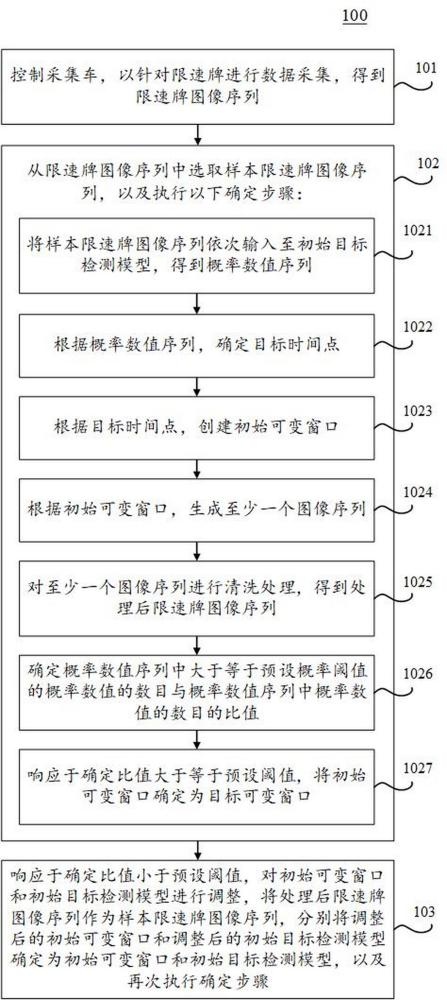
Fig. 1 illustrates a flow 100 of some embodiments of an image cleaning method according to the present disclosure. The image cleaning method comprises the following steps:
And 101, controlling an acquisition vehicle to acquire data aiming at the speed limit plate so as to obtain a speed limit plate image sequence.
In some embodiments, the executing body (e.g., electronic device) of the above image cleaning method may control the collection vehicle to perform data collection for the speed limit plate, so as to obtain the speed limit plate image sequence. The limit board image data sequence may be an image sequence ordered according to the time sequence of the tray falling when the collecting vehicle collects the limit board. The landing can be to store the acquired speed limit sign image sequence to a magnetic disk. The time to drop may be the time the speed limit sign image is stored in the disk. The collection vehicle may be a vehicle that collects the speed limit sign. For example, the collection vehicle may be an unmanned vehicle.
In some optional implementations of some embodiments, the controlling the collection vehicle to collect data for the speed limit sign to obtain the speed limit sign image sequence may include the following steps:
and the first step is to control the acquisition vehicle to acquire data aiming at the speed limiting plate so as to obtain an acquisition image sequence. The image collection sequence may be an image sequence obtained by collecting the speed limit plate. The sequence of the image acquisition sequences can be a sequence obtained by sorting according to the time sequence of the tray.
And secondly, carrying out channel division on the acquired image sequences to obtain a plurality of channel image sequences. Wherein the channel images in the plurality of channel image sequences may be images including only one color channel. For example, the plurality of channel image sequences may include: a red channel image sequence, a green channel image sequence, and a blue channel image sequence.
Third, for each of the plurality of channel images in the sequence of channel images, performing the determining step of:
and a substep 1, performing smoothing processing on the channel image to obtain a smoothed image. The smoothing process may be an image in which high-frequency pixels in the channel image are removed. In practice, the execution subject may first convert the channel image into a frequency domain by fourier transform to obtain a frequency domain image. The frequency domain image may be an image obtained by fourier transforming a channel image located in a spatial domain to a frequency domain. The frequency domain can represent the change condition of the gray scale of the channel image. The spatial domain may be a two-dimensional planar coordinate system. Then, the frequency domain image is subjected to denoising processing by using a low-pass filter, and a smooth image sequence is obtained.
And 2, performing frequency domain conversion on the smooth image to obtain a spatial domain image. The spatial domain image may be an image in which pixels in the image are located in a two-dimensional plane coordinate system. In practice, the executing body may perform frequency domain conversion on the smoothed image by using inverse fourier transform, to obtain a spatial domain image.
And 3, determining the reflectivity of the spatial domain image. The reflectivity may be a ratio of the energy of the reflection of light by the object itself to the total energy of the light projected onto the object. As shown in fig. 2, the spatial domain image is an image composed of the product of incident light and reflectance. I (x, y) represents a spatial domain image. L (x, y) represents incident light. R (x, y) represents reflectance. The incident light may be external light when photographing the speed limit sign. In practice, the execution body may first perform normalization processing on the pixel values in the spatial domain image to obtain a normalized value. And then, carrying out Gaussian convolution filtering processing on the normalized value to obtain the reflectivity of the spatial domain image.
And fourthly, channel fusion is carried out on the obtained multiple reflectivity sequences, and a fused image sequence is obtained. The fused image sequence may be a speed-limiting plate image sequence obtained by fusing the corresponding reflectances of the three color channels.
And fifthly, carrying out equalization treatment on the fused image sequence to obtain a speed-limiting plate image sequence. In practice, the executing body may perform equalization processing on the fused image sequence by using a histogram equalization method, so as to obtain a speed-limiting plate image sequence.
The above technical solution and related content are taken as an invention point of the embodiments of the present disclosure, which solves the second "time-space domain only image filter or frequency domain image filter" technical problem mentioned in the background art, and performs filtering processing on collected image data in bad weather, so that edge information of an object in an image is unclear, and further, accuracy and safety of automatic driving vehicle recognition are low. Factors that lead to lower accuracy and safety of automatic driving vehicle identification tend to be as follows: and only the time-space domain image filter or the frequency domain image filter is used for filtering the acquired image data in severe weather, so that the edge information of an object in the image is unclear, and further the accuracy and safety of automatic driving vehicle identification are lower. If the above factors are solved, the effects of improving the definition of the edge information of the object in the image and reducing the overall brightness difference of the image can be achieved. To achieve this, the present disclosure first controls the above-described collection vehicle to perform data collection for the speed limit sign, resulting in a collection image sequence. Secondly, carrying out channel division on the acquired image sequences to obtain a plurality of channel image sequences. Here, the channel division can enhance the image to a fine granularity degree, and a clearer and noiseless image can be obtained. And then, carrying out smoothing processing on the channel image to obtain a smoothed image. Here, the smoothing process is advantageous in reducing noise in the image, and more highlighting important information in the image. And carrying out frequency domain conversion on the smooth image to obtain a spatial domain image. Here, the conversion from the frequency domain to the spatial domain is more advantageous for determining the reflectivity of the subsequent image. And determining the reflectivity of the spatial domain image. And then, carrying out channel fusion on the obtained multiple reflectivity sequences to obtain a fused image sequence. Here, determining the reflectivity may enhance defogging effects in bad weather, improving sharpness of the image and marginalizing information. And finally, carrying out equalization treatment on the fused image sequence to obtain the speed-limiting plate image sequence. Here, the equalization process may increase contrast and sharpness of the image, as well as reduce noise in the image. Therefore, the technical scheme combines the frequency domain and the spatial domain denoising method, so that the definition of images and the edge information of objects in an image sequence acquired in severe weather can be improved, and the accuracy and the safety of automatic driving vehicle identification are further improved.
Step 102, selecting a sample speed limit card image sequence from the speed limit card image sequence, and executing the following determining steps:
and 1021, sequentially inputting the sample speed limit plate image sequence into an initial target detection model to obtain a probability value sequence.
In some embodiments, the executing body may sequentially input the sample speed-limiting card image sequence to an initial target detection model to obtain a probability value sequence. The probability value in the probability value sequence represents the probability value of the speed limit plate in the sample speed limit plate image. The sample speed limit plate image sequence may be an image sequence for training the initial target detection model. The initial object detection model may include, but is not limited to: YOLO (You Only Look Once) model, SSD (Single Shot MultiBox Detector) model.
Step 1022, determining the target time point according to the probability value sequence.
In some embodiments, the execution body may determine the target time point according to the probability value sequence. The target time point may be a landing time point corresponding to a probability value located at an initial position, where the probability value is greater than or equal to a preset probability threshold in the probability value sequence. The initial position may be a first position.
As an example, the execution body may first compare each probability value in the probability value sequence with a preset probability threshold value to generate a comparison result, so as to obtain a comparison result sequence. And secondly, determining a comparison result which is larger than or equal to a preset probability threshold value in the comparison result sequence as a target result sequence. And finally, determining the acquisition time point corresponding to the probability value corresponding to the comparison result positioned at the initial position in the target result sequence as a target time point.
In some optional implementations of some embodiments, determining the target time point according to the probability value sequence may include the following steps:
the first step, probability values which are larger than or equal to the preset probability threshold value are screened out from the probability value sequence, and a target probability value sequence is obtained. Wherein the preset probability threshold may be 0.75.
And secondly, determining the sample speed limiting plate image sequence corresponding to the target probability value sequence as a target sample speed limiting plate image sequence.
And thirdly, determining an acquisition time point corresponding to the target sample speed limit plate image positioned at the initial position in the target sample speed limit plate image sequence as a target time point.
Step 1023, creating an initial variable window according to the target time point.
In some embodiments, the execution body may create an initial variable window according to the target time point. The initial variable window is used for determining a window of a sample speed limit plate image to be cleaned.
As an example, the execution subject may create an initial variable window for the sample speed limit board image corresponding to the target time point.
In some optional implementations of some embodiments, creating the initial variable window according to the target time point may include the steps of:
and determining a time point, of which the corresponding difference value is within a first preset time range, from the target time point as a starting time point. For example, the first preset time range may be 1 second to 3 seconds. The corresponding difference from the target time point may be 3 seconds.
And secondly, selecting a sample speed-limiting plate image corresponding to the same acquisition time point as the initial time point from the sample speed-limiting plate image sequence as an initial sample speed-limiting plate image. The collection time point can be a time point when the collection vehicle collects the speed limit plate and falls into the memory.
And thirdly, determining a time point, of which the corresponding difference value between the target time point and the target time point is within a second preset time range, as a termination time point. For example, the second preset time range may be 1 second to 2 seconds. The corresponding difference from the above-mentioned point in time may be 1 second.
And step four, selecting a sample speed limit plate image corresponding to the same acquisition time point as the termination time point from the sample speed limit plate image sequence as a termination sample speed limit plate image.
And fifthly, determining a sample speed limit plate image which is positioned between the initial sample speed limit plate image and the final sample speed limit plate image in the sample speed limit plate image sequence as a sample speed limit plate image sequence included in the initial variable window.
Step 1024, generating at least one image sequence according to the initial variable window.
In some embodiments, the execution body may generate at least one image sequence according to the initial variable window. Wherein the at least one image sequence may be a sample speed limit card image sequence included in the at least one initial variable window.
As an example, the execution subject may create an initial variable window for a probability value greater than or equal to a preset probability threshold value from probability values corresponding to the sample speed limit card image sequence, to obtain at least one image sequence.
In some optional implementations of some embodiments, generating at least one image sequence according to the initial variable window may include:
first, based on a first sequence of probability values, the following sequence determination steps are performed:
and 1, in response to determining that the initial variable window does not comprise a sample speed limit plate image sequence corresponding to the acquisition time point which is the same as the sequence termination time point, expanding the initial variable window to obtain an expanded variable window and an expanded window. The extended window may be a window corresponding to a portion of the extended variable window larger than the initial variable window. The extended variable window may be a window obtained by extending a time point corresponding to a termination position of the initial variable window. The first probability value sequence is the probability value sequence from the target time point to a sequence termination time point, and the sequence termination time point may be a time point corresponding to a probability value located at a termination position of the probability value sequence.
And 2, in response to determining that no probability value which is larger than or equal to the preset probability threshold exists in the probability value sequence corresponding to the sample speed limit plate image sequence included in the expansion window, adding the sample speed limit plate image sequence included in the expansion variable window to at least one preset image sequence. The at least one preset image sequence may be a preset image sequence including at least one image sequence.
And 3, in response to determining that a second probability value larger than or equal to the preset probability threshold exists in the second probability value sequence, screening the second probability value larger than or equal to the preset probability value from the second probability value sequence, and obtaining a target screening probability value sequence. The second probability value sequence is a probability value sequence located between the probability value sequence and a probability value corresponding to the sequence termination time point from the extended probability value. The expansion probability value is a probability value corresponding to a sample speed limit plate image sequence positioned at a termination position in the obtained expansion variable window.
And step 4, aiming at the sample speed limiting plate image corresponding to the probability value positioned at the initial position in the target screening probability value sequence, creating a sample variable window. The sample variable window can be used for determining a window of a sample speed limit plate image to be cleaned.
And a substep 5, determining the at least one preset image sequence as the at least one image sequence in response to determining that the sample variable window comprises a sample speed limit plate image corresponding to the same acquisition time point as the sequence termination time point.
And a second step of determining a probability value sequence located between the window termination time point and the sequence termination time point as a first probability value sequence in response to determining that the sample variable window does not include a sample speed limit plate image corresponding to the same acquisition time point as the sequence termination time point, and performing the sequence determining step again. The window ending time point is a time point corresponding to the sample speed limit plate image at the ending position of the sample variable window.
In some optional implementations of some embodiments, the expanding the initial variable window to obtain an expanded variable window and an expanded window includes:
first, based on the initial variable window, the following expansion steps are performed:
and 1, determining probability values corresponding to the sample speed limit plate images between the target time point and the ending time point as a window probability value sequence. The window probability value sequence may be a probability value corresponding to a sample speed limit plate image sequence included between a target time point and a termination time point.
And 2, determining at least one window probability value which is larger than or equal to the preset probability threshold value as a target window probability value sequence in response to determining that the window probability value which is larger than or equal to the preset probability threshold value exists in the window probability value sequence. The target window probability value sequence may be a probability value sequence that is located in the window probability value sequence and is equal to or greater than the preset probability threshold.
And 3, determining a target window probability value at the ending position of the target window probability value sequence as a target ending window probability value.
And step 4, determining the acquisition time point of the target termination window probability value as an adjustment time point.
And step 5, expanding the initial variable window according to the adjustment time point to obtain an expanded variable window and the expanded window. The extended variable window may be a window extended backward by a preset time at a time point corresponding to a termination position of the initial variable window. For example, the preset time may be 1 second.
As an example, the execution body expands the initial variable window for 1 second from the adjustment time point to the start time point, and then expands the initial variable window for 1 second.
And a substep 6, wherein the expanding step is ended in response to determining that no probability value larger than or equal to the preset probability threshold exists in the probability value sequence corresponding to the sample speed limit plate image sequence included in the expanding window.
Optionally, the above execution body may further execute the following steps:
and in response to determining that a probability value greater than or equal to the preset probability threshold exists in a probability value sequence corresponding to a sample speed-limiting card image sequence included in the expansion window, determining a collection time point of the sample speed-limiting card image positioned at a termination position in the initial variable window as a target time point, determining the expansion variable window as the initial variable window, and executing the expansion step again.
Optionally, after the expanding the initial variable window in response to determining that the initial variable window does not include the sample speed limit plate image sequence corresponding to the same acquisition time point as the sequence termination time point, the method further includes:
and in response to determining that the initial variable window comprises a sample speed limit plate image sequence corresponding to the same acquisition time point as the sequence termination time point, adding the sample speed limit plate image sequence comprising the initial variable window to the at least one preset image sequence.
Step 1025, cleaning at least one image sequence to obtain a processed speed limit plate image sequence.
In some embodiments, the executing body may perform a cleaning process on the at least one image sequence to obtain a processed speed-limiting card image sequence. The processed speed limit plate image sequence can be an image sequence with a probability threshold smaller than a preset probability threshold and including a speed limit plate. The above-described cleaning process may include, but is not limited to: and (3) performing cleaning treatment and manual detection cleaning treatment on at least one image sequence by using a statistical method.
Step 1026, determining a ratio of the number of probability values in the probability value sequence that is greater than or equal to the preset probability threshold to the number of probability values in the probability value sequence.
In some embodiments, the execution body may determine a ratio of a number of probability values in the probability value sequence that is greater than or equal to a preset probability threshold to a number of probability values in the probability value sequence. The preset probability threshold may represent that training of the initial target detection model is completed. For example, the preset probability threshold may be 0.75.
In step 1027, in response to determining that the ratio is greater than or equal to the preset threshold, the initial variable window is determined to be the target variable window.
In some embodiments, the executing entity may determine the initial variable window as the target variable window in response to determining that the ratio is greater than or equal to a preset threshold. Wherein, the target variable window may be a window corresponding to the initial target detection model. The target variable window may be a window in which the length of the variable window decreases as the accuracy of the initial target model increases.
And step 103, in response to determining that the ratio is smaller than the preset threshold, adjusting the initial variable window and the initial target detection model, taking the processed speed-limiting plate image sequence as a sample speed-limiting plate image sequence, respectively determining the adjusted initial variable window and the adjusted initial target detection model as an initial variable window and an initial target detection model, and executing the determining step again.
In some embodiments, the executing body may adjust the initial variable window and the initial target detection model in response to determining that the ratio is smaller than the preset threshold, determine the adjusted initial variable window and the adjusted initial target detection model as the initial variable window and the initial target detection model, respectively, using the processed speed limit image sequence as the sample speed limit image sequence, and execute the determining step again.
The above embodiments of the present disclosure have the following advantages: the image cleaning method of some embodiments of the present disclosure can reduce the omission ratio of image cleaning and improve the efficiency of image cleaning by using a variable window with adjustable size and a target detection model. Specifically, the reason for the reduced safety of the related autopilot is that: the efficiency of manual cleaning is lower, and cleaning cycle and cleaning cost are higher, and the accuracy of utilizing the target detection model trained in advance to detect speed limit plate is lower, and the omission ratio of the image to some marginal scenes is higher, leads to the image cleaning efficiency lower. Based on this, the image cleaning method of some embodiments of the present disclosure may first control the collection vehicle to perform data collection for the speed limit sign, resulting in a speed limit sign image sequence. Here, the speed limit tile image sequence facilitates reducing miss rate in combination with the initial variable window and subsequent adjustment of the variable window and the target detection model. Then, selecting a sample speed limit plate image sequence from the speed limit plate image sequences, and executing the following determining steps: and sequentially inputting the sample speed-limiting plate image sequence to an initial target detection model to obtain a probability value sequence, wherein the probability value in the probability value sequence represents the probability value of the speed-limiting plate in the sample speed-limiting plate image. Here, the resulting sequence of probability values facilitates a subsequent determination of the accuracy of the initial target detection model. And determining a target time point according to the probability value sequence. Here, obtaining the target time point facilitates creating an initial variable window, and reducing the omission ratio of the sample speed limit plate image sequence cleaning, and obtaining the edge image data of the speed limit plate facilitates improving the model detection rate. And creating an initial variable window according to the target time point, wherein the initial variable window is used for determining a window of the sample speed limit plate image to be cleaned. Here, creating an initial variable window can acquire an edge image in the sample speed-limiting card image sequence, and improve the omission ratio of the sample speed-limiting card image sequence cleaning. At least one image sequence is generated based on the initial variable window. Here, the acquisition of at least one image sequence facilitates the subsequent cleaning process, resulting in an edge image. And then, cleaning the at least one image sequence to obtain a processed speed-limiting plate image sequence. Here, the cleaning of the at least one image sequence can improve the detection accuracy of the target detection model, and reduce the cleaning period and the cleaning cost of the sample speed-limiting plate image sequence. Determining the ratio of the number of probability values in the probability value sequence which are larger than or equal to a preset probability threshold value to the number of probability values in the probability value sequence; and in response to determining that the ratio is greater than or equal to a preset threshold, determining the initial variable window as a target variable window. And finally, in response to determining that the ratio is smaller than the preset threshold, adjusting the initial variable window and the initial target detection model, taking the processed speed-limiting plate image sequence as a sample speed-limiting plate image sequence, respectively determining the adjusted initial variable window and the adjusted initial target detection model as an initial variable window and an initial target detection model, and executing the determining step again. Here, the omission ratio of the sample speed limit plate image sequence cleaning can be reduced based on the target detection model and the variable window, and the initial variable window and the initial target detection model can be adjusted to improve the efficiency of model and image cleaning and reduce the cleaning period and the cleaning cost. Therefore, the image cleaning method can reduce the omission ratio of image cleaning and improve the efficiency of image cleaning and the detection efficiency of the target detection model by using the variable window with adjustable size and the target detection model.
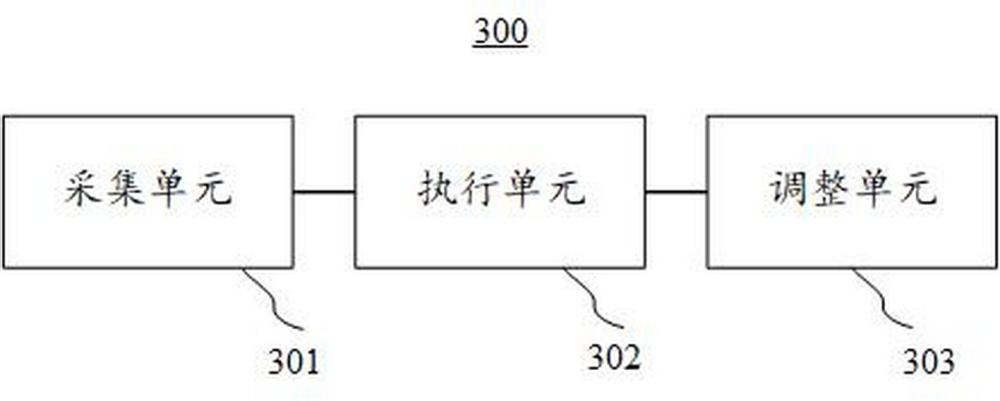
With further reference to fig. 3, as an implementation of the method shown in the above figures, the present disclosure provides embodiments of an image cleaning apparatus, which correspond to those method embodiments shown in fig. 1, which may find particular application in a variety of electronic devices.
As shown in fig. 3, an image cleaning apparatus 300 includes: an acquisition unit 301, an execution unit 302 and an adjustment unit 303. Wherein the acquisition unit 301 is configured to: and controlling the acquisition vehicle to acquire data aiming at the speed limit plate so as to obtain a speed limit plate image sequence. The execution unit 302 is configured to: selecting a sample speed limit plate image sequence from the speed limit plate image sequences, and executing the following determining steps: sequentially inputting the sample speed-limiting plate image sequence into an initial target detection model to obtain a probability value sequence, wherein the probability value in the probability value sequence represents the probability value of the speed-limiting plate in the sample speed-limiting plate image; determining a target time point according to the probability value sequence; creating an initial variable window according to the target time point, wherein the initial variable window is used for determining a window of a sample speed limit plate image to be cleaned; generating at least one image sequence according to the initial variable window; cleaning the at least one image sequence to obtain a processed speed limit plate image sequence; determining the ratio of the number of probability values in the probability value sequence which are larger than or equal to a preset probability threshold value to the number of probability values in the probability value sequence; and in response to determining that the ratio is greater than or equal to a preset threshold, determining the initial variable window as a target variable window. The adjustment unit 303 is configured to: and in response to determining that the ratio is smaller than the preset threshold, adjusting the initial variable window and the initial target detection model, taking the processed speed-limiting plate image sequence as a sample speed-limiting plate image sequence, respectively determining the adjusted initial variable window and the adjusted initial target detection model as the initial variable window and the initial target detection model, and executing the determining step again.
It will be appreciated that the elements described in the image cleaning apparatus 300 correspond to the various steps in the method described with reference to fig. 1. Thus, the operations, features and advantages described above with respect to the method are equally applicable to the image cleaning apparatus 300 and the units contained therein, and are not described herein.
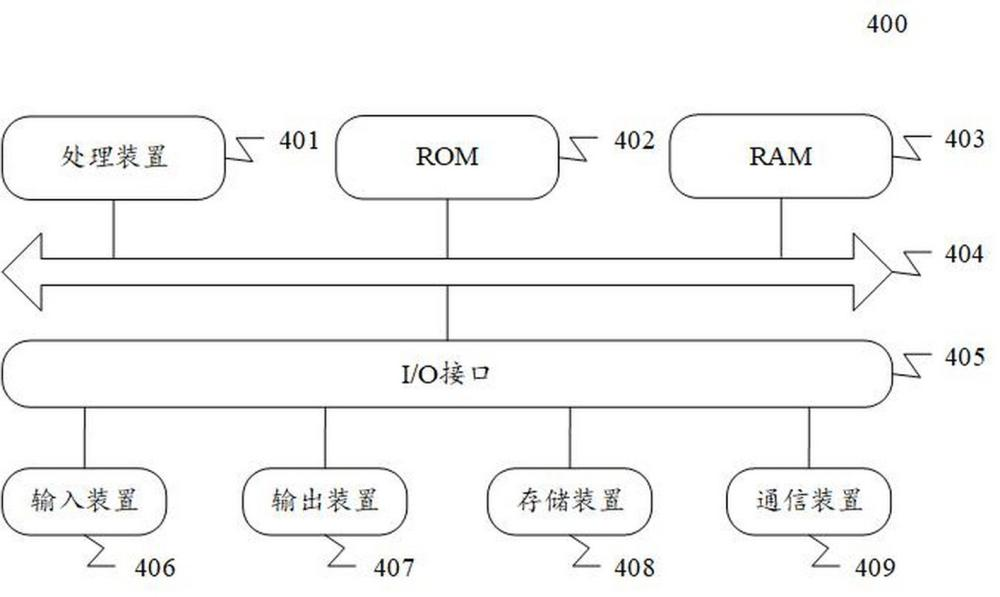
Referring now to fig. 4, a schematic diagram of an electronic device (e.g., electronic device) 400 suitable for use in implementing some embodiments of the present disclosure is shown. The electronic device shown in fig. 4 is merely an example and should not impose any limitations on the functionality and scope of use of embodiments of the present disclosure.
As shown in fig. 4, the electronic device 400 may include a processing means (e.g., a central processing unit, a graphics processor, etc.) 401, which may perform various suitable actions and processes according to a program stored in a Read Only Memory (ROM) 402 or a program loaded from a storage means 408 into a Random Access Memory (RAM) 403. In the RAM403, various programs and data necessary for the operation of the electronic device 400 are also stored. The processing device 401, the ROM 402, and the RAM403 are connected to each other by a bus 404. An input/output (I/O) interface 305 is also connected to bus 404.
In general, the following devices may be connected to the I/O interface 405: input devices 406 including, for example, a touch screen, touchpad, keyboard, mouse, camera, microphone, accelerometer, gyroscope, etc.; an output device 407 including, for example, a Liquid Crystal Display (LCD), a speaker, a vibrator, and the like; storage 408 including, for example, magnetic tape, hard disk, etc.; and a communication device 409. The communication means 409 may allow the electronic device 400 to communicate with other devices wirelessly or by wire to exchange data. While fig. 4 shows an electronic device 400 having various means, it is to be understood that not all of the illustrated means are required to be implemented or provided. More or fewer devices may be implemented or provided instead. Each block shown in fig. 4 may represent one device or a plurality of devices as needed.
In particular, according to some embodiments of the present disclosure, the processes described above with reference to flowcharts may be implemented as computer software programs. For example, some embodiments of the present disclosure include a computer program product comprising a computer program embodied on a computer readable medium, the computer program comprising program code for performing the method shown in the flow chart. In such embodiments, the computer program may be downloaded and installed from a network via communications device 409, or from storage 408, or from ROM 402. The above-described functions defined in the methods of some embodiments of the present disclosure are performed when the computer program is executed by the processing device 401.
It should be noted that, in some embodiments of the present disclosure, the computer readable medium may be a computer readable signal medium or a computer readable storage medium, or any combination of the two. The computer readable storage medium can be, for example, but not limited to, an electronic, magnetic, optical, electromagnetic, infrared, or semiconductor system, apparatus, or device, or a combination of any of the foregoing. More specific examples of the computer-readable storage medium may include, but are not limited to: an electrical connection having one or more wires, a portable computer diskette, a hard disk, a Random Access Memory (RAM), a read-only memory (ROM), an erasable programmable read-only memory (EPROM or flash memory), an optical fiber, a portable compact disc read-only memory (CD-ROM), an optical storage device, a magnetic storage device, or any suitable combination of the foregoing. In some embodiments of the present disclosure, a computer readable storage medium may be any tangible medium that can contain, or store a program for use by or in connection with an instruction execution system, apparatus, or device. In some embodiments of the present disclosure, however, the computer-readable signal medium may comprise a data signal propagated in baseband or as part of a carrier wave, with the computer-readable program code embodied therein. Such a propagated data signal may take any of a variety of forms, including, but not limited to, electro-magnetic, optical, or any suitable combination of the foregoing. A computer readable signal medium may also be any computer readable medium that is not a computer readable storage medium and that can communicate, propagate, or transport a program for use by or in connection with an instruction execution system, apparatus, or device. Program code embodied on a computer readable medium may be transmitted using any appropriate medium, including but not limited to: electrical wires, fiber optic cables, RF (radio frequency), and the like, or any suitable combination of the foregoing.
In some implementations, the clients, servers may communicate using any currently known or future developed network protocol, such as HTTP (Hyper Text Transfer Protocol ), and may be interconnected with any form or medium of digital data communication (e.g., a communication network). Examples of communication networks include a local area network ("LAN"), a wide area network ("WAN"), the internet (e.g., the internet), and peer-to-peer networks (e.g., ad hoc peer-to-peer networks), as well as any currently known or future developed networks.
The computer readable medium may be contained in the electronic device; or may exist alone without being incorporated into the electronic device. The computer readable medium carries one or more programs which, when executed by the electronic device, cause the electronic device to: controlling an acquisition vehicle to acquire data aiming at the speed limit plate to obtain a speed limit plate image sequence; selecting a sample speed limit plate image sequence from the speed limit plate image sequences, and executing the following determining steps: sequentially inputting the sample speed-limiting plate image sequence into an initial target detection model to obtain a probability value sequence, wherein the probability value in the probability value sequence represents the probability value of the speed-limiting plate in the sample speed-limiting plate image; determining a target time point according to the probability value sequence; creating an initial variable window according to the target time point, wherein the initial variable window is used for determining a window of a sample speed limit plate image to be cleaned; generating at least one image sequence according to the initial variable window; cleaning the at least one image sequence to obtain a processed speed limit plate image sequence; determining the ratio of the number of probability values in the probability value sequence which are larger than or equal to a preset probability threshold value to the number of probability values in the probability value sequence; in response to determining that the ratio is greater than or equal to a preset threshold, determining the initial variable window as a target variable window; and in response to determining that the ratio is smaller than the preset threshold, adjusting the initial variable window and the initial target detection model, taking the processed speed-limiting plate image sequence as a sample speed-limiting plate image sequence, respectively determining the adjusted initial variable window and the adjusted initial target detection model as the initial variable window and the initial target detection model, and executing the determining step again.
Computer program code for carrying out operations for some embodiments of the present disclosure may be written in one or more programming languages, including an object oriented programming language such as Java, smalltalk, C ++ and conventional procedural programming languages, such as the "C" programming language or similar programming languages. The program code may execute entirely on the user's computer, partly on the user's computer, as a stand-alone software package, partly on the user's computer and partly on a remote computer or entirely on the remote computer or server. In the case of a remote computer, the remote computer may be connected to the user's computer through any kind of network, including a Local Area Network (LAN) or a Wide Area Network (WAN), or may be connected to an external computer (for example, through the Internet using an Internet service provider).
The flowcharts and block diagrams in the figures illustrate the architecture, functionality, and operation of possible implementations of systems, methods and computer program products according to various embodiments of the present disclosure. In this regard, each block in the flowchart or block diagrams may represent a module, segment, or portion of code, which comprises one or more executable instructions for implementing the specified logical function(s). It should also be noted that, in some alternative implementations, the functions noted in the block may occur out of the order noted in the figures. For example, two blocks shown in succession may, in fact, be executed substantially concurrently, or the blocks may sometimes be executed in the reverse order, depending upon the functionality involved. It will also be noted that each block of the block diagrams and/or flowchart illustration, and combinations of blocks in the block diagrams and/or flowchart illustration, can be implemented by special purpose hardware-based systems which perform the specified functions or acts, or combinations of special purpose hardware and computer instructions.
The units described in some embodiments of the present disclosure may be implemented by means of software, or may be implemented by means of hardware. The described units may also be provided in a processor, for example, described as: a processor includes an acquisition unit, an execution unit, and an adjustment unit. The names of these units do not in any way limit the units themselves, for example, the acquisition unit may also be described as "a unit that controls the acquisition vehicle to perform data acquisition for the speed limit sign, resulting in a sequence of speed limit sign images".
The functions described above herein may be performed, at least in part, by one or more hardware logic components. For example, without limitation, exemplary types of hardware logic components that may be used include: a Field Programmable Gate Array (FPGA), an Application Specific Integrated Circuit (ASIC), an Application Specific Standard Product (ASSP), a system on a chip (SOC), a Complex Programmable Logic Device (CPLD), and the like.
The foregoing description is only of the preferred embodiments of the present disclosure and description of the principles of the technology being employed. It will be appreciated by those skilled in the art that the scope of the invention in the embodiments of the present disclosure is not limited to the specific combination of the above technical features, but encompasses other technical features formed by any combination of the above technical features or their equivalents without departing from the spirit of the invention. Such as the above-described features, are mutually substituted with (but not limited to) the features having similar functions disclosed in the embodiments of the present disclosure.





 400-4929-0909
 contact@catarc.com.cn

