当前位置: 首页> 专利交易> 详情页
    待售中

    道路隔音罩的去除方法及其去除装置[ZH]

    专利编号: ZL202603190001

    收藏

    拟转化方式: 转让;普通许可;独占许可;排他许可;开放许可

    交易价格:面议

    专利类型:发明专利

    法律状态:授权

    技术领域:智能网联汽车

    发布日期:2026-03-19

    发布有效期: 2026-03-19 至 2041-08-02

    专利顾问 — 王老师

    电话咨询

    咨询电话

    13760886304

    专利基本信息
    >
    申请号 CN202110880501.3 公开号 CN115701548A
    申请日 2021-08-02 公开日 2023-02-10
    申请人 合肥保航汽车科技有限公司 专利授权日期 2025-07-25
    发明人 梁秀娟 专利权期限届满日 2041-08-02
    申请人地址 230601 安徽省合肥市经济技术开发区天都路1588号保隆园区4幢301室 最新法律状态 授权
    技术领域 智能网联汽车 分类号 G01S7/292
    技术效果 可靠性 有效性 有效(授权、部分无效)
    专利代理机构 上海专利商标事务所有限公司 31100 代理人 孙英杰
    专利技术详情
    >
    01

    专利摘要

    本发明涉及一种道路隔音罩的去除方法及其去除装置。该去除方法适用于车辆雷达,该方法包括:步骤S1,寻找目标点;步骤S2,拟合直线;步骤S3,第一次筛选所拟合的直线;步骤S4,第二次筛选所拟合的直线;步骤S5,选定目标点;步骤S6,删除所选定的目标点。通过本发明提供的方案有助于去除道路隔音罩,保留车辆前方正常目标航迹。
    展开 >
    02

    专利详情

    技术领域

    本发明涉及车辆雷达信号处理技术领域,具体地说是一种适用于车载毫米波雷达的道路隔音罩的去除方法法及其去除装置。

    背景技术

    车辆行驶在高架或特殊路段上时,侧方路段上的隔音罩正好在车辆雷达的高度探测范围内,隔音罩的回波显示在雷达正前方,由于雷达没有高度信息,导致雷达误以为前方有障碍物。而且隔音罩航迹非常长,前方正常目标的航迹会淹没在隔音罩航迹中,无法分辨出前方正常目标。

    发明内容

    本发明要解决的技术问题是提供一种在车辆雷达上去除道路隔音罩的方法法及其去除装置,能保留车辆前方正常目标航迹。

    为解决上述技术问题,本发明提供了一种道路隔音罩的去除方法,适用于车辆雷达,包括:

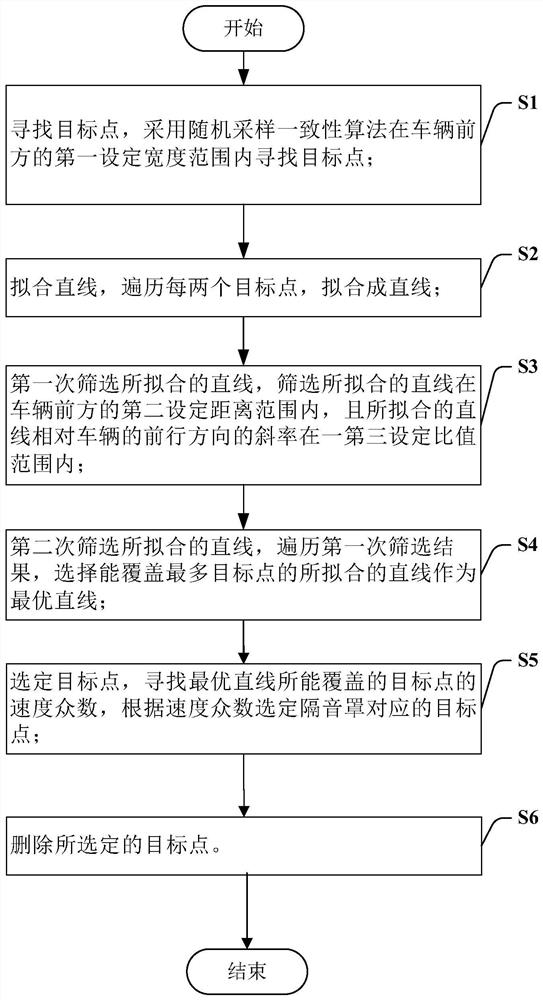
    步骤S1,寻找目标点,采用随机采样一致性算法在所述车辆前方的第一设定宽度范围内寻找所述目标点;

    步骤S2,拟合直线,遍历每两个所述目标点,拟合成直线;

    步骤S3,第一次筛选所拟合的直线,筛选所拟合的直线在所述车辆前方的第二设定距离范围内,且所拟合的直线相对所述车辆的前行方向的斜率在一第三设定比值范围内;

    步骤S4,第二次筛选所拟合的直线,遍历第一次筛选结果,选择能覆盖最多所述目标点的所拟合的直线作为最优直线;

    步骤S5,选定目标点,寻找所述最优直线所能覆盖的所述目标点的速度众数,根据所述速度众数选定所述隔音罩对应的目标点;

    步骤S6,删除所选定的目标点。

    根据本发明的一个实施例,在步骤S1中,所述第一设定宽度在垂直于所述车辆的中轴线上,所述第一设定宽度为1m~2m。

    根据本发明的一个实施例,在步骤S3中,所述第二设定距离为10m~30m。

    根据本发明的一个实施例,在步骤S3中,所述第三设定比值为小于8且大于-8。

    根据本发明的一个实施例,在步骤S4中,若所述目标点到所拟合的直线的距离小于一设定门限,那么所述目标点能被所拟合的直线覆盖。

    根据本发明的一个实施例,在执行步骤S5之前,采用状态机减少直线拟合的随机性。

    根据本发明的一个实施例,所述状态机采用计数器,所述计数器设定门限值,所述状态机的执行步骤包括:

    步骤T1,所述状态机查找所拟合的直线中的最优直线,若找到最优直线,则所述计数器加1;

    步骤T2,判断所述计数器是否达到设定的门限值,若未达到,返回步骤S1;否则进入下一步;

    步骤T3,判断所述目标点有效。

    根据本发明的一个实施例,在步骤S5中,所述速度众数通过寻找具有相同速度的所述目标点来获得,或通过所述车辆的车速来获得。

    根据本发明的一个实施例,在步骤S5中,寻找所述目标点的速度众数过程中,符合所述速度众数的目标点达到设定数量,则所获得的速度众数有效。

    本发明还提供了一种道路隔音罩的去除装置,适用于车辆雷达,包括:

    搜寻模块,采用随机采样一致性算法在所述车辆雷达前方的第一设定宽度范围内寻找目标点;

    直线拟合模块,接收所述搜寻模块寻找到的所述目标点,遍历每两个所述目标点,拟合成直线;

    第一筛选模块,接收所述直线拟合模块所拟合的直线,筛选保留所述直线在所述车辆前方的第二设定距离范围内,且所拟合的直线相对所述车辆的前行方向的斜率在一第三设定比值范围内;

    第二筛选模块,接收所述第一筛选模块筛选的所述直线,选择能覆盖最多所述目标点的所拟合的直线作为最优直线;

    选定目标点模块,寻找所述最优直线所覆盖的所述目标点的速度众数,根据所述速度众数选定所述隔音罩对应的目标点;

    删除模块,删除所述选定目标点模块所选定的目标点。。

    本发明提供的一种道路隔音罩的去除方法及其去除装置,能分辨并去除道路隔音罩,从而能保留车辆前方正常目标航迹。

    附图说明

    为让本发明的上述目的、特征和优点能更明显易懂,以下结合附图对本发明的具体实施方式作详细说明,其中:

    图1是本发明一实施例的道路隔音罩的去除方法的流程图;

    图2是本发明一实施例的简要示意图。

    图3是本发明一实施例的道路隔音罩的去除装置的结构示意图。

    具体实施方式

    为让本发明的上述目的、特征和优点能更明显易懂,以下结合附图对本发明的具体实施方式作详细说明。

    在下面的描述中阐述了很多具体细节以便于充分理解本发明,但是本发明还可以采用其它不同于在此描述的其它方式来实施,因此本发明不受下面公开的具体实施例的限制。

    如本申请和权利要求书中所示,除非上下文明确提示例外情形,“一”、“一个”、“一种”和/或“该”等词并非特指单数,也可包括复数。一般说来,术语“包括”与“包含”仅提示包括已明确标识的步骤和元素,而这些步骤和元素不构成一个排它性的罗列,方法或者设备也可能包含其他的步骤或元素。

    在详述本申请实施例时,为便于说明,表示器件结构的剖面图会不依一般比例作局部放大,而且所述示意图只是示例,其在此不应限制本申请保护的范围。此外,在实际制作中应包含长度、宽度及深度的三维空间尺寸。

    为了方便描述,此处可能使用诸如“之下”、“下方”、“低于”、“下面”、“上方”、“上”等等的空间关系词语来描述附图中所示的一个元件或特征与其他元件或特征的关系。将理解到,这些空间关系词语意图包含使用中或操作中的器件的、除了附图中描绘的方向之外的其他方向。例如,如果翻转附图中的器件,则被描述为在其他元件或特征“下方”或“之下”或“下面”的元件的方向将改为在所述其他元件或特征的“上方”。因而,示例性的词语“下方”和“下面”能够包含上和下两个方向。器件也可能具有其他朝向(旋转90度或处于其他方向),因此应相应地解释此处使用的空间关系描述词。此外,还将理解,当一层被称为在两层“之间”时,它可以是所述两层之间仅有的层,或者也可以存在一个或多个介于其间的层。

    在本申请的上下文中,所描述的第一特征在第二特征之“上”的结构可以包括第一和第二特征形成为直接接触的实施例,也可以包括另外的特征形成在第一和第二特征之间的实施例,这样第一和第二特征可能不是直接接触。

    由于隔音罩通常设置在道路的正上方,其形状多为半圆管状,但从车辆雷达所显示的外形上不能将隔音罩与普通目标区别出来。隔音罩不像栅栏一样从外观上就能看出是整齐的直线型。因此只能通过隔音罩的回波数据特点来寻找隔音罩的特征。由于雷达的俯仰角度和雷达的波束宽度,雷达波在半圆管状的隔音罩只有最顶端的点有回波,这些点形成了一条细长的直线,根据这条直线能滤除隔音罩数据。定义这些构成细长直线的点为目标点。

    图1是本发明一实施例的道路隔音罩的去除方法的流程图。图2是本发明一实施例的简要示意图。如图所示,一种道路隔音罩的去除方法,适用于车辆雷达,包括:

    步骤S1,寻找目标点,采用随机采样一致性算法在车辆的前方的第一设定宽度范围内寻找目标点。目标点是车辆雷达收到的前方障碍物的回波信号。参考图2,X轴方向为车辆车头的水平方向,Y轴方向为车辆的中轴线。在第一设定宽度L1范围内寻找目标点201。

    步骤S2,拟合直线,遍历每两个目标点,拟合成直线。具体来说,需要遍历每两个目标点的组合来拟合直线,进而找到全局最优解,也就是最合适的直线。

    步骤S3,第一次筛选所拟合的直线,使所拟合的直线在车辆前方的第二设定距离范围内,且所拟合的直线与车辆的前行方向形成的斜率在一第三设定比值范围内。这里通过第二设定距离和第三设定比值作为限定条件来挑选符合要求的拟合直线,相当于去除那些非隔音罩所拟合成的直线。参考图2,在第二设定距离L2内寻找符合要求的拟合直线。

    步骤S4,第二次筛选所拟合的直线,遍历第一次筛选结果,选择能覆盖最多目标点的所拟合的直线作为最优直线。

    步骤S5,选定目标点,寻找最优直线所能覆盖的目标点201的速度众数,根据速度众数选定隔音罩对应的目标点201。

    步骤S6,删除所选定的目标点201,即相当于删除隔音罩在车辆雷达上的轨迹。

    较佳地,在步骤S1中,第一设定宽度为1m~2m。由于隔音罩只在车辆雷达的正前方有数据,所以在拟合直线时,只需找正前方的目标点201,也就是车辆雷达前方,相当于车辆车头位置沿中轴线左右各0.5~1米的范围内提取直线,这样就不会错误拟合到其他的障碍物比如栅栏上。容易理解的,参考图2,车辆的中轴线为Y轴,车辆沿着Y轴行进。在Y轴左右各1m的宽度范围内,寻找目标点201。第一设定宽度L1方向垂直于Y轴,且与车身的宽度方向一致。此外,通过该种方式能有效减少随机采样一致性算法的计算量,提升去除效率。

    较佳地,在步骤S3中,第二设定距离L2为10m~30m。由于离车辆雷达相近的道路边的栅栏也满足拟合直线,且也能达到其它条件的情况,所以根据栅栏和隔音罩的区别来保证不误删栅栏对应的目标点201的情况。经过实际观察,发现隔音罩出现在雷达正前方十多米的位置开始形成直线,而栅栏是从车辆雷达正左或者正右的水平位置开始形成直线的。所以控制拟合隔音罩直线的开始点选择为10米到30米的范围,能有效减少误删除栅栏的情况。控制10米到30米的区域,是由于车辆雷达有俯仰角,比如雷达的俯仰角在-15度到15之间时,3米高的隔音罩,探测距离大概为12米,所以只有10以外开始出现的拟合直线才有可能是隔音罩,而10米以内出现的拟合直线极大可能是正前方范围内的栅栏。

    较佳地,在步骤S3中,第三设定比值为小于8且大于-8。在拟合直线时,由于车辆在高架的隔音罩中只能沿高架前方行驶,不会出现转弯和掉头的现象,所以控制拟合直线与车辆前行方向的斜率倾斜较小的范围内,斜率范围小于8且大于-8,这样能正确找到隔音罩对应的目标点201拟合成的直线。

    较佳地,在步骤S4中,若目标点201到所拟合的直线的距离小于一设定门限,那么目标点201能被所拟合的直线覆盖。或者说该目标点201属于所拟合的直线。最优直线就是找出一条所拟合的直线使属于该直线的目标点201最多。

    较佳地,在执行步骤S5之前,采用状态机减少直线拟合的随机性。由于直线拟合的效果会因为车辆雷达的回波产生起伏,采用状态机以减少直线拟合的随机性,增加直线拟合的可信度。

    较佳地,状态机采用计数器,该计数器设定门限值,状态机的执行步骤包括:

    步骤T1,状态机查找所拟合的直线中的最优直线,若找到最优直线,则计数器加1;

    步骤T2,判断计数器是否达到设定的门限值,若未达到,返回步骤S41;否则进入下一步;

    步骤T3,判断目标点201有效。

    由于直线拟合的效果会因为车辆雷达的回波产生起伏,所以采用状态机的方法来减少直线拟合的随机性,增加直线拟合的可信度。状态机采用了计数的方式,如果当前时间能找到最优直线,那么计数器加一,在若干时间周期后,计数器达到次数门限值时,判断车辆雷达现在处于隔音罩环境,则组成拟合直线的目标点201有效,可以进行后续的滤除隔音罩轨迹的操作。此外,在连续稳定滤除隔音罩轨迹很多次后,状态机偶尔有几次若没有找到最优直线,根据状态机的原理,会根据历史信息来拟合的直线用来消除隔音罩的轨迹。采用状态机能保证在遗漏数据的情况下仍能稳定滤除隔音罩轨迹,也能保证在偶发虚假最优时不滤除。

    较佳地,在步骤S5中,速度众数通过寻找具有相同速度的目标点201来获得,或通过车辆的车速来获得。若车辆的车速已知,则可以将速度众数设置为绝对速度为零。

    较佳地,在步骤S5中,寻找目标点201的速度众数过程中,符合速度众数的目标点201达到设定数量,则速度众数有效。更佳地,该设定数量为4个。容易理解的,在求取速度众数时,只有满足速度众数的目标点201达到一定量的个数时,才采用速度众数去选定隔音罩回波对应的目标点201,即判定目标点201的速度与速度众数相近的目标点201被认为是隔音罩所产生,进而删除该目标点201,避免前方正常运动的目标被删除。

    本发明还提供了一种适用于车辆雷达的道路隔音罩的去除装置。图3是本发明一实施例的道路隔音罩的去除装置的结构示意图。如图所示,该去除装置300主要包括搜寻模块301、直线拟合模块302、第一筛选模块303、第二筛选模块304、选定目标点模块305和删除模块306。

    其中搜寻模块301采用随机采样一致性算法在车辆雷达前方的第一设定宽度L1范围内寻找目标点201。

    直线拟合模块302用于接收搜寻模块301寻找到的目标点201,遍历每两个目标点201,拟合成直线。

    第一筛选模块303接收直线拟合模块302所拟合的直线,筛选保留直线在车辆前方的第二设定距离L2范围内,且所拟合的直线相对车辆的前行方向的斜率在一第三设定比值范围内。

    第二筛选模块304接收第一筛选模块303筛选的直线,选择能覆盖最多目标点201的所拟合的直线作为最优直线。

    选定目标点模块305用于寻找最优直线所覆盖的目标点201的速度众数,根据速度众数选定隔音罩对应的目标点201。

    删除模块306用于在雷达上删除选定目标点模块305所选定的目标点201。

    虽然本发明已参照当前的具体实施例来描述,但是本技术领域中的普通技术人员应当认识到,以上的实施例仅是用来说明本发明,在没有脱离本发明精神的情况下还可作出各种等效的变化或替换,因此,只要在本发明的实质精神范围内对上述实施例的变化、变型都将落在本申请的权利要求书的范围内。

    道路隔音罩的去除方法及其去除装置

    Technical field

    The present invention relates to the field of vehicle radar signal processing technology, in particular, a method for removing road noise enclosures suitable for vehicle millimeter wave radar and its removal device.

    Background technology

    When the vehicle is driving on an elevated or special road section, the sound insulation cover on the side road section is exactly within the height detection range of the vehicle radar, and the echo of the sound insulation cover is displayed directly in front of the radar, because the radar has no altitude information, causing the radar to mistakenly think that there is an obstacle ahead. Moreover, the sound enclosure track is very long, and the track of the normal target in front will be submerged in the sound enclosure track, and it is impossible to distinguish the normal target ahead.

    Invention content

    The technical problem to be solved by the present invention is to provide a method for removing the road sound insulation cover on the vehicle radar and its removal device, which can retain the normal target track in front of the vehicle.

    To solve the above technical problems, the present invention provides a method for removing road acoustic covers, suitable for vehicle radar, comprising:

    Step S1, find the target point, using a random sampling consensus algorithm to find the target point within the first set width range in front of the vehicle;

    Step S2, fit a straight line, traverse each of the two said target points, fit a straight line;

    Step S3, the fitted straight line is screened for the first time, the fitted straight line is screened within the second set distance in front of the vehicle, and the slope of the fitted straight line relative to the forward direction of the vehicle is within a third set ratio;

    Step S4, the second screening of the fitted line, iterating through the first screening results, selecting the fitted line that can cover the most of the target points as the optimal straight line;

    Step S5, select the target point, find the velocity mode of the target point that the optimal straight line can cover, and select the target point corresponding to the acoustic enclosure according to the velocity mode;

    Step S6, delete the selected target point.

    According to one embodiment of the present invention, in step S1, the first setting width is perpendicular to the central axis of the vehicle, and the first setting width is 1m ~ 2m.

    According to one embodiment of the present invention, in step S3, the second set distance is 10m ~ 30m.

    According to one embodiment of the present invention, in step S3, the third set ratio is less than 8 and greater than -8.

    According to one embodiment of the present invention, in step S4, if the distance from the target point to the fitted straight line is less than a set threshold, then the target point can be covered by the fitted straight line.

    According to one embodiment of the present invention, before performing step S5, a state machine is employed to reduce the randomness of the straight-line fitting.

    According to one embodiment of the present invention, the state machine adopts a counter, the counter sets a threshold value, and the execution steps of the state machine comprise:

    Step T1, the state machine finds the optimal line in the fitted line, and if the optimal line is found, the counter is added by 1;

    Step T2, determine whether the counter reaches the set threshold, if not, return to step S1; Otherwise proceed to the next step;

    Step T3, determine that the target point is valid.

    According to one embodiment of the present invention, in step S5, the velocity mode is obtained by finding the target point having the same speed, or by the speed of the vehicle.

    According to one embodiment of the present invention, in step S5, in the process of finding the velocity mode of the target point, the target point conforming to the velocity majority reaches a set number, then the velocity mode obtained is valid.

    The present invention also provides a removal device for road acoustic enclosures, suitable for vehicle radar, comprising:

    The search module uses a random sampling consensus algorithm to find a target point within the first set width range in front of the vehicle radar;

    the straight-line fitting module, receiving the target point found by the search module, traversing each of the two target points, fitting a straight line;

    the first screening module, receiving the straight line fitted by the straight line fitting module, screening retaining the straight line within the second set distance in front of the vehicle, and the slope of the fitted straight line relative to the forward direction of the vehicle is within a third set ratio;

    the second screening module, which receives the line screened by the first screening module, selects the fitted straight line that can cover the most of the target point as the optimal straight line;

    Select the target point module, find the velocity mode of the target point covered by the optimal straight line, and select the target point corresponding to the acoustic enclosure according to the velocity mode;

    Delete Module, deletes the target point selected by the Selected Target Point module.

    The present invention provides a removal method for road sound insulation cover and a removal device thereof, which can distinguish and remove the road sound insulation cover, so that the normal target track in front of the vehicle can be retained.

    Description of the drawings

    In order to make the above objects, features and advantages of the present invention more obvious and easy to understand, the following in conjunction with the accompanying drawings of the specific embodiments of the present invention are described in detail, wherein:

    FIG 1 is a flowchart of the removal method of a road sound insulation cover in an embodiment of the present invention;

    FIG 2 is a brief schematic diagram of one embodiment of the present invention.

    FIG 3 is a schematic diagram of the structure of a road sound enclosure removal device in an embodiment of the present invention.

    Specific embodiment

    In order to make the above objects, features and advantages of the present invention more obvious and easy to understand, the following in conjunction with the accompanying drawings of the present invention in detail in detail.

    Many specific details are set forth in the following description in order to fully understand the present invention, but the present invention may also be implemented in other ways different from those described herein, so the present invention is not limited by the specific embodiments disclosed below.

    As indicated in this application and the claims, the terms "one", "a", "a" and/or "the" do not refer specifically to the singular and may include the plural, unless the context expressly indicates an exception. In general, the terms "including" and "including" only imply the inclusion of clearly identified steps and elements, and these steps and elements do not constitute an exclusive list, methods or devices may also contain other steps or elements.

    In detailing embodiments of the present application, for ease of illustration, the profile view indicating the device structure will not be partially enlarged according to the general proportion, and the schematic diagram is only an example, which should not limit the scope of protection of the present application. In addition, the actual production should include three-dimensional spatial dimensions of length, width and depth.

    For ease of description, spatial relationship words such as "below", "below", "below", "below", "above", "above", etc. may be used herein to describe the relationship of one element or feature shown in the drawings to other components or features. It will be understood that these spatial relationship words are intended to include directions other than those depicted in the drawings of the device in use or in operation. For example, if the device in the drawing is flipped, the orientation of the component described "below" or "below" or "below" other components or features will be changed to "above" the other components or features. Thus, the exemplary words "below" and "below" can encompass both up and down directions. Devices may also have other orientations (90 degrees of rotation or other orientations), so the spatial relationship descriptors used here should be interpreted accordingly. Further, it will be understood that when a layer is referred to as "between" between two layers, it may be the only layer between the two layers, or there may also be one or more layers in between.

    In the context of the present application, the structure of the first feature described "above" the second feature may include embodiments of the first and second features forming as direct contact, and may also include additional embodiments of feature formation between the first and second features, such that the first and second features may not be in direct contact.

    Since the acoustic enclosure is usually set directly above the road, its shape is mostly semicircular tubular, but the acoustic enclosure cannot be distinguished from ordinary targets from the shape displayed by the vehicle radar. The acoustic enclosure is not like a fence, and it can be seen from the appearance that it is neatly straight. Therefore, the characteristics of the acoustic enclosure can only be found through the echo data characteristics of the acoustic enclosure. Due to the pitch angle of the radar and the beam width of the radar, the radar wave has echoes at only the top point of the semicircular tubular acoustic enclosure, and these points form an elongated straight line according to which the acoustic enclosure data can be filtered. Define these points that make up an elongated line as target points.

    FIG 1 is a flowchart of a removal method for a road sound enclosure in an embodiment of the present invention. FIG 2 is a brief schematic diagram of one embodiment of the present invention. As shown in the figure, a method for removing road acoustic covers, suitable for vehicle radar, comprising:

    Step S1, to find the target point, the random sampling consensus algorithm is used to find the target point within the first set width range in front of the vehicle. The target point is the echo signal received by the vehicle's radar from the obstacle ahead. Referring to Figure 2, the X-axis direction is the horizontal direction of the front of the vehicle, and the Y-axis direction is the central axis of the vehicle. Look for the target point 201 within the first set width L1.

    Step S2, Fit Straight Line, traverse every two target points, Fit Straight Line. Specifically, it is necessary to traverse the combination of each of the two target points to fit the straight line, and then find the global optimal solution, that is, the most suitable straight line.

    Step S3, the fitted straight line is screened for the first time, so that the fitted straight line is within the second set distance in front of the vehicle, and the slope formed by the fitted straight line and the forward direction of the vehicle is within the range of a third set ratio. Here, the second set distance and the third set ratio are used as constraints to select the fitted straight lines that meet the requirements, which is equivalent to removing those lines that are not fitted by the acoustic enclosure. Refer to Figure 2 to find a fitted line within the second set distance L2.

    Step S4, the second screening of the fitted line, iterating through the first screening result, selecting the fitted line that covers the most target points as the optimal straight line.

    Step S5, select the target point, find the velocity mode of the target point 201 covered by the optimal straight line, and select the target point 201 corresponding to the acoustic enclosure according to the velocity mode.

    Step S6, delete the selected target point 201, which is equivalent to deleting the trajectory of the acoustic enclosure on the vehicle radar.

    Preferably, in step S1, the first set width is 1m~2m. Since the sound enclosure only has data in front of the vehicle radar, when fitting the straight line, it is only necessary to find the target point 201 directly in front, that is, in front of the vehicle radar, which is equivalent to extracting the straight line within 0.5~1 meters of the left and right of the vehicle head position along the central axis, so that it will not be wrongly fitted to other obstacles such as fences. Easy to understand, referring to Figure 2, the central axis of the vehicle is the Y axis, and the vehicle travels along the Y axis. In the width range of 1m on the left and right of the Y axis, look for the target point 201. The first set width L1 direction is perpendicular to the Y axis and is consistent with the width direction of the body. In addition, this method can effectively reduce the calculation amount of random sampling consensus algorithm and improve the removal efficiency.

    Preferably, in step S3, the second set distance L2 is 10m~30m. Since the fence on the side of the road close to the vehicle radar also meets the fitting straight line and can also meet other conditions, it is ensured that the target point 201 corresponding to the fence is not mistakenly deleted according to the difference between the fence and the sound insulation hood. After actual observation, it was found that the acoustic enclosure appeared more than ten meters in front of the radar and began to form a straight line, while the fence formed a straight line from the horizontal position directly left or right of the vehicle radar. Therefore, the starting point of the straight line of the control fitting sound enclosure is selected as a range of 10 meters to 30 meters, which can effectively reduce the situation of accidental deletion of fences. Control the area of 10 meters to 30 meters, because the vehicle radar has a pitch angle, such as when the pitch angle of the radar is between -15 degrees and 15, the 3-meter-high sound insulation cover, the detection distance is about 12 meters, so only the fitted straight line that begins to appear outside 10 is likely to be a sound enclosure, and the fitted straight line that appears within 10 meters is most likely to be a fence within the front range.

    Preferably, in step S3, the third set ratio is less than 8 and greater than -8. When fitting a straight line, because the vehicle can only drive along the front of the elevated in the elevated sound enclosure, there will be no turning and U-turn, so the slope of the control fitting line and the vehicle forward direction is less inclined in the range, and the slope range is less than 8 and greater than -8, so that the target point 201 fitted straight line corresponding to the sound insulation cover can be correctly found.

    Preferably, in step S4, if the distance from the target point 201 to the fitted line is less than a set threshold, then the target point 201 can be covered by the fitted line. Or that the target point 201 belongs to the fitted straight line. The optimal line is to find a fitted line such that the target point 201 belonging to the line is the most.

    Preferably, a state machine is employed to reduce the randomness of the straight-line fitting before performing Step S5. Since the effect of straight-line fitting will fluctuate due to the echo of vehicle radar, a state machine is used to reduce the randomness of straight-line fitting and increase the credibility of straight-line fitting.

    Preferably, the state machine uses a counter, which sets the threshold, and the steps performed by the state machine include:

    Step T1, the state machine finds the optimal line in the fitted line, and if the optimal line is found, the counter adds 1;

    Step T2, determine whether the counter reaches the set threshold, if not, return to step S41; Otherwise proceed to the next step;

    Step T3, determine that the target point 201 is valid.

    Since the effect of straight-line fitting will fluctuate due to the echo of vehicle radar, the state machine method is used to reduce the randomness of straight-line fitting and increase the credibility of straight-line fitting. The state machine adopts the counting method, if the current time can find the optimal straight line, then the counter is added to one, after a number of time periods, when the counter reaches the number of thresholds, it is judged that the vehicle radar is now in the acoustic enclosure environment, then the target point 201 that forms the fitted straight line is effective, and the subsequent operation of filtering out the soundproof hood trajectory can be carried out. In addition, after continuously and stably filtering out the trajectory of the acoustic enclosure many times, the state machine occasionally if the optimal straight line is not found, according to the principle of the state machine, the straight line that will be fitted according to historical information is used to eliminate the trajectory of the acoustic enclosure. The use of state function can ensure that the sound enclosure trajectory can be stably filtered out in the case of missing data, and can also ensure that it is not filtered out when there is occasional false optimum.

    Preferably, in step S5, the velocity mode is obtained by looking for a target point 201 with the same speed, or by the vehicle's speed. If the vehicle's speed is known, the speed mode can be set to an absolute speed of zero.

    Preferably, in step S5, in the process of finding the velocity mode of the target point 201, the target point 201 that conforms to the velocity majority reaches a set number, then the velocity mode is valid. Preferably, the number of settings is 4. It is easy to understand, when finding the velocity majority, only when the target point 201 that satisfies the velocity majority reaches a certain number, the velocity majority is used to select the target point 201 corresponding to the echo of the acoustic enclosure, that is, the target point 201 that determines that the velocity of the target point 201 is similar to the velocity majority is considered to be generated by the acoustic enclosure, and then the target point 201 is deleted to avoid the target of normal movement in front of it being deleted.

    The present invention also provides a removal device suitable for road noise enclosures of vehicle radar. FIG 3 is a schematic diagram of the structure of a road sound enclosure removal device in an embodiment of the present invention. As shown in the figure, the removal device 300 mainly includes a search module 301, a straight line fitting module 302, a first screening module 303, a second screening module 304, a selected target point module 305 and a deletion module 306.

    wherein the search module 301 adopts a random sampling consensus algorithm to find the target point 201 within the first set width L1 range in front of the vehicle radar.

    The straight-line fitting module 302 is used to receive the target point 201 found by the search module 301, traverse every two target points 201, fit a straight line.

    The first screening module 303 receives the straight line fitted by the straight line fitting module 302, the screening retention line is within the range of the second set distance L2 in front of the vehicle, and the slope of the fitted straight line relative to the forward direction of the vehicle is within a third set ratio.

    The second screening module 304 receives the first screening module 303 filtered straight line, and selects the fitted straight line that can cover the maximum target point 201 as the optimal straight line.

    The selected target point module 305 is used to find the velocity mode of the target point 201 covered by the optimal straight line, and selects the target point 201 corresponding to the acoustic enclosure according to the velocity mode.

    Delete module 306 is used to delete the selected target point module 305 selected target point 201 on the radar.

    Although the present invention has been described with reference to the current specific embodiment, but ordinary skill in the art should realize that the above embodiments are only used to illustrate the present invention, and may make various equivalent changes or replacements without departing from the spirit of the present invention, therefore, as long as the substance of the present invention within the spirit of the present invention of the changes, variants will fall within the scope of the claims of the present application.

    Method and device for removing road sound insulation cover

    Technical field

    The present invention relates to the field of vehicle radar signal processing technology, in particular, a method for removing road noise enclosures suitable for vehicle millimeter wave radar and its removal device.

    Background technology

    When the vehicle is driving on an elevated or special road section, the sound insulation cover on the side road section is exactly within the height detection range of the vehicle radar, and the echo of the sound insulation cover is displayed directly in front of the radar, because the radar has no altitude information, causing the radar to mistakenly think that there is an obstacle ahead. Moreover, the sound enclosure track is very long, and the track of the normal target in front will be submerged in the sound enclosure track, and it is impossible to distinguish the normal target ahead.

    Invention content

    The technical problem to be solved by the present invention is to provide a method for removing the road sound insulation cover on the vehicle radar and its removal device, which can retain the normal target track in front of the vehicle.

    To solve the above technical problems, the present invention provides a method for removing road acoustic covers, suitable for vehicle radar, comprising:

    Step S1, find the target point, using a random sampling consensus algorithm to find the target point within the first set width range in front of the vehicle;

    Step S2, fit a straight line, traverse each of the two said target points, fit a straight line;

    Step S3, the fitted straight line is screened for the first time, the fitted straight line is screened within the second set distance in front of the vehicle, and the slope of the fitted straight line relative to the forward direction of the vehicle is within a third set ratio;

    Step S4, the second screening of the fitted line, iterating through the first screening results, selecting the fitted line that can cover the most of the target points as the optimal straight line;

    Step S5, select the target point, find the velocity mode of the target point that the optimal straight line can cover, and select the target point corresponding to the acoustic enclosure according to the velocity mode;

    Step S6, delete the selected target point.

    According to one embodiment of the present invention, in step S1, the first setting width is perpendicular to the central axis of the vehicle, and the first setting width is 1m ~ 2m.

    According to one embodiment of the present invention, in step S3, the second set distance is 10m ~ 30m.

    According to one embodiment of the present invention, in step S3, the third set ratio is less than 8 and greater than -8.

    According to one embodiment of the present invention, in step S4, if the distance from the target point to the fitted straight line is less than a set threshold, then the target point can be covered by the fitted straight line.

    According to one embodiment of the present invention, before performing step S5, a state machine is employed to reduce the randomness of the straight-line fitting.

    According to one embodiment of the present invention, the state machine adopts a counter, the counter sets a threshold value, and the execution steps of the state machine comprise:

    Step T1, the state machine finds the optimal line in the fitted line, and if the optimal line is found, the counter is added by 1;

    Step T2, determine whether the counter reaches the set threshold, if not, return to step S1; Otherwise proceed to the next step;

    Step T3, determine that the target point is valid.

    According to one embodiment of the present invention, in step S5, the velocity mode is obtained by finding the target point having the same speed, or by the speed of the vehicle.

    According to one embodiment of the present invention, in step S5, in the process of finding the velocity mode of the target point, the target point conforming to the velocity majority reaches a set number, then the velocity mode obtained is valid.

    The present invention also provides a removal device for road acoustic enclosures, suitable for vehicle radar, comprising:

    The search module uses a random sampling consensus algorithm to find a target point within the first set width range in front of the vehicle radar;

    the straight-line fitting module, receiving the target point found by the search module, traversing each of the two target points, fitting a straight line;

    the first screening module, receiving the straight line fitted by the straight line fitting module, screening retaining the straight line within the second set distance in front of the vehicle, and the slope of the fitted straight line relative to the forward direction of the vehicle is within a third set ratio;

    the second screening module, which receives the line screened by the first screening module, selects the fitted straight line that can cover the most of the target point as the optimal straight line;

    Select the target point module, find the velocity mode of the target point covered by the optimal straight line, and select the target point corresponding to the acoustic enclosure according to the velocity mode;

    Delete Module, deletes the target point selected by the Selected Target Point module.

    The present invention provides a removal method for road sound insulation cover and a removal device thereof, which can distinguish and remove the road sound insulation cover, so that the normal target track in front of the vehicle can be retained.

    Description of the drawings

    In order to make the above objects, features and advantages of the present invention more obvious and easy to understand, the following in conjunction with the accompanying drawings of the specific embodiments of the present invention are described in detail, wherein:

    FIG 1 is a flowchart of the removal method of a road sound insulation cover in an embodiment of the present invention;

    FIG 2 is a brief schematic diagram of one embodiment of the present invention.

    FIG 3 is a schematic diagram of the structure of a road sound enclosure removal device in an embodiment of the present invention.

    Specific embodiment

    In order to make the above objects, features and advantages of the present invention more obvious and easy to understand, the following in conjunction with the accompanying drawings of the present invention in detail in detail.

    Many specific details are set forth in the following description in order to fully understand the present invention, but the present invention may also be implemented in other ways different from those described herein, so the present invention is not limited by the specific embodiments disclosed below.

    As indicated in this application and the claims, the terms "one", "a", "a" and/or "the" do not refer specifically to the singular and may include the plural, unless the context expressly indicates an exception. In general, the terms "including" and "including" only imply the inclusion of clearly identified steps and elements, and these steps and elements do not constitute an exclusive list, methods or devices may also contain other steps or elements.

    In detailing embodiments of the present application, for ease of illustration, the profile view indicating the device structure will not be partially enlarged according to the general proportion, and the schematic diagram is only an example, which should not limit the scope of protection of the present application. In addition, the actual production should include three-dimensional spatial dimensions of length, width and depth.

    For ease of description, spatial relationship words such as "below", "below", "below", "below", "above", "above", etc. may be used herein to describe the relationship of one element or feature shown in the drawings to other components or features. It will be understood that these spatial relationship words are intended to include directions other than those depicted in the drawings of the device in use or in operation. For example, if the device in the drawing is flipped, the orientation of the component described "below" or "below" or "below" other components or features will be changed to "above" the other components or features. Thus, the exemplary words "below" and "below" can encompass both up and down directions. Devices may also have other orientations (90 degrees of rotation or other orientations), so the spatial relationship descriptors used here should be interpreted accordingly. Further, it will be understood that when a layer is referred to as "between" between two layers, it may be the only layer between the two layers, or there may also be one or more layers in between.

    In the context of the present application, the structure of the first feature described "above" the second feature may include embodiments of the first and second features forming as direct contact, and may also include additional embodiments of feature formation between the first and second features, such that the first and second features may not be in direct contact.

    Since the acoustic enclosure is usually set directly above the road, its shape is mostly semicircular tubular, but the acoustic enclosure cannot be distinguished from ordinary targets from the shape displayed by the vehicle radar. The acoustic enclosure is not like a fence, and it can be seen from the appearance that it is neatly straight. Therefore, the characteristics of the acoustic enclosure can only be found through the echo data characteristics of the acoustic enclosure. Due to the pitch angle of the radar and the beam width of the radar, the radar wave has echoes at only the top point of the semicircular tubular acoustic enclosure, and these points form an elongated straight line according to which the acoustic enclosure data can be filtered. Define these points that make up an elongated line as target points.

    FIG 1 is a flowchart of a removal method for a road sound enclosure in an embodiment of the present invention. FIG 2 is a brief schematic diagram of one embodiment of the present invention. As shown in the figure, a method for removing road acoustic covers, suitable for vehicle radar, comprising:

    Step S1, to find the target point, the random sampling consensus algorithm is used to find the target point within the first set width range in front of the vehicle. The target point is the echo signal received by the vehicle's radar from the obstacle ahead. Referring to Figure 2, the X-axis direction is the horizontal direction of the front of the vehicle, and the Y-axis direction is the central axis of the vehicle. Look for the target point 201 within the first set width L1.

    Step S2, Fit Straight Line, traverse every two target points, Fit Straight Line. Specifically, it is necessary to traverse the combination of each of the two target points to fit the straight line, and then find the global optimal solution, that is, the most suitable straight line.

    Step S3, the fitted straight line is screened for the first time, so that the fitted straight line is within the second set distance in front of the vehicle, and the slope formed by the fitted straight line and the forward direction of the vehicle is within the range of a third set ratio. Here, the second set distance and the third set ratio are used as constraints to select the fitted straight lines that meet the requirements, which is equivalent to removing those lines that are not fitted by the acoustic enclosure. Refer to Figure 2 to find a fitted line within the second set distance L2.

    Step S4, the second screening of the fitted line, iterating through the first screening result, selecting the fitted line that covers the most target points as the optimal straight line.

    Step S5, select the target point, find the velocity mode of the target point 201 covered by the optimal straight line, and select the target point 201 corresponding to the acoustic enclosure according to the velocity mode.

    Step S6, delete the selected target point 201, which is equivalent to deleting the trajectory of the acoustic enclosure on the vehicle radar.

    Preferably, in step S1, the first set width is 1m~2m. Since the sound enclosure only has data in front of the vehicle radar, when fitting the straight line, it is only necessary to find the target point 201 directly in front, that is, in front of the vehicle radar, which is equivalent to extracting the straight line within 0.5~1 meters of the left and right of the vehicle head position along the central axis, so that it will not be wrongly fitted to other obstacles such as fences. Easy to understand, referring to Figure 2, the central axis of the vehicle is the Y axis, and the vehicle travels along the Y axis. In the width range of 1m on the left and right of the Y axis, look for the target point 201. The first set width L1 direction is perpendicular to the Y axis and is consistent with the width direction of the body. In addition, this method can effectively reduce the calculation amount of random sampling consensus algorithm and improve the removal efficiency.

    Preferably, in step S3, the second set distance L2 is 10m~30m. Since the fence on the side of the road close to the vehicle radar also meets the fitting straight line and can also meet other conditions, it is ensured that the target point 201 corresponding to the fence is not mistakenly deleted according to the difference between the fence and the sound insulation hood. After actual observation, it was found that the acoustic enclosure appeared more than ten meters in front of the radar and began to form a straight line, while the fence formed a straight line from the horizontal position directly left or right of the vehicle radar. Therefore, the starting point of the straight line of the control fitting sound enclosure is selected as a range of 10 meters to 30 meters, which can effectively reduce the situation of accidental deletion of fences. Control the area of 10 meters to 30 meters, because the vehicle radar has a pitch angle, such as when the pitch angle of the radar is between -15 degrees and 15, the 3-meter-high sound insulation cover, the detection distance is about 12 meters, so only the fitted straight line that begins to appear outside 10 is likely to be a sound enclosure, and the fitted straight line that appears within 10 meters is most likely to be a fence within the front range.

    Preferably, in step S3, the third set ratio is less than 8 and greater than -8. When fitting a straight line, because the vehicle can only drive along the front of the elevated in the elevated sound enclosure, there will be no turning and U-turn, so the slope of the control fitting line and the vehicle forward direction is less inclined in the range, and the slope range is less than 8 and greater than -8, so that the target point 201 fitted straight line corresponding to the sound insulation cover can be correctly found.

    Preferably, in step S4, if the distance from the target point 201 to the fitted line is less than a set threshold, then the target point 201 can be covered by the fitted line. Or that the target point 201 belongs to the fitted straight line. The optimal line is to find a fitted line such that the target point 201 belonging to the line is the most.

    Preferably, a state machine is employed to reduce the randomness of the straight-line fitting before performing Step S5. Since the effect of straight-line fitting will fluctuate due to the echo of vehicle radar, a state machine is used to reduce the randomness of straight-line fitting and increase the credibility of straight-line fitting.

    Preferably, the state machine uses a counter, which sets the threshold, and the steps performed by the state machine include:

    Step T1, the state machine finds the optimal line in the fitted line, and if the optimal line is found, the counter adds 1;

    Step T2, determine whether the counter reaches the set threshold, if not, return to step S41; Otherwise proceed to the next step;

    Step T3, determine that the target point 201 is valid.

    Since the effect of straight-line fitting will fluctuate due to the echo of vehicle radar, the state machine method is used to reduce the randomness of straight-line fitting and increase the credibility of straight-line fitting. The state machine adopts the counting method, if the current time can find the optimal straight line, then the counter is added to one, after a number of time periods, when the counter reaches the number of thresholds, it is judged that the vehicle radar is now in the acoustic enclosure environment, then the target point 201 that forms the fitted straight line is effective, and the subsequent operation of filtering out the soundproof hood trajectory can be carried out. In addition, after continuously and stably filtering out the trajectory of the acoustic enclosure many times, the state machine occasionally if the optimal straight line is not found, according to the principle of the state machine, the straight line that will be fitted according to historical information is used to eliminate the trajectory of the acoustic enclosure. The use of state function can ensure that the sound enclosure trajectory can be stably filtered out in the case of missing data, and can also ensure that it is not filtered out when there is occasional false optimum.

    Preferably, in step S5, the velocity mode is obtained by looking for a target point 201 with the same speed, or by the vehicle's speed. If the vehicle's speed is known, the speed mode can be set to an absolute speed of zero.

    Preferably, in step S5, in the process of finding the velocity mode of the target point 201, the target point 201 that conforms to the velocity majority reaches a set number, then the velocity mode is valid. Preferably, the number of settings is 4. It is easy to understand, when finding the velocity majority, only when the target point 201 that satisfies the velocity majority reaches a certain number, the velocity majority is used to select the target point 201 corresponding to the echo of the acoustic enclosure, that is, the target point 201 that determines that the velocity of the target point 201 is similar to the velocity majority is considered to be generated by the acoustic enclosure, and then the target point 201 is deleted to avoid the target of normal movement in front of it being deleted.

    The present invention also provides a removal device suitable for road noise enclosures of vehicle radar. FIG 3 is a schematic diagram of the structure of a road sound enclosure removal device in an embodiment of the present invention. As shown in the figure, the removal device 300 mainly includes a search module 301, a straight line fitting module 302, a first screening module 303, a second screening module 304, a selected target point module 305 and a deletion module 306.

    wherein the search module 301 adopts a random sampling consensus algorithm to find the target point 201 within the first set width L1 range in front of the vehicle radar.

    The straight-line fitting module 302 is used to receive the target point 201 found by the search module 301, traverse every two target points 201, fit a straight line.

    The first screening module 303 receives the straight line fitted by the straight line fitting module 302, the screening retention line is within the range of the second set distance L2 in front of the vehicle, and the slope of the fitted straight line relative to the forward direction of the vehicle is within a third set ratio.

    The second screening module 304 receives the first screening module 303 filtered straight line, and selects the fitted straight line that can cover the maximum target point 201 as the optimal straight line.

    The selected target point module 305 is used to find the velocity mode of the target point 201 covered by the optimal straight line, and selects the target point 201 corresponding to the acoustic enclosure according to the velocity mode.

    Delete module 306 is used to delete the selected target point module 305 selected target point 201 on the radar.

    Although the present invention has been described with reference to the current specific embodiment, but ordinary skill in the art should realize that the above embodiments are only used to illustrate the present invention, and may make various equivalent changes or replacements without departing from the spirit of the present invention, therefore, as long as the substance of the present invention within the spirit of the present invention of the changes, variants will fall within the scope of the claims of the present application.

    展开 >
    说明书附图
    >
    交易服务流程
    >

    挑选中意的板块

    ----

    客服确认选择专利的交易信息和价格并支付相应款项

    办理转让材料

    ----

    协助双方准备相应的材料

    签订协议

    ----

    协助卖家签订协议

    办理备案手续

    ----

    买卖双方达成一致后

    交易完成

    ----

    交易完成可投入使用

    过户资料 & 安全保障 & 承诺信息
    >

    过户资料

    买卖双方需提供的资料
    公司 个人
    买家 企业营业执照
    企业组织机构代码证
    身份证
    卖家 企业营业执照
    专利证书原件
    身份证
    专利证书原件
    网站提供 过户后您将获得
    专利代理委托书
    专利权转让协议
    办理文件副本请求书
    发明人变更声明
    专利证书
    手续合格通知书
    专利登记薄副本

    安全保障

    承诺信息

    我方拟转让所持标的项目,通过中国汽车知识产权交易平台公开披露项目信息和组织交易活动,依照公开、公平、公正和诚信的原则作如下承诺:

    1、本次项目交易是我方真实意思表示,项目标的权属清晰,除已披露的事项外,我方对该项目拥有完全的处置权且不存在法律法规禁止或限制交易的情形;
    2、本项目标的中所涉及的处置行为已履行了相应程序,经过有效的内部决策,并获得相应批准;交易标的涉及共有或交易标的上设置有他项权利,已获得相关权利 人同意的有效文件。
    3、我方所提交的信息发布申请及相关材料真实、完整、准确、合法、有效,不存在虚假记载、误导性陈述或重大遗漏;我方同意平台按上述材料内容发布披露信息, 并对披露内容和上述的真实性、完整性、准确性、合法性、有效性承担法律责任;
    4、我方在交易过程中自愿遵守有关法律法规和平台相关交易规则及规定,恪守信息发布公告约定,按照相关要求履行我方义务;
    5、我方已认真考虑本次项目交易行为可能导致的企业经营、行业、市场、政策以及其他不可预计的各项风险因素,愿意自行承担可能存在的一切交易风险;
    6、我方在平台所组织交易期间将不通过其他渠道对标的项目进行交易;
    7、我方将按照平台收费办法及相关交易文件的约定及时、足额支付相关费用,不因与受让方争议或合同解除、终止等原因拒绝、拖延、减少交纳或主张退还相关费用。