当前位置: 首页> 专利交易> 详情页
    待售中

    一种制动系统、车辆及制动方法[ZH]

    专利编号: ZL202606054552

    收藏

    拟转化方式: 其他(面议)

    交易价格:面议

    专利类型:发明专利

    法律状态:授权

    技术领域:制动系统

    发布日期:2026-06-05

    发布有效期: 2026-06-05 至 2043-05-09

    专利顾问 — 王老师

    电话咨询

    咨询电话

    13760886304

    专利基本信息
    >
    申请号 CN202310516604.0 公开号 CN116572920A
    申请日 2023-05-09 公开日 2023-08-11
    申请人 一汽解放汽车有限公司 专利授权日期 2026-03-17
    发明人 张军;万里恩;刘明明;郭冬妮;王天璐;王彦;王顺一 专利权期限届满日 2043-05-09
    申请人地址 130011 吉林省长春市汽车开发区东风大街2259号 最新法律状态 授权
    技术领域 制动系统 分类号 B60T13/68
    技术效果 降低成本 有效性 有效(授权、部分无效)
    专利代理机构 北京远智汇知识产权代理有限公司 11659 代理人 林波
    专利技术详情
    >
    01

    专利摘要

    本发明公开了一种制动系统、车辆及制动方法,涉及车辆紧急制动技术领域。该制动系统包括供气组件、制动阀、前桥控制组件及电子控制单元。制动阀包括制动阀芯、制动进气口与制动出气口,制动阀芯能连通或断开制动进气口与制动出气口,制动进气口与供气组件连通;前桥控制组件包括前桥继动阀与第一电磁阀,前桥继动阀的进气口和第一电磁阀的进气口均与供气组件连通,前桥继动阀的出气口与前桥的气动制动件连通,制动出气口以及第一电磁阀的出气口均与前桥继动阀的控制口连通;电子控制单元被配置为控制第一电磁阀的通断。该制动系统能够实现车辆的自动紧急制动,且只需要在制动系统增加第一电磁阀,无需更改硬件架构,硬件成本低且更易量产实现。
    展开 >
    02

    专利详情

    技术领域

    本发明涉及车辆紧急制动技术领域,尤其涉及一种制动系统、车辆及制动方法。

    背景技术

    随着汽车主动安全技术的发展,车辆智能化已经成为体现汽车产品力的重要方面。自动紧急制动技术(Autonomous Emergency Braking,AEB)是实现车辆智能化的重要手段,在降低交通事故和提升驾驶安全方面发挥了至关重要的作用,使得自动紧急制动技术已经成为驾驶辅助系统(ADAS)中的一项重要功能。

    车辆的自动紧急制动技术一方面可以避免人员因疲劳驾驶导致的交通事故,另一方面可以支撑未来电控制动技术,特别是无人驾驶技术。目前市面上的车辆自动紧急制动功能多数基于电控制动系统(EBS),成本较高,且无法对老款车型进行改装适配。

    针对上述问题,需要开发一种制动系统、车辆及制动方法。

    发明内容

    本发明的目的在于提出一种制动系统、车辆及制动方法,能够实现车辆的自动紧急制动,且只需要在现有的具有继动阀的制动系统的基础上增加第一电磁阀,无需更改硬件架构,硬件成本低且更易量产实现。

    为达此目的,本发明采用以下技术方案:

    一种制动系统,包括:

    供气组件;

    制动阀,包括制动阀芯、制动进气口与制动出气口,所述制动阀芯连接有制动踏板,所述制动阀芯通过移动能够连通或断开所述制动进气口与所述制动出气口,所述制动进气口与所述供气组件连通;

    前桥控制组件,包括前桥继动阀与第一电磁阀,所述前桥继动阀的进气口和所述第一电磁阀的进气口均与所述供气组件连通,所述前桥继动阀的出气口与前桥的气动制动件连通,所述制动出气口以及所述第一电磁阀的出气口均与所述前桥继动阀的控制口连通;

    电子控制单元,所述电子控制单元被配置为控制所述第一电磁阀的通断。

    在一些实施例中,所述前桥控制组件还包括第二电磁阀,所述第二电磁阀的进气口与所述第一电磁阀的出气口连通,所述电子控制单元被配置为控制所述第二电磁阀的通断。

    在一些实施例中,所述第一电磁阀与所述第二电磁阀的通断状态相反。

    在一些实施例中,所述前桥控制组件还包括双通单向阀,所述双通单向阀的一个进气口与所述制动出气口连通,所述双通单向阀的另一个进气口与所述第一电磁阀的出气口连通,所述双通单向阀的出气口与所述前桥继动阀的控制口连通。

    在一些实施例中,所述制动系统还包括后桥控制组件,所述后桥控制组件包括后桥继动阀与第三电磁阀,所述后桥继动阀的进气口和所述第三电磁阀的进气口均与所述供气组件连通,所述后桥继动阀的出气口与后桥的气动制动件连通,所述制动出气口以及所述第三电磁阀的出气口均与所述后桥继动阀的控制口连通,所述电子控制单元被配置为控制所述第三电磁阀的通断。

    在一些实施例中,所述第三电磁阀为两位三通电磁阀,所述第三电磁阀的阀芯位于第一位置时,所述第三电磁阀的进气口与所述第三电磁阀的出气口连通,所述第三电磁阀的阀芯位于第二位置时,所述第三电磁阀的出气口与所述第三电磁阀的排气口连通,所述电子控制单元被配置为控制所述第三电磁阀的阀芯在所述第一位置与所述第二位置间切换。

    在一些实施例中,所述后桥控制组件还包括两位三通阀,所述两位三通阀的一个进气口与所述制动出气口连通,所述两位三通阀的另一个进气口与所述第三电磁阀的出气口连通,所述两位三通阀的出气口与所述后桥继动阀的控制口连通,所述第三电磁阀的出气口还与所述两位三通阀的第一控制口连通,以推动所述两位三通阀的阀芯,使所述两位三通阀连接所述第三电磁阀的出气口的进气口与所述两位三通阀的出气口连通。

    在一些实施例中,所述制动阀芯通过滑动具有第三位置与第四位置,所述制动进气口包括第一制动进气口与第二制动进气口,所述制动出气口包括第一制动出气口与第二制动出气口,所述制动阀芯位于第三位置时,所述第一制动进气口与所述第一制动出气口连通,所述制动阀芯位于第四位置时,所述第一制动进气口与所述第一制动出气口连通,且所述第二制动进气口与所述第二制动出气口连通,所述第一制动进气口和所述第二制动进气口均与所述供气组件连通,所述第一制动出气口与所述后桥继动阀的控制口连通,所述第二制动出气口与所述前桥继动阀的控制口连通。

    在一些实施例中,所述供气组件包括第一储气筒与第二储气筒,所述第一储气筒分别与所述前桥继动阀的进气口、所述第一电磁阀的进气口以及所述第一制动进气口连通,所述第二储气筒分别与所述后桥继动阀的进气口、所述第三电磁阀的进气口以及所述第二制动进气口连通。

    一种车辆,所述车辆包括所述的制动系统。

    一种制动方法,用于所述的制动系统,所述制动方法包括:

    S1:电子控制单元判断是否需要触发自动紧急制动;

    S2:若是,所述电子控制单元控制第一电磁阀的阀芯移动,使所述第一电磁阀的进气口与所述第一电磁阀的出气口连通;

    S3:判断是否需要解除自动紧急制动;

    S4:若是,所述电子控制单元控制所述第一电磁阀的阀芯移动,使所述第一电磁阀的进气口与所述第一电磁阀的出气口断开。

    在一些实施例中,所述步骤S3中,若驾驶员踩踏制动踏板或车辆的速度小于或等于前方障碍物的速度,则解除自动紧急制动。

    本发明的有益效果:

    本发明提供了一种制动系统、车辆及制动方法。该制动系统中,驾驶员可以通过踩踏制动踏板,使供气组件内的高压气体进入前桥的气动制动件实施对车辆的制动,还能够在电子控制单元判断需要紧急制动时,控制第一电磁阀的阀芯移动,使第一电磁阀的进气口与出气口连通,此时供气组件内的高压气体能够通过第一电磁阀进入前桥继动阀的控制口,从而推动前桥继动阀的阀芯移动,使前桥继动阀的进气口与出气口连通,则供气组件内的高压气体进入前桥的气动制动件实施对车辆的制动。

    该制动系统能够实现车辆的自动紧急制动,且只需要在现有的具有继动阀的制动系统的基础上增加第一电磁阀,无需更改硬件架构,硬件成本低且更易量产实现。

    附图说明

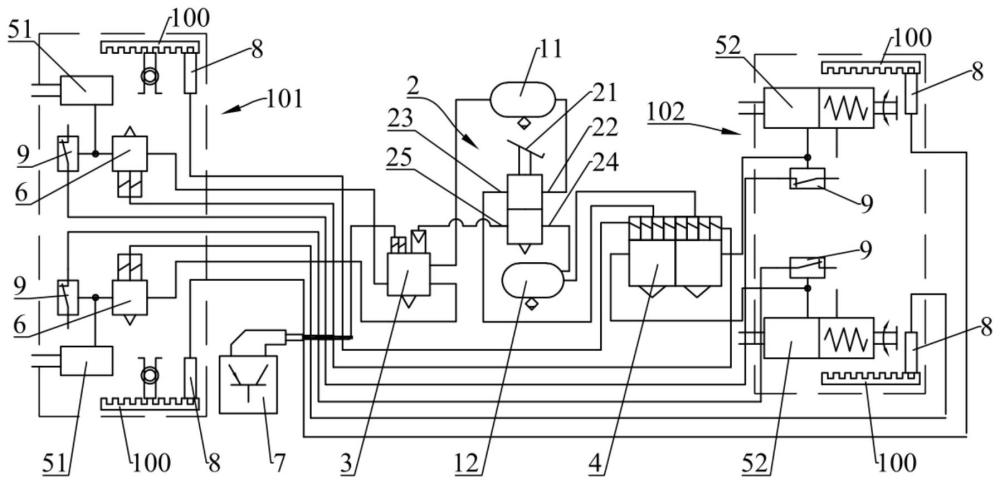
    图1是本发明提供的制动系统的结构示意图;

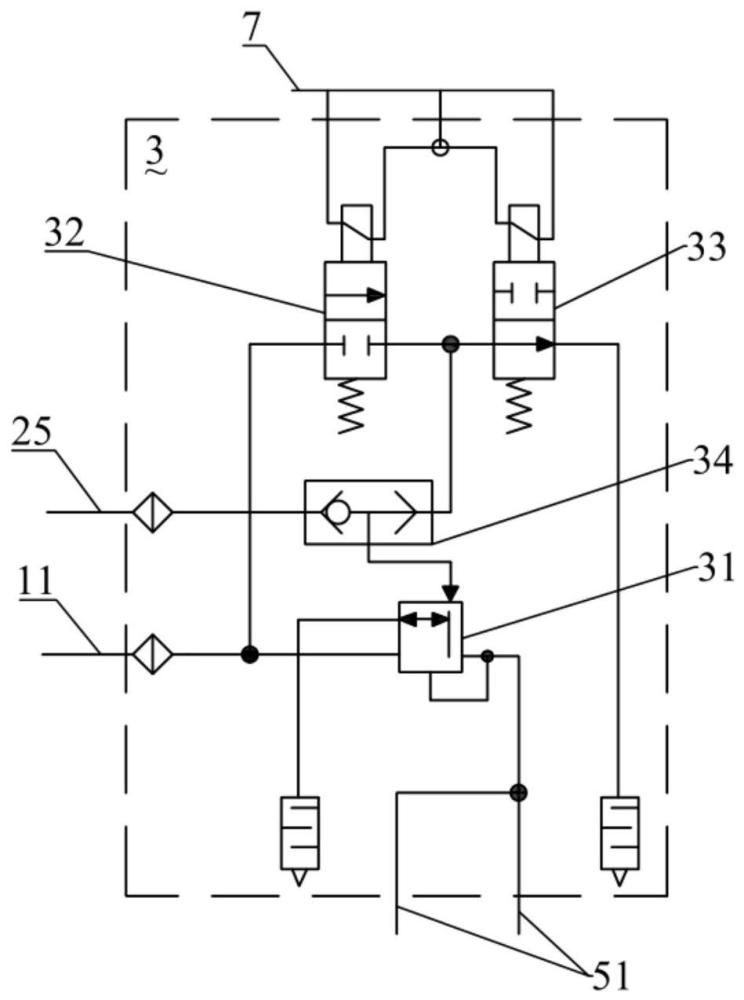
    图2是本发明提供的前桥控制组件的结构示意图;

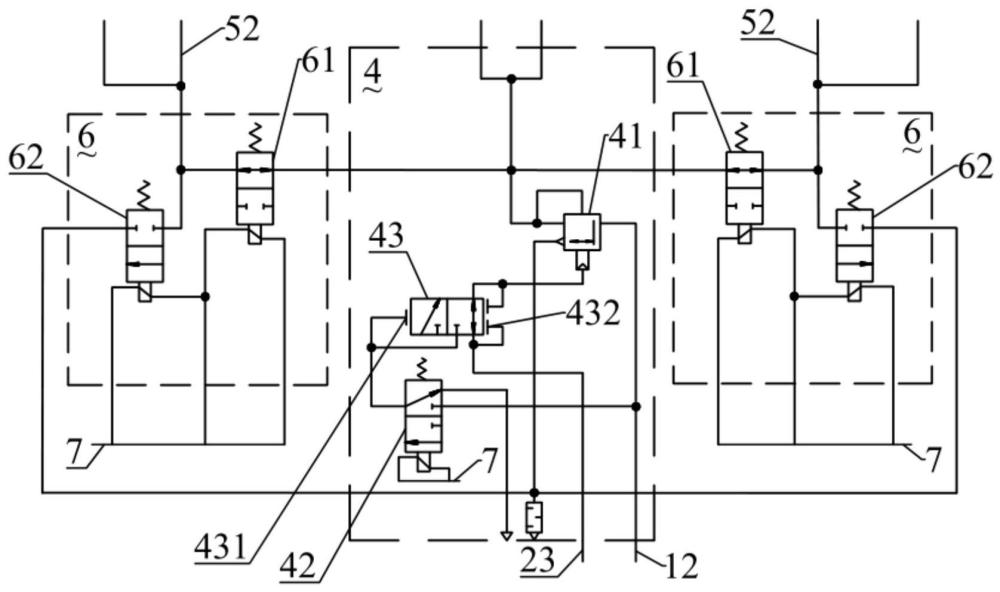
    图3是本发明提供的后桥控制组件的结构示意图;

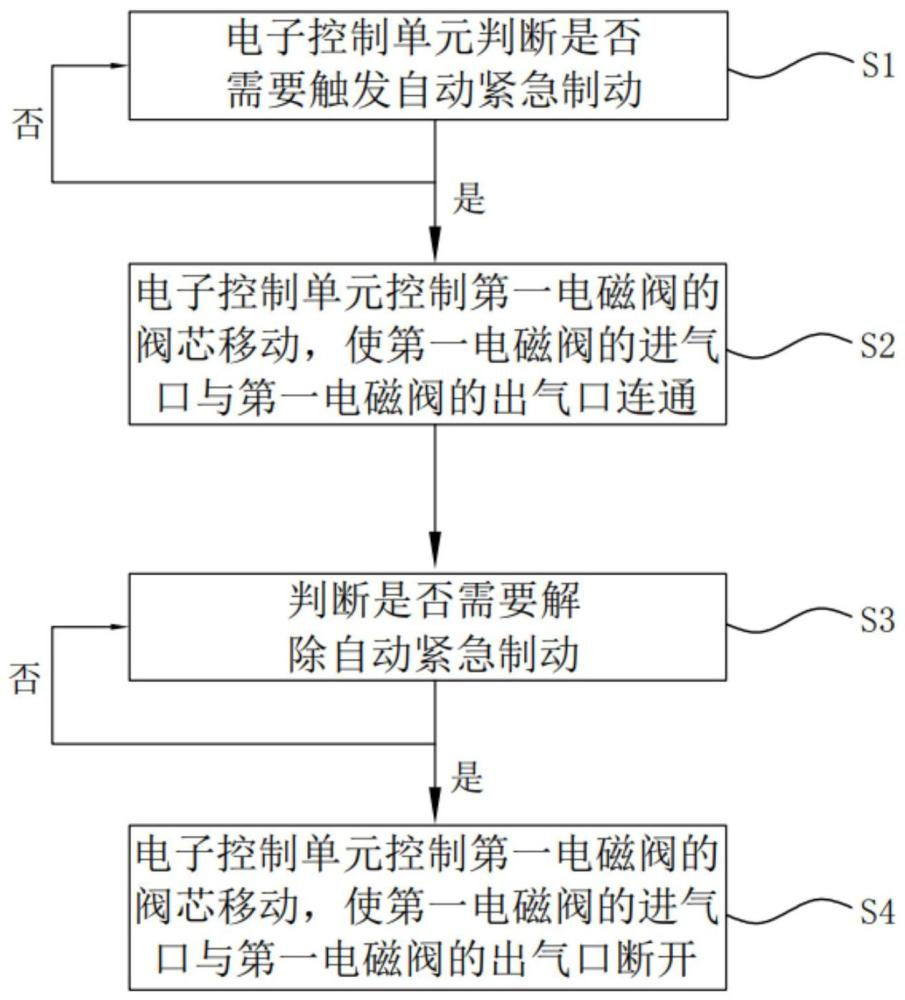
    图4是本发明提供的制动方法的流程图。

    图中:

    100、车轮;101、前桥;102、后桥;

    2、制动阀;3、前桥控制组件;4、后桥控制组件;6、ABS电磁阀;7、电子控制单元;8、轮速传感器;9、压力传感器;

    11、第一储气筒;12、第二储气筒;21、制动踏板;22、第一制动进气口;23、第一制动出气口;24、第二制动进气口;25、第二制动出气口;31、前桥继动阀;32、第一电磁阀;33、第二电磁阀;34、双通单向阀;41、后桥继动阀;42、第三电磁阀;43、两位三通阀;51、制动气室;52、弹簧制动缸;61、第四电磁阀;62、第五电磁阀;

    431、第一控制口;432、第二控制口。

    具体实施方式

    下面详细描述本发明的实施例,实施例的示例在附图中示出,其中自始至终相同或类似的标号表示相同或类似的元件或具有相同或类似功能的元件。下面通过参考附图描述的实施例是示例性的,旨在用于解释本发明,而不能理解为对本发明的限制。

    在本发明的描述中,需要说明的是,术语“中心”、“上”、“下”、“左”、“右”、“竖直”、“水平”、“内”、“外”等指示的方位或位置关系为基于附图所示的方位或位置关系,仅是为了便于描述本发明和简化描述,而不是指示或暗示所指的装置或元件必须具有特定的方位、以特定的方位构造和操作,因此不能理解为对本发明的限制。此外,术语“第一”、“第二”仅用于描述目的,而不能理解为指示或暗示相对重要性。其中,术语“第一位置”和“第二位置”为两个不同的位置。

    除非另有明确的规定和限定,术语“安装”、“相连”、“连接”、“固定”应做广义理解,例如,可以是固定连接,也可以是可拆卸连接;可以是机械连接,也可以是电连接;可以是直接相连,也可以通过中间媒介间接相连,可以是两个元件内部的连通或两个元件的相互作用关系。对于本领域的普通技术人员而言,可以根据具体情况理解上述术语在本发明中的具体含义。

    除非另有明确的规定和限定,第一特征在第二特征之“上”或之“下”可以包括第一特征和第二特征直接接触,也可以包括第一特征和第二特征不是直接接触而是通过它们之间的另外的特征接触。而且,第一特征在第二特征“之上”、“上方”和“上面”包括第一特征在第二特征正上方和斜上方,或仅仅表示第一特征水平高度高于第二特征。第一特征在第二特征“之下”、“下方”和“下面”包括第一特征在第二特征正下方和斜下方,或仅仅表示第一特征水平高度小于第二特征。

    下面结合附图并通过具体实施方式来进一步说明本发明的技术方案。

    如图1所示,通常来说,商用车的制动系统包括供气组件、制动阀2以及气动制动件,供气组件通过制动阀2与气动制动件连通,制动阀2包括制动阀芯、制动进气口与制动出气口,制动阀芯连接有制动踏板21,制动阀芯通过移动能够连通或断开制动进气口与制动出气口,制动进气口与供气组件连通,制动出气口与气动制动件连通。

    当驾驶员踩踏制动踏板21时,制动阀2的制动阀芯移动,使制动进气口与制动出气口连通,供气组件内的高压气体能够进入气动制动件,气动制动件即可为车轮100提供制动力,从而使车辆减速。

    然而,车辆的最大减速度与路面的附着系数相关,根据经验得知,当车轮100与地面之间的滑移率保持在10%~20%时,附着系数最大,也就是车辆的减速度能够达到最大,从而大大降低车辆的刹车距离。为了能够最大限度的减小车辆的刹车距离,车辆的制动系统还包括ABS(Antilock Brake System,防抱死制动系统)电磁阀、电子控制单元7以及轮速传感器8,其中,轮速传感器8和ABS电磁阀6均与电子控制单元7通讯连接,制动出气口通过ABS电磁阀6与气动制动件连通,轮速传感器8能够感应车轮100的转动情况,电子控制单元7根据轮速传感器8的感应结果控制ABS电磁阀6的通断,改变气动制动件内的气压,从而调节车轮100上的制动力大小,实现对车轮100滑移率的控制。

    优选地,该制动系统还包括压力传感器9,压力传感器9与电子控制单元7通讯连接,压力传感器9用于检测气动制动件内的气压,从而使电子控制单元7对车轮100的制动力的控制更精确。

    可以理解的是,车辆具有多个车轮100,通常来说,车辆包括前桥101与后桥102,前桥101连接有两个车轮100,后桥102连接有两个车轮100。故该制动系统包括四个轮速传感器8和四个压力传感器9,而在车辆制动的过程中,前桥101能够提供的制动力要明显大于后桥102能够提供的制动力,故前桥101的气动制动件为制动气室51,后桥102的气动制动件为弹簧制动缸52。同理,每个气动制动件与供气组件之间均设置有ABS电磁阀6,以单独控制每一个车轮100的滑移率。其中,电子控制单元7对车轮100的滑移率以及制动力的控制均为成熟技术,此处不再赘述。

    随着汽车主动安全技术的发展,车辆智能化已经成为国家战略。自动紧急制动技术(Autonomous Emergency Braking,AEB)是实现车辆智能化的重要手段,在降低交通事故和提升驾驶安全方面发挥了至关重要的作用,使得自动紧急制动技术已经成为驾驶辅助系统中的一项重要功能。

    如图1和图2所示,本实施例提供的制动系统还包括前桥控制组件3,前桥控制组件3包括前桥继动阀31与第一电磁阀32,前桥继动阀31的进气口和第一电磁阀32的进气口均与供气组件连通,前桥继动阀31的出气口与前桥101的气动制动件连通,具体的,前桥继动阀31的出气口与制动气室51连通,制动出气口以及第一电磁阀32的出气口均与前桥继动阀31的控制口连通,电子控制单元7被配置为控制第一电磁阀32的通断。

    该制动系统中,驾驶员可以通过踩踏制动踏板21使制动进气口与制动出气口连通,供气组件中的高压气体通过制动阀2进入前桥继动阀31的控制口,使得前桥继动阀31的进气口与出气口连通,供气组件中的高压气体即可进入制动气室51并对前车轮100进行制动。

    该制动系统还能够在电子控制单元7判断需要自动紧急制动时,控制第一电磁阀32的阀芯移动,使第一电磁阀32的进气口与出气口连通,此时供气组件内的高压气体能够通过第一电磁阀32进入前桥继动阀31的控制口,从而推动前桥继动阀31的阀芯移动,使前桥继动阀31的进气口与出气口连通,则供气组件内的高压气体进入制动气室51实施对车辆的制动。

    该制动系统能够实现车辆的自动紧急制动,且只需要在现有的具有继动阀的制动系统的基础上增加第一电磁阀32,无需更改硬件架构,硬件成本低且更易量产实现。

    优选地,前桥控制组件3还包括第二电磁阀33,第二电磁阀33的进气口与第一电磁阀32的出气口连通,电子控制单元7被配置为控制第二电磁阀33的通断。当车辆触发自动紧急制动后,若风险排除并继续行驶时,需要降低前桥101的制动气室51内的气压时,电子控制单元7控制第二电磁阀33的阀芯移动,使第二电磁阀33的进气口与出气口连通,此时进入前桥继动阀31的控制口的气体就能够通过第二电磁阀33排出,使得前桥继动阀31能够关闭以停止对前桥101的制动气室51提供高压气体,同时前桥101对应的ABS电磁阀6将前桥101的制动气室51内的气体排出,即可解除对前桥101连接的车轮100的制动。

    进一步地,第一电磁阀32与第二电磁阀33的通断状态相反。当第一电磁阀32打开且第二电磁阀33关闭时,该制动系统处于自动紧急制动的状态,而当第二电磁阀33打开且第一电磁阀32关闭时,该制动系统解除自动紧急制动。

    优选地,前桥控制组件3还包括双通单向阀34,双通单向阀34的一个进气口与制动出气口连通,双通单向阀34的另一个进气口与第一电磁阀32的出气口连通,双通单向阀34的出气口与前桥继动阀31的控制口连通。双通单向阀34的特点就是气压高的进气口会与出气口连通,也就是说,第一电磁阀32的出气口和制动出气口中仅有一个能够与双通单向阀34的出气口连通,从而防止第一电磁阀32关闭时,制动出气口的高压气体通过第二电磁阀33排出,导致无法正常打开前桥继动阀31,避免了驾驶员踩踏制动踏板21时无制动力的情况。

    如图1和图2所示,制动系统还包括后桥控制组件4,后桥控制组件4包括后桥继动阀41与第三电磁阀42,后桥继动阀41的进气口和第三电磁阀42的进气口均与供气组件连通,后桥继动阀41的出气口与后桥102的气动制动件连通,也就是后桥继动阀41的出气口与弹簧制动缸52连通,制动出气口以及第三电磁阀42的出气口均与后桥继动阀41的控制口连通,电子控制单元7被配置为控制第三电磁阀42的通断。

    该制动系统中,当驾驶员踩踏制动踏板21时,供气组件中的高压气体通过制动阀2进入后桥继动阀41的控制口,使得后桥继动阀41的进气口与出气口连通,供气组件中的高压气体即可进入弹簧制动缸52并对后车轮100进行制动。

    该制动系统还能够在电子控制单元7判断需要自动紧急制动时,控制第三电磁阀42的阀芯移动,使第三电磁阀42的进气口与出气口连通,此时供气组件内的高压气体能够通过第三电磁阀42进入后桥继动阀41的控制口,从而推动后桥继动阀41的阀芯移动,使后桥继动阀41的进气口与出气口连通,则供气组件内的高压气体进入弹簧制动缸52实施对车辆的制动。

    优选地,制动阀芯通过滑动具有第三位置与第四位置,制动进气口包括第一制动进气口22与第二制动进气口24,制动出气口包括第一制动出气口23与第二制动出气口25。

    制动阀芯位于第三位置时,第一制动进气口22与第一制动出气口23连通,制动阀芯位于第四位置时,第一制动进气口22与第一制动出气口23连通,且第二制动进气口24与第二制动出气口25连通,第一制动进气口22和第二制动进气口24均与供气组件连通,第一制动出气口23与后桥继动阀41的控制口连通,第二制动出气口25与前桥继动阀31的控制口连通。

    由于前桥101能够提供的制动力要明显大于后桥102能够提供的制动力,故当驾驶员仅需要使车辆缓慢减速时,踩踏制动踏板21的行程较小,此时制动阀芯位于第三位置,第一制动进气口22与第一制动出气口23连通,高压气体能够进入后桥继动阀41的控制口,此时仅需要对后桥102连接的车轮100施加制动力即可;当驾驶员需要使车辆快速减速甚至急刹车时,踩踏制动踏板21的行程较大,此时制动阀芯位于第四位置,第一制动进气口22与第一制动出气口23连通,且第二制动进气口24与第二制动出气口25连通,高压气体能够同时进入前桥继动阀31的控制口和后桥继动阀41的控制口,同时对前桥101连接的车轮100和后桥102连接的车轮100施加制动力。

    优选地,供气组件包括第一储气筒11与第二储气筒12,第一储气筒11分别与前桥继动阀31的进气口、第一电磁阀32的进气口以及第一制动进气口22连通,第二储气筒12分别与后桥继动阀41的进气口、第三电磁阀42的进气口以及第二制动进气口24连通。通过设置两个储气筒,能够增加安全冗余,即便其中一个储气筒故障,也能够通过另一个储气筒的高压气体进行制动。

    当然,若第二储气筒12故障导致气压降低,虽然不足以提供制动力,但能够通过前桥继动阀31的控制口打开前桥继动阀31,则驾驶员踩踏制动踏板21时,第一储气筒11内的高压气体能够通过前桥继动阀31进入制动气室51,从而提供制动力。若第二储气筒12故障导致气压不足以通过前桥继动阀31的控制口打开前桥继动阀31,该制动系统也能够通过触发自动紧急制动,电子控制单元7打开第一电磁阀32,使第一储气筒11内的高压气体进入前桥继动阀31的控制口以打开前桥继动阀31,此时第一储气筒11内的高压气体能够通过前桥继动阀31进入制动气室51,从而提供制动力。

    同理,当第一储气筒11故障时,制动原理类似,此处不在赘述。

    具体的,第三电磁阀42为两位三通电磁阀,第三电磁阀42的阀芯位于第一位置时,第三电磁阀42的进气口与第三电磁阀42的出气口连通,第三电磁阀42的阀芯位于第二位置时,第三电磁阀42的出气口与第三电磁阀42的排气口连通,电子控制单元7被配置为控制第三电磁阀42的阀芯在第一位置与第二位置间切换。

    当电子控制单元7判断需要自动紧急制动时,电子控制单元7控制第三电磁阀42的阀芯处于第一位置,第二储气筒12的高压气体能够通过第三电磁阀42进入后桥继动阀41的控制口,推动后桥继动阀41的阀芯移动,使后桥继动阀41的进气口与出气口连通,则第二储气筒12内的高压气体能够进入弹簧制动缸52实施对车辆的制动。

    当车辆触发自动紧急制动后,若风险排除并继续行驶时,需要降低弹簧制动缸52内的气压时,电子控制单元7控制第三电磁阀42的阀芯移动至第二位置,使第三电磁阀42的出气口与排气口连通,此时进入后桥继动阀41的控制口的高压气体就能够通过第三电磁阀42的排气口排出,使得后桥继动阀41能够关闭以停止对弹簧制动缸52提供高压气体,同时后桥102对应的ABS电磁阀6将弹簧制动缸52内的气体排出,即可解除对后桥102连接的车轮100的制动。

    可以理解的是,前桥制动组件3的第一电磁阀32与第二电磁阀33实现的功能与后桥制动组件4的第三电磁阀42相同,在一些实施例中,前桥制动组件3的第一电磁阀32与第二电磁阀33可以替换为第三电磁阀42,后桥制动组件4的第三电磁阀42可以替换为第一电磁阀32与第二电磁阀33,也能够实现自动紧急制动以及排气防止车轮100抱死。

    进一步地,后桥控制组件4还包括两位三通阀43,两位三通阀43的一个进气口与制动出气口连通,具体的,两位三通阀43的一个进气口与第一制动出气口23连通,两位三通阀43的另一个进气口与第三电磁阀42的出气口连通,两位三通阀43的出气口与后桥继动阀41的控制口连通,第三电磁阀42的出气口还与两位三通阀43的第一控制口431连通,以推动两位三通阀43的阀芯,使两位三通阀43连接第三电磁阀42的出气口的进气口与两位三通阀43的出气口连通。

    当触发自动紧急制动时,第三电磁阀42的进气口与出气口连通,高压气体通过第一控制口431推动两位三通阀43的阀芯,使得高压气体能够通过两位三通阀43进入后桥继动阀41的控制口,后桥继动阀41打开,高压气体通过后桥继动阀41进入弹簧制动缸52对车轮100实施制动;当需要解除自动紧急制动时,第三电磁阀42的出气口与排气口连通,后桥继动阀41的控制口的高压气体通过第三电磁阀42的排气口排出,后桥继动阀41关闭以停止对弹簧制动缸52提供高压气体,同时后桥102对应的ABS电磁阀6将弹簧制动缸52内的气体排出,即可解除对后桥102连接的车轮100的制动。

    该两位三通阀43使得第三电磁阀42的出气口和第一制动出气口23中,仅有一个能够与后桥继动阀41的控制口连通,从而防止第三电磁阀42的出气口和第一制动出气口23连通而引起的高压气体通过第三电磁阀42的排气口排出,导致无法正常打开后桥继动阀41,避免了驾驶员踩踏制动踏板21时无制动力的情况。

    进一步地,制动出气口还与两位三通阀43的第二控制口432连通,以推动两位三通阀43的阀芯,使两位三通阀43连接第一制动出气口23的进气口与两位三通阀43的出气口连通。当驾驶员踩踏制动踏板21时,高压气体通过第一制动出气口23进入两位三通阀43的第二控制口432,从而使两位三通阀43连接第一制动出气口23的进气口与两位三通阀43的出气口连通,高压气体能够顺利进入后桥继动阀41的控制口。

    在本实施例中,后桥102对应的ABS电磁阀6包括第四电磁阀61与第五电磁阀62,第四电磁阀61的进气口与后桥继动阀41的出气口连通,第四电磁阀61的出气口以及第五电磁阀62的进气口与弹簧制动缸52连通,电子控制单元7被配置为控制第四电磁阀61和第五电磁阀62的通断。

    其中,无论是自动紧急制动还是驾驶员踩踏制动踏板21,第四电磁阀61打开,高压气体都会通过第四电磁阀61进入弹簧制动缸52,而第五电磁阀62打开,弹簧制动缸52内的高压气体又会通过第五电磁阀62的出气口排出降低制动力。电子控制单元7通过切换第四电磁阀61与第五电磁阀62的通断配合,即可控制弹簧制动缸52内的气压,从而调节后桥102的车轮100的制动力。

    其中,第四电磁阀61与第五电磁阀62的通断状态相反,以防止第四电磁阀61与第五电磁阀62同时打开时无法正常提供制动力,以及第四电磁阀61与第五电磁阀62同时关闭时,无法解除制动。

    如图4所示,本实施例还提供了一种制动方法,用于上述的制动系统,该制动方法包括:

    S1:电子控制单元7判断是否需要触发自动紧急制动,若是,执行步骤S2;

    S2:电子控制单元7控制第一电磁阀32的阀芯移动,使第一电磁阀32的进气口与第一电磁阀32的出气口连通;

    S3:判断是否需要解除自动紧急制动,若是,执行步骤S4;

    S4:电子控制单元7控制第一电磁阀32的阀芯移动,使第一电磁阀32的进气口与第一电磁阀32的出气口断开。

    当第一电磁阀32的进气口与出气口连通,供气组件内的高压气体能够进入前桥继动阀31的控制口,使前桥继动阀31的进气口与出气口连通,供气组件内的高压气体进入制动气室51实施自动紧急制动。当第一电磁阀32的进气口与出气口断开,供气组件内的高压气体无法进入前桥继动阀31的控制口,则供气组件内的高压气体也就无法通过前桥继动阀31进入制动气室51,从而解除自动紧急制动。

    其中,电子控制单元7能够通过设置在车辆上的传感器获取车辆与前方障碍物的相对速度以及距离,从而计算出车辆是否需要进行自动紧急制动。其中,传感器包括摄像头、雷达等。

    优选地,步骤S3中,若驾驶员踩踏制动踏板21或车辆的速度小于或等于前方障碍物的速度,则解除自动紧急制动。当驾驶员踩踏制动踏板21时,电子控制单元7将车辆的控制权交还给驾驶员,或者当判断车辆不会与前方障碍物发生碰撞时,均需要解除自动紧急制动。

    进一步地,步骤S2还包括电子控制单元7控制第二电磁阀33的阀芯移动,使第二电磁阀33的进气口与第二电磁阀33的出气口断开。步骤S4还包括电子控制单元7控制第二电磁阀33的阀芯移动,使第二电磁阀33的进气口与第二电磁阀33的出气口连通。

    当需要触发自动紧急制动时,第二电磁阀33的进气口与出气口断开,保证供气组件内的高压气体能够进入前桥继动阀31的控制口,使前桥继动阀31的进气口与出气口连通;而当需要解除自动紧急制动时,第二电磁阀33的进气口与出气口连通,保证进入前桥继动阀31的控制口的高压气体能够通过第二电磁阀33排出,从而解除自动紧急制动。

    优选地,当电子控制单元7判断需要触发自动紧急制动时,还包括步骤S21:电子控制单元7控制第三电磁阀42的阀芯移动,使第三电磁阀42的进气口与第三电磁阀42的出气口连通,供气组件内的高压气体能够进入后桥继动阀41的控制口,使后桥继动阀41的进气口与出气口连通,供气组件内的高压气体进入弹簧制动缸52实施自动紧急制动。

    进一步地,当电子控制单元7判断需要解除自动紧急制动时,还包括步骤S41:电子控制单元7控制第三电磁阀42的阀芯移动,使第三电磁阀42的出气口与第一电磁阀32的排气口连通,保证进入后桥继动阀41的控制口的高压气体能够通过第三电磁阀42排出,从而解除自动紧急制动。

    可以理解的是,步骤S1中,若否,则继续重复步骤S1;步骤S3中,若否,则继续重复步骤S3。

    以上内容仅为本发明的较佳实施例,对于本领域的普通技术人员,依据本发明的思想,在具体实施方式及应用范围上均会有改变之处,本说明书内容不应理解为对本发明的限制。

    一种制动系统、车辆及制动方法

    Technical field

    The present invention relates to the field of vehicle emergency braking technology, in particular to a braking system, vehicle and braking method.

    Background technology

    With the development of automotive active safety technology, vehicle intelligence has become an important aspect of automotive product strength. Autonomous Emergency Braking (AEB) is an important means to realize vehicle intelligence, which plays a vital role in reducing traffic accidents and improving driving safety, making automatic emergency braking technology an important function in driver assistance systems (ADAS).

    On the one hand, the vehicle's automatic emergency braking technology can avoid traffic accidents caused by fatigue driving, and on the other hand, it can support future electric braking technology, especially driverless technology. At present, most of the automatic emergency braking functions of vehicles on the market are based on the electric control brakes (EBS), which is expensive and cannot be modified and adapted to older models.

    To solve the above problems, it is necessary to develop a braking system, vehicle and braking method.

    Invention content

    Object of the present invention is to propose a braking system, vehicle and braking method, which can realize automatic emergency braking of vehicles, and only need to add a first solenoid valve on the basis of the existing braking system with a relay valve, without changing the hardware architecture, low hardware cost and easier to mass production implementation.

    To achieve this object, the present invention adopts the following technical solution:

    A braking system comprising:

    gas supply components;

    brake valve, including a brake spool, a brake air inlet and a brake outlet, the brake valve spool is connected to a brake pedal, the brake valve spool can communicate or disconnect the brake air intake port and the brake outlet by moving, and the brake air intake port is connected with the air supply assembly;

    the front axle control assembly, including a front axle relay valve and a first solenoid valve, the air inlet of the front axle relay valve and the air inlet of the first solenoid valve are connected with the air supply assembly, the air outlet of the front axle relay valve is connected with the pneumatic brake parts of the front axle, the brake outlet port and the outlet of the first solenoid valve are connected with the control port of the front axle relay valve;

    Electronic control unit, the electronic control unit is configured to control the on-off of the first solenoid valve.

    In some embodiments, the front axle control assembly further comprises a second solenoid valve, the inlet of the second solenoid valve is connected with the outlet of the first solenoid valve, and the electronic control unit is configured to control the on-off of the second solenoid valve.

    In some embodiments, the first solenoid valve is opposite to the on-off state of the second solenoid valve.

    In some embodiments, the front axle control assembly further comprises a double-way check valve, one inlet of the double-way check valve is connected with the brake outlet, the other inlet of the double-way check valve is connected with the outlet of the first solenoid valve, and the outlet of the double-way check valve is connected with the control port of the front axle relay valve.

    In some embodiments, the braking system further comprises a rear axle control assembly, the rear axle control assembly comprises a rear axle relay valve and a third solenoid valve, the air inlet of the rear axle relay valve and the air inlet of the third solenoid valve are connected with the air supply assembly, the outlet of the rear axle relay valve is connected with the pneumatic brake of the rear axle, the brake outlet and the outlet of the third solenoid valve are connected with the control port of the rear axle relay valve, and the electronic control unit is configured to control the opening and breaking of the third solenoid valve.

    In some embodiments, the third solenoid valve is a two-position three-way solenoid valve, when the spool of the third solenoid valve is located in the first position, the inlet port of the third solenoid valve is connected with the outlet port of the third solenoid valve, when the spool of the third solenoid valve is located in the second position, the outlet port of the third solenoid valve is connected with the exhaust port of the third solenoid valve, and the electronic control unit is configured to control the spool of the third solenoid valve to switch between the first position and the second position.

    In some embodiments, the rear axle control assembly further comprises a two-bit three-way valve, one inlet port of the two-position three-way valve is connected with the brake outlet, the other inlet port of the two-position three-way valve is connected with the outlet port of the third solenoid valve, the outlet port of the two-position three-way valve is connected with the control port of the rear axle relay valve, and the outlet port of the third solenoid valve is also connected with the first control port of the two-position three-way valve to push the spool of the two-position three-way valve, The inlet port connecting the two-position three-way valve to the outlet of the third solenoid valve is connected with the outlet of the two-position three-way valve.

    In some embodiments, the brake valve spool has a third position and a fourth position by sliding, the brake air intake includes a first brake air intake and a second brake air intake, the brake air outlet includes a first brake outlet and a second brake air outlet, when the brake valve core is located in the third position, the first brake air intake port is connected with the first brake air outlet, and when the brake valve core is located in the fourth position, the first brake air intake port is connected with the first brake air outlet, and the second brake air intake is connected with the second brake air outlet, the first brake air intake port and the second brake air intake port are connected with the air supply assembly, the first brake outlet is connected with the control port of the rear axle relay valve, and the second brake outlet is connected with the control port of the front axle relay valve.

    In some embodiments, the gas supply assembly comprises a first gas reservoir and a second gas reservoir, the first gas reservoir is respectively connected with the air inlet of the front axle relay valve, the air inlet of the first solenoid valve, and the first brake air intake, and the second air reservoir is respectively connected with the air inlet of the rear axle relay valve, the air intake port of the third solenoid valve, and the second brake air intake.

    A vehicle in which the vehicle includes the braking system.

    A braking method for the braking system, the braking method comprising:

    S1: The electronic control unit determines whether automatic emergency braking needs to be triggered;

    S2: If yes, the electronic control unit controls the movement of the spool of the first solenoid valve so that the inlet port of the first solenoid valve is connected with the outlet port of the first solenoid valve;

    S3: Determine whether automatic emergency braking needs to be released;

    S4: If yes, the electronic control unit controls the movement of the spool of the first solenoid valve so that the inlet port of the first solenoid valve is disconnected from the outlet of the first solenoid valve.

    In some embodiments, the step S3, if the driver presses the brake pedal or the speed of the vehicle is less than or equal to the speed of the obstacle ahead, the automatic emergency braking is released.

    Beneficial effects of the present invention:

    The present invention provides a braking system, a vehicle and a braking method. In the braking system, the driver can brake the vehicle by stepping on the brake pedal so that the high-pressure gas in the air supply component enters the pneumatic brake parts of the front axle, and can also control the spool of the first solenoid valve to move when the electronic control unit judges the need for emergency braking, so that the inlet port of the first solenoid valve is connected with the air outlet, at this time, the high-pressure gas in the gas supply component can enter the control port of the front axle relay valve through the first solenoid valve, thereby pushing the spool of the front axle relay valve to move, so that the inlet port of the front axle relay valve is connected with the air outlet. The high-pressure gas in the air supply assembly enters the pneumatic brake of the front axle to brake the vehicle.

    The braking system can realize the automatic emergency braking of the vehicle, and only need to add the first solenoid valve to the existing braking system with relay valve, without changing the hardware architecture, the hardware cost is low and it is easier to mass production.

    Description of the drawings

    FIG 1 is a schematic diagram of the structure of the braking system provided by the present invention;

    FIG 2 is a schematic diagram of the structure of the front axle control assembly provided by the present invention;

    FIG 3 is a schematic diagram of the structure of the rear axle control assembly provided by the present invention;

    FIG 4 is a flowchart of the braking method provided by the present invention.

    In the picture:

    100. Wheels; 101, front axle; 102, rear axle;

    2. Brake valve; 3. Front axle control component; 4. Rear axle control component; 6. ABS solenoid valve; 7. Electronic control unit; 8. Wheel speed sensor; 9. Pressure sensor;

    11. The first gas storage cylinder; 12. Second gas reservoir; 21. Brake pedal; 22. First brake air intake; 23. First brake outlet; 24. Second brake air intake; 25. Second brake outlet; 31. Front axle relay valve; 32. First solenoid valve; 33. Second solenoid valve; 34. Double way check valve; 41. Rear axle relay valve; 42. Third solenoid valve; 43. Two-position three-way valve; 51. Brake chamber; 52. Spring brake cylinder; 61. Fourth solenoid valve; 62. Fifth solenoid valve;

    431, first control port; 432, second control port.

    Specific embodiment

    Embodiments of the present invention are described in detail below, examples of embodiments are shown in the drawings, wherein the same or similar designator indicates the same or similar element or element having the same or similar function from beginning to end. The embodiments described below by reference to the accompanying drawings are exemplary and intended to be used to explain the present invention and cannot be understood as limitations on the present invention.

    In the description of the present invention, it should be noted that the terms "center", "up", "down", "left", "right", "vertical", "horizontal", "inside", "outside" and the like indicate the orientation or position relationship based on the orientation or position relationship shown in the drawings, only for the convenience of describing the present invention and simplifying the description, not to indicate or imply that the device or element referred to must have a specific orientation, constructed and operated in a particular orientation, so it cannot be understood as a limitation of the present invention. In addition, the terms "first", "second" are for descriptive purposes only and cannot be understood as indicating or implying relative importance. Among them, the terms "first position" and "second position" are two different locations.

    Unless expressly and qualified otherwise, the terms "installation", "connection", "connection", "fixation" shall be understood in a broad sense, for example, it may be a fixed connection or a detachable connection; It can be a mechanical connection or an electrical connection; It can be directly connected or indirectly connected through an intermediate medium, and it can be a connection within two elements or an interaction relationship between two elements. For those of ordinary skill in the art, the specific meaning of the above terms in the present invention may be understood according to the specific circumstances.

    Unless expressly provided and qualified otherwise, the first feature "above" or "below" the second feature may include direct contact between the first feature and the second feature, or may include that the first feature and the second feature are not in direct contact but through another feature between them. Moreover, the first feature "above", "above", and "above" the second feature includes the first feature directly above and diagonally above the second feature, or simply indicates that the first feature is horizontal above the second feature. The first feature "below", "below", and "below" includes the first feature directly below and diagonally below the second feature, or simply indicates that the horizontal height of the first feature is less than the second feature.

    The following in conjunction with the accompanying drawings and further illustrate the technical solution of the present invention by a specific embodiment.

    As shown in FIG. 1, in general, the braking system of a commercial vehicle includes an air supply component, a brake valve 2 and a pneumatic brake member, the air supply component is connected to the pneumatic brake part through the brake valve 2, the brake valve 2 includes a brake spool, a brake air intake port and a brake air outlet, the brake valve core is connected to the brake pedal 21, the brake valve core can be connected or disconnected from the brake air intake port and the brake outlet by moving, the brake air intake port is connected to the air supply component, and the brake outlet is connected with the pneumatic brake part.

    When the driver presses the brake pedal 21, the brake spool of the brake valve 2 moves, so that the brake intake port is connected with the brake outlet, and the high-pressure gas in the air supply assembly can enter the pneumatic brake parts, and the pneumatic brake parts can provide braking force for the wheel 100, thereby slowing down the vehicle.

    However, the maximum deceleration of the vehicle is related to the adhesion coefficient of the road surface, and it is known from experience that when the slip rate between the wheel 100 and the ground is maintained at 10%~20%, the adhesion coefficient is the largest, that is, the deceleration of the vehicle can reach the maximum, thereby greatly reducing the braking distance of the vehicle. In order to minimize the braking distance of the vehicle, the braking system of the vehicle also includes ABS (Antilock Brake System) solenoid valve, electronic control unit 7 and wheel speed sensor 8, of which the wheel speed sensor 8 and ABS solenoid valve 6 are connected with the electronic control unit 7, the brake outlet is connected with the pneumatic brake through the ABS solenoid valve 6, and the wheel speed sensor 8 can sense the rotation of the wheel 100. The electronic control unit 7 controls the on-off of the ABS solenoid valve 6 according to the induction results of the wheel speed sensor 8, changes the air pressure in the pneumatic brake, thereby adjusting the braking force on the wheel 100, and realizing the control of the slip rate of the wheel 100.

    Preferably, the braking system further comprises a pressure sensor 9, a pressure sensor 9 is connected to an electronic control unit 7, a pressure sensor 9 is used to detect air pressure within a pneumatic brake, so that the electronic control unit 7 controls the braking force of the wheel 100 more accurately.

    It is understood that the vehicle has a plurality of wheels 100, in general, the vehicle includes a front axle 101 and a rear axle 102, the front axle 101 is connected with two wheels 100, and the rear axle 102 is connected with two wheels 100. Therefore, the braking system includes four wheel speed sensors 8 and four pressure sensors 9, and in the process of vehicle braking, the front axle 101 can provide braking force is significantly greater than the rear axle 102 can provide braking force, so the pneumatic brake of the front axle 101 is the brake chamber 51, and the pneumatic brake of the rear axle 102 is the spring brake cylinder 52. Similarly, an ABS solenoid valve 6 is provided between each pneumatic brake and the air supply assembly to individually control the slip rate of 100 per wheel. Among them, the slip rate of the electronic control unit 7 to the wheel 100 and the control of the braking force are mature technologies and will not be repeated here.

    With the development of automotive active safety technology, vehicle intelligence has become a national strategy. Autonomous Emergency Braking (AEB) is an important means to realize vehicle intelligence, which plays a vital role in reducing traffic accidents and improving driving safety, making automatic emergency braking technology an important function in driver assistance systems.

    As shown in FIGS. 1 and 2, the braking system provided by the present embodiment further comprises a front axle control assembly 3, the front axle control assembly 3 includes a front axle relay valve 31 and a first solenoid valve 32, the air inlet of the front axle relay valve 31 and the first solenoid valve 32 are connected with the air supply assembly, the air outlet of the front axle relay valve 31 is connected with the pneumatic brake parts of the front axle 101, specifically, the air outlet of the front axle relay valve 31 is connected with the brake chamber 51, The brake outlet and the outlet of the first solenoid valve 32 are connected to the control port of the front axle relay valve 31, and the electronic control unit 7 is configured to control the on-off of the first solenoid valve 32.

    In this braking system, the driver can connect the brake air intake port with the brake outlet by pressing the brake pedal 21, and the high-pressure gas in the air supply assembly enters the control port of the front axle relay valve 31 through the brake valve 2, so that the air inlet port of the front axle relay valve 31 is connected with the air outlet, and the high-pressure gas in the air supply component can enter the brake air chamber 51 and brake the front wheel 100.

    The braking system can also control the spool movement of the first solenoid valve 32 when the electronic control unit 7 judges the need for automatic emergency braking, so that the inlet port of the first solenoid valve 32 is connected with the air outlet, at this time the high-pressure gas in the air supply assembly can enter the control port of the front axle relay valve 31 through the first solenoid valve 32, thereby pushing the spool of the front axle relay valve 31 to move, so that the inlet port of the front axle relay valve 31 is connected with the air outlet, then the high-pressure gas in the air supply component enters the brake chamber 51 to implement the braking of the vehicle.

    The braking system can realize automatic emergency braking of the vehicle, and only needs to add a first solenoid valve 32 to the existing braking system with a relay valve, without changing the hardware architecture, the hardware cost is low and it is easier to mass production.

    Preferably, the front axle control assembly 3 further comprises a second solenoid valve 33, the inlet of the second solenoid valve 33 is connected with the outlet of the first solenoid valve 32, and the electronic control unit 7 is configured to control the on-off of the second solenoid valve 33. When the vehicle triggers automatic emergency braking, if the risk is eliminated and continues to drive, it is necessary to reduce the air pressure in the brake chamber 51 of the front axle 101, the electronic control unit 7 controls the movement of the spool of the second solenoid valve 33, so that the inlet port of the second solenoid valve 33 is connected with the air outlet, at this time the gas entering the control port of the front axle relay valve 31 can be discharged through the second solenoid valve 33, so that the front axle relay valve 31 can be closed to stop the supply of high-pressure gas to the brake chamber 51 of the front axle 101, At the same time, the ABS solenoid valve 6 corresponding to the front axle 101 discharges the gas in the brake chamber 51 of the front axle 101, which can release the braking of the wheel 100 connected to the front axle 101.

    Further, the first solenoid valve 32 and the second solenoid valve 33 on and off state opposite. When the first solenoid valve 32 is opened and the second solenoid valve 33 is closed, the braking system is in a state of automatic emergency braking, and when the second solenoid valve 33 is opened and the first solenoid valve 32 is closed, the braking system releases the automatic emergency braking.

    Preferably, the front axle control assembly 3 further comprises a double-way check valve 34, one inlet of the double-way check valve 34 is connected to the brake outlet, the other inlet of the double-way check valve 34 is connected with the outlet of the first solenoid valve 32, and the outlet of the double-way check valve 34 is connected with the control port of the front axle relay valve 31. The feature of the double-way check valve 34 is that the air intake port with high air pressure will be connected with the air outlet, that is, only one of the outlet port and the brake outlet of the first solenoid valve 32 can communicate with the outlet of the double-way check valve 34, thereby preventing the first solenoid valve 32 from being closed, the high-pressure gas of the brake outlet is discharged through the second solenoid valve 33, resulting in the inability to open the front axle relay valve 31 normally, avoiding the situation that the driver does not have braking force when he steps on the brake pedal 21.

    As shown in FIGS. 1 and 2, the braking system further comprises a rear axle control assembly 4, the rear axle control assembly 4 includes a rear axle relay valve 41 and a third solenoid valve 42, the air inlet of the rear axle relay valve 41 and the inlet port of the third solenoid valve 42 are connected with the air supply assembly, the outlet of the rear axle relay valve 41 is connected with the pneumatic brake part of the rear axle 102, that is, the outlet of the rear axle relay valve 41 is connected with the spring brake cylinder 52, and the brake outlet port and the outlet of the third solenoid valve 42 are connected with the control port of the rear axle relay valve 41, The electronic control unit 7 is configured to control the on-off of the third solenoid valve 42.

    In this braking system, when the driver presses the brake pedal 21, the high-pressure gas in the air supply assembly enters the control port of the rear axle relay valve 41 through the brake valve 2, so that the air inlet port of the rear axle relay valve 41 is connected with the air outlet, and the high-pressure gas in the air supply assembly can enter the spring brake cylinder 52 and brake the rear wheel 100.

    The braking system can also control the spool movement of the third solenoid valve 42 when the electronic control unit 7 judges the need for automatic emergency braking, so that the inlet port of the third solenoid valve 42 is connected with the outlet port, at this time the high-pressure gas in the gas supply assembly can enter the control port of the rear axle relay valve 41 through the third solenoid valve 42, thereby pushing the spool of the rear axle relay valve 41 to move, so that the inlet port of the rear axle relay valve 41 is connected with the air outlet, then the high-pressure gas in the gas supply assembly enters the spring brake cylinder 52 to implement the braking of the vehicle.

    Preferably, the brake spool has a third position and a fourth position by sliding, the brake intake includes a first brake intake 22 and a second brake intake 24, the brake outlet includes a first brake outlet 23 and a second brake outlet 25.

    When the brake spool is located in the third position, the first brake intake port 22 is connected to the first brake outlet 23, when the brake spool is in the fourth position, the first brake intake port 22 is connected to the first brake outlet 23, and the second brake intake port 24 is connected to the second brake outlet 25, the first brake intake port 22 and the second brake intake port 24 are connected with the air supply assembly, the first brake outlet 23 is connected with the control port of the rear axle relay valve 41, and the second brake outlet 25 is connected with the control port of the front axle relay valve 31.

    Since the front axle 101 can provide the braking force is significantly greater than the rear axle 102 can provide the braking force, so when the driver only needs to slow down the vehicle, the stroke of the pedal 21 is smaller, at this time the brake spool is located in the third position, the first brake intake port 22 is connected with the first brake outlet 23, and the high-pressure gas can enter the control port of the rear axle relay valve 41, at this time only need to apply braking force to the wheel 100 connected to the rear axle 102; When the driver needs to make the vehicle quickly decelerate or even brake sharply, the stroke of the pedal 21 is larger, at this time the brake spool is located in the fourth position, the first brake intake port 22 is connected with the first brake outlet 23, and the second brake intake port 24 is connected with the second brake outlet 25, the high-pressure gas can simultaneously enter the control port of the front axle relay valve 31 and the control port of the rear axle relay valve 41, and at the same time apply braking force to the wheel 100 connected to the front axle 101 and the wheel 100 connected to the rear axle 102.

    Preferably, the air supply assembly comprises a first gas reservoir 11 and a second reservoir 12, the first reservoir 11 is connected to the inlet port of the front axle relay valve 31, the first solenoid valve 32 and the first brake inlet port 22, respectively, the second reservoir 12 is connected with the inlet port of the rear axle relay valve 41, the third solenoid valve 42 inlet port and the second brake intake port 24 respectively. Safety redundancy can be increased by setting up two cylinders, so that even if one of the cylinders fails, braking can be carried out by the high-pressure gas of the other cylinder.

    Of course, if the second gas reservoir 12 fails to reduce the air pressure, although it is not enough to provide braking force, but can open the front axle relay valve 31 through the control port of the front axle relay valve 31, then when the driver steps on the brake pedal 21, the high-pressure gas in the first gas reservoir 11 can enter the brake chamber 51 through the front axle relay valve 31, thereby providing braking force. If the second gas reservoir 12 fails to cause the air pressure is insufficient to open the front axle relay valve 31 through the control port of the front axle relay valve 31, the braking system can also be able to trigger automatic emergency braking, the electronic control unit 7 opens the first solenoid valve 32, so that the high-pressure gas in the first reservoir 11 enters the control port of the front axle relay valve 31 to open the front axle relay valve 31, at this time the high-pressure gas in the first gas reservoir 11 can enter the brake chamber 51 through the front axle relay valve 31, thereby providing braking force.

    Similarly, when the first gas reservoir 11 fails, the braking principle is similar, which is not repeated here.

    Specifically, the third solenoid valve 42 is a two-position three-way solenoid valve, when the spool of the third solenoid valve 42 is located in the first position, the inlet port of the third solenoid valve 42 is connected with the outlet port of the third solenoid valve 42, when the spool of the third solenoid valve 42 is located in the second position, the outlet of the third solenoid valve 42 is connected with the exhaust port of the third solenoid valve 42, and the electronic control unit 7 is configured to control the spool of the third solenoid valve 42 to switch between the first position and the second position.

    When the electronic control unit 7 judges that automatic emergency braking is required, the electronic control unit 7 controls the spool of the third solenoid valve 42 in the first position, and the high-pressure gas of the second gas reservoir 12 can enter the control port of the rear axle relay valve 41 through the third solenoid valve 42, and push the spool of the rear axle relay valve 41 to move, so that the inlet port of the rear axle relay valve 41 is connected with the air outlet, then the high-pressure gas in the second gas reservoir 12 can enter the spring brake cylinder 52 to implement the braking of the vehicle.

    When the vehicle triggers automatic emergency braking, if the risk is eliminated and continues to drive, when it is necessary to reduce the air pressure in the spring brake cylinder 52, the electronic control unit 7 controls the spool of the third solenoid valve 42 to move to the second position, so that the outlet of the third solenoid valve 42 is connected with the exhaust port, at this time the high-pressure gas entering the control port of the rear axle relay valve 41 can be discharged through the exhaust port of the third solenoid valve 42, so that the rear axle relay valve 41 can be closed to stop the supply of high-pressure gas to the spring brake cylinder 52, At the same time, the ABS solenoid valve 6 corresponding to the rear axle 102 discharges the gas in the spring brake cylinder 52, which can release the brake on the wheel 100 connected to the rear axle 102.

    It is understood that the first solenoid valve 32 and the second solenoid valve 33 of the front axle brake assembly 3 achieve the same function as the third solenoid valve 42 of the rear axle brake assembly 4, in some embodiments, the first solenoid valve 32 and the second solenoid valve 33 of the front axle brake assembly 3 may be replaced by a third solenoid valve 42, the third solenoid valve 42 of the rear axle brake assembly 4 may be replaced with a first solenoid valve 32 and a second solenoid valve 33, and can also achieve automatic emergency braking and exhaust prevention wheel 100 locking.

    Further, the rear axle control assembly 4 further comprises a two-position three-way valve 43, an inlet port of the two-position three-way valve 43 is connected to the brake outlet, specifically, one inlet port of the two-position three-way valve 43 is connected to the first brake outlet 23, the other inlet of the two-position three-way valve 43 is connected to the outlet of the third solenoid valve 42, the outlet of the two-position three-way valve 43 is connected to the control port of the rear axle relay valve 41, and the outlet of the third solenoid valve 42 is also connected with the first control port 431 of the two-position three-way valve 43, To push the spool of the two-position three-way valve 43, so that the two-position three-way valve 43 connects the inlet port of the outlet of the third solenoid valve 42 and the outlet port of the two-position three-way valve 43 is connected.

    When automatic emergency braking is triggered, the inlet port of the third solenoid valve 42 is connected with the outlet port, and the high-pressure gas pushes the spool of the two-position three-way valve 43 through the first control port 431, so that the high-pressure gas can enter the control port of the rear axle relay valve 41 through the two-position three-way valve 43, the rear axle relay valve 41 opens, and the high-pressure gas enters the spring brake cylinder 52 through the rear axle relay valve 41 to brake the wheel 100; When it is necessary to release the automatic emergency brake, the outlet of the third solenoid valve 42 is connected with the exhaust port, the high-pressure gas of the control port of the rear axle relay valve 41 is discharged through the exhaust port of the third solenoid valve 42, the rear axle relay valve 41 is closed to stop the supply of high-pressure gas to the spring brake cylinder 52, and the ABS solenoid valve 6 corresponding to the rear axle 102 discharges the gas in the spring brake cylinder 52, which can release the braking of the wheel 100 connected to the rear axle 102.

    The two-position three-way valve 43 makes only one of the outlet port of the third solenoid valve 42 and the first brake outlet 23 can communicate with the control port of the rear axle relay valve 41, thereby preventing the high-pressure gas caused by the connection between the outlet port of the third solenoid valve 42 and the first brake outlet 23 from being discharged through the exhaust port of the third solenoid valve 42, resulting in the inability to open the rear axle relay valve 41 normally, avoiding the situation that there is no braking force when the driver steps on the brake pedal 21.

    Further, the brake outlet is further connected with the second control port 432 of the two-position three-way valve 43 to push the spool of the two-position three-way valve 43, so that the two-position three-way valve 43 connects the first brake outlet 23 to the air inlet port and the two-position three-way valve 43 outlet port communicates. When the driver presses the brake pedal 21, the high-pressure gas enters the second control port 432 of the two-position three-way valve 43 through the first brake outlet 23, so that the two-position three-way valve 43 connects the air inlet port of the first brake outlet 23 and the outlet port of the two-way valve 43, and the high-pressure gas can smoothly enter the control port of the rear axle relay valve 41.

    In the present embodiment, the ABS solenoid valve 6 corresponding to the rear axle 102 includes a fourth solenoid valve 61 and a fifth solenoid valve 62, the inlet of the fourth solenoid valve 61 is connected with the outlet of the rear axle relay valve 41, the outlet of the fourth solenoid valve 61 and the inlet port of the fifth solenoid valve 62 is connected with the spring brake cylinder 52, and the electronic control unit 7 is configured to control the fourth solenoid valve 61 and the fifth solenoid valve 62 on and off.

    Among them, whether it is automatic emergency braking or the driver stepping on the brake pedal 21, the fourth solenoid valve 61 opens, the high-pressure gas will enter the spring brake cylinder 52 through the fourth solenoid valve 61, and the fifth solenoid valve 62 opens, the high-pressure gas in the spring brake cylinder 52 will be discharged through the outlet of the fifth solenoid valve 62 to reduce the braking force. The electronic control unit 7 by switching the fourth solenoid valve 61 and the fifth solenoid valve 62 on-off fit, can control the air pressure in the spring brake cylinder 52, thereby adjusting the braking force of the wheel 100 of the rear axle 102.

    Wherein the fourth solenoid valve 61 and the fifth solenoid valve 62 on and off state is opposite, to prevent the fourth solenoid valve 61 and the fifth solenoid valve 62 from being opened at the same time can not provide normal braking force, and the fourth solenoid valve 61 and the fifth solenoid valve 62 closed at the same time, can not release the brake.

    As shown in FIG. 4, the present embodiment also provides a braking method for the braking system described above, the braking method comprising:

    S1: The electronic control unit 7 determines whether automatic emergency braking needs to be triggered, if so, perform step S2;

    S2: The electronic control unit 7 controls the movement of the spool of the first solenoid valve 32, so that the inlet port of the first solenoid valve 32 is connected with the outlet port of the first solenoid valve 32;

    S3: Determine whether the automatic emergency brake needs to be released, if so, perform step S4;

    S4: The electronic control unit 7 controls the movement of the spool of the first solenoid valve 32 so that the inlet port of the first solenoid valve 32 is disconnected from the outlet of the first solenoid valve 32.

    When the inlet port of the first solenoid valve 32 is connected with the outlet port, the high-pressure gas in the gas supply assembly can enter the control port of the front axle relay valve 31, so that the air inlet port of the front axle relay valve 31 is connected with the air outlet, and the high-pressure gas in the gas supply component enters the brake chamber 51 to implement automatic emergency braking. When the inlet port of the first solenoid valve 32 is disconnected from the outlet port, the high-pressure gas in the gas supply assembly cannot enter the control port of the front axle relay valve 31, then the high-pressure gas in the gas supply assembly cannot enter the brake chamber 51 through the front axle relay valve 31, thereby releasing the automatic emergency braking.

    Among them, the electronic control unit 7 can obtain the relative speed and distance between the vehicle and the obstacle in front of the vehicle through the sensor installed on the vehicle, so as to calculate whether the vehicle needs automatic emergency braking. Among them, sensors include cameras, radar, etc.

    Preferably, step S3, if the driver presses the brake pedal 21 or the speed of the vehicle is less than or equal to the speed of the obstacle ahead, the automatic emergency braking is released. When the driver presses the brake pedal 21, the electronic control unit 7 returns control of the vehicle to the driver, or when it is judged that the vehicle will not collide with the obstacle ahead, the automatic emergency brake needs to be released.

    Further, step S2 further comprises an electronic control unit 7 to control the spool movement of the second solenoid valve 33, so that the inlet of the second solenoid valve 33 is disconnected from the outlet of the second solenoid valve 33. Step S4 further comprises an electronic control unit 7 to control the movement of the spool of the second solenoid valve 33, so that the inlet port of the second solenoid valve 33 is connected with the outlet of the second solenoid valve 33.

    When automatic emergency braking needs to be triggered, the inlet port of the second solenoid valve 33 is disconnected from the outlet port to ensure that the high-pressure gas in the air supply assembly can enter the control port of the front axle relay valve 31, so that the inlet port of the front axle relay valve 31 is connected with the air outlet; When it is necessary to release the automatic emergency brake, the inlet port of the second solenoid valve 33 is connected with the outlet port to ensure that the high-pressure gas entering the control port of the front axle relay valve 31 can be discharged through the second solenoid valve 33, thereby releasing the automatic emergency braking.

    Preferably, when the electronic control unit 7 determines that automatic emergency braking needs to be triggered, further comprising step S21: the electronic control unit 7 controls the movement of the spool of the third solenoid valve 42, so that the inlet port of the third solenoid valve 42 is connected with the outlet of the third solenoid valve 42, the high-pressure gas in the gas supply assembly can enter the control port of the rear axle relay valve 41, so that the inlet port of the rear axle relay valve 41 is connected with the air outlet, and the high-pressure gas in the gas supply assembly enters the spring brake cylinder 52 to implement automatic emergency braking.

    Further, when the electronic control unit 7 determines that automatic emergency braking needs to be released, further steps S41 are further included: the electronic control unit 7 controls the movement of the spool of the third solenoid valve 42, so that the outlet port of the third solenoid valve 42 is connected with the exhaust port of the first solenoid valve 32, ensuring that the high-pressure gas entering the control port of the rear axle relay valve 41 can be discharged through the third solenoid valve 42, thereby releasing the automatic emergency brake.

    Understandably, in Step S1, if not, continue to repeat Step S1; In Step S3, repeat Step S3 if not.

    The above content is only a better embodiment of the present invention, for those of ordinary skill in the art, according to the idea of the present invention, there will be changes in the specific embodiment and the scope of application, the content of the present specification should not be understood as a limitation of the present invention.

    Braking system, vehicle and braking method

    Technical field

    The present invention relates to the field of vehicle emergency braking technology, in particular to a braking system, vehicle and braking method.

    Background technology

    With the development of automotive active safety technology, vehicle intelligence has become an important aspect of automotive product strength. Autonomous Emergency Braking (AEB) is an important means to realize vehicle intelligence, which plays a vital role in reducing traffic accidents and improving driving safety, making automatic emergency braking technology an important function in driver assistance systems (ADAS).

    On the one hand, the vehicle's automatic emergency braking technology can avoid traffic accidents caused by fatigue driving, and on the other hand, it can support future electric braking technology, especially driverless technology. At present, most of the automatic emergency braking functions of vehicles on the market are based on the electric control brakes (EBS), which is expensive and cannot be modified and adapted to older models.

    To solve the above problems, it is necessary to develop a braking system, vehicle and braking method.

    Invention content

    Object of the present invention is to propose a braking system, vehicle and braking method, which can realize automatic emergency braking of vehicles, and only need to add a first solenoid valve on the basis of the existing braking system with a relay valve, without changing the hardware architecture, low hardware cost and easier to mass production implementation.

    To achieve this object, the present invention adopts the following technical solution:

    A braking system comprising:

    gas supply components;

    brake valve, including a brake spool, a brake air inlet and a brake outlet, the brake valve spool is connected to a brake pedal, the brake valve spool can communicate or disconnect the brake air intake port and the brake outlet by moving, and the brake air intake port is connected with the air supply assembly;

    the front axle control assembly, including a front axle relay valve and a first solenoid valve, the air inlet of the front axle relay valve and the air inlet of the first solenoid valve are connected with the air supply assembly, the air outlet of the front axle relay valve is connected with the pneumatic brake parts of the front axle, the brake outlet port and the outlet of the first solenoid valve are connected with the control port of the front axle relay valve;

    Electronic control unit, the electronic control unit is configured to control the on-off of the first solenoid valve.

    In some embodiments, the front axle control assembly further comprises a second solenoid valve, the inlet of the second solenoid valve is connected with the outlet of the first solenoid valve, and the electronic control unit is configured to control the on-off of the second solenoid valve.

    In some embodiments, the first solenoid valve is opposite to the on-off state of the second solenoid valve.

    In some embodiments, the front axle control assembly further comprises a double-way check valve, one inlet of the double-way check valve is connected with the brake outlet, the other inlet of the double-way check valve is connected with the outlet of the first solenoid valve, and the outlet of the double-way check valve is connected with the control port of the front axle relay valve.

    In some embodiments, the braking system further comprises a rear axle control assembly, the rear axle control assembly comprises a rear axle relay valve and a third solenoid valve, the air inlet of the rear axle relay valve and the air inlet of the third solenoid valve are connected with the air supply assembly, the outlet of the rear axle relay valve is connected with the pneumatic brake of the rear axle, the brake outlet and the outlet of the third solenoid valve are connected with the control port of the rear axle relay valve, and the electronic control unit is configured to control the opening and breaking of the third solenoid valve.

    In some embodiments, the third solenoid valve is a two-position three-way solenoid valve, when the spool of the third solenoid valve is located in the first position, the inlet port of the third solenoid valve is connected with the outlet port of the third solenoid valve, when the spool of the third solenoid valve is located in the second position, the outlet port of the third solenoid valve is connected with the exhaust port of the third solenoid valve, and the electronic control unit is configured to control the spool of the third solenoid valve to switch between the first position and the second position.

    In some embodiments, the rear axle control assembly further comprises a two-bit three-way valve, one inlet port of the two-position three-way valve is connected with the brake outlet, the other inlet port of the two-position three-way valve is connected with the outlet port of the third solenoid valve, the outlet port of the two-position three-way valve is connected with the control port of the rear axle relay valve, and the outlet port of the third solenoid valve is also connected with the first control port of the two-position three-way valve to push the spool of the two-position three-way valve, The inlet port connecting the two-position three-way valve to the outlet of the third solenoid valve is connected with the outlet of the two-position three-way valve.

    In some embodiments, the brake valve spool has a third position and a fourth position by sliding, the brake air intake includes a first brake air intake and a second brake air intake, the brake air outlet includes a first brake outlet and a second brake air outlet, when the brake valve core is located in the third position, the first brake air intake port is connected with the first brake air outlet, and when the brake valve core is located in the fourth position, the first brake air intake port is connected with the first brake air outlet, and the second brake air intake is connected with the second brake air outlet, the first brake air intake port and the second brake air intake port are connected with the air supply assembly, the first brake outlet is connected with the control port of the rear axle relay valve, and the second brake outlet is connected with the control port of the front axle relay valve.

    In some embodiments, the gas supply assembly comprises a first gas reservoir and a second gas reservoir, the first gas reservoir is respectively connected with the air inlet of the front axle relay valve, the air inlet of the first solenoid valve, and the first brake air intake, and the second air reservoir is respectively connected with the air inlet of the rear axle relay valve, the air intake port of the third solenoid valve, and the second brake air intake.

    A vehicle in which the vehicle includes the braking system.

    A braking method for the braking system, the braking method comprising:

    S1: The electronic control unit determines whether automatic emergency braking needs to be triggered;

    S2: If yes, the electronic control unit controls the movement of the spool of the first solenoid valve so that the inlet port of the first solenoid valve is connected with the outlet port of the first solenoid valve;

    S3: Determine whether automatic emergency braking needs to be released;

    S4: If yes, the electronic control unit controls the movement of the spool of the first solenoid valve so that the inlet port of the first solenoid valve is disconnected from the outlet of the first solenoid valve.

    In some embodiments, the step S3, if the driver presses the brake pedal or the speed of the vehicle is less than or equal to the speed of the obstacle ahead, the automatic emergency braking is released.

    Beneficial effects of the present invention:

    The present invention provides a braking system, a vehicle and a braking method. In the braking system, the driver can brake the vehicle by stepping on the brake pedal so that the high-pressure gas in the air supply component enters the pneumatic brake parts of the front axle, and can also control the spool of the first solenoid valve to move when the electronic control unit judges the need for emergency braking, so that the inlet port of the first solenoid valve is connected with the air outlet, at this time, the high-pressure gas in the gas supply component can enter the control port of the front axle relay valve through the first solenoid valve, thereby pushing the spool of the front axle relay valve to move, so that the inlet port of the front axle relay valve is connected with the air outlet. The high-pressure gas in the air supply assembly enters the pneumatic brake of the front axle to brake the vehicle.

    The braking system can realize the automatic emergency braking of the vehicle, and only need to add the first solenoid valve to the existing braking system with relay valve, without changing the hardware architecture, the hardware cost is low and it is easier to mass production.

    Description of the drawings

    FIG 1 is a schematic diagram of the structure of the braking system provided by the present invention;

    FIG 2 is a schematic diagram of the structure of the front axle control assembly provided by the present invention;

    FIG 3 is a schematic diagram of the structure of the rear axle control assembly provided by the present invention;

    FIG 4 is a flowchart of the braking method provided by the present invention.

    In the picture:

    100. Wheels; 101, front axle; 102, rear axle;

    2. Brake valve; 3. Front axle control component; 4. Rear axle control component; 6. ABS solenoid valve; 7. Electronic control unit; 8. Wheel speed sensor; 9. Pressure sensor;

    11. The first gas storage cylinder; 12. Second gas reservoir; 21. Brake pedal; 22. First brake air intake; 23. First brake outlet; 24. Second brake air intake; 25. Second brake outlet; 31. Front axle relay valve; 32. First solenoid valve; 33. Second solenoid valve; 34. Double way check valve; 41. Rear axle relay valve; 42. Third solenoid valve; 43. Two-position three-way valve; 51. Brake chamber; 52. Spring brake cylinder; 61. Fourth solenoid valve; 62. Fifth solenoid valve;

    431, first control port; 432, second control port.

    Specific embodiment

    Embodiments of the present invention are described in detail below, examples of embodiments are shown in the drawings, wherein the same or similar designator indicates the same or similar element or element having the same or similar function from beginning to end. The embodiments described below by reference to the accompanying drawings are exemplary and intended to be used to explain the present invention and cannot be understood as limitations on the present invention.

    In the description of the present invention, it should be noted that the terms "center", "up", "down", "left", "right", "vertical", "horizontal", "inside", "outside" and the like indicate the orientation or position relationship based on the orientation or position relationship shown in the drawings, only for the convenience of describing the present invention and simplifying the description, not to indicate or imply that the device or element referred to must have a specific orientation, constructed and operated in a particular orientation, so it cannot be understood as a limitation of the present invention. In addition, the terms "first", "second" are for descriptive purposes only and cannot be understood as indicating or implying relative importance. Among them, the terms "first position" and "second position" are two different locations.

    Unless expressly and qualified otherwise, the terms "installation", "connection", "connection", "fixation" shall be understood in a broad sense, for example, it may be a fixed connection or a detachable connection; It can be a mechanical connection or an electrical connection; It can be directly connected or indirectly connected through an intermediate medium, and it can be a connection within two elements or an interaction relationship between two elements. For those of ordinary skill in the art, the specific meaning of the above terms in the present invention may be understood according to the specific circumstances.

    Unless expressly provided and qualified otherwise, the first feature "above" or "below" the second feature may include direct contact between the first feature and the second feature, or may include that the first feature and the second feature are not in direct contact but through another feature between them. Moreover, the first feature "above", "above", and "above" the second feature includes the first feature directly above and diagonally above the second feature, or simply indicates that the first feature is horizontal above the second feature. The first feature "below", "below", and "below" includes the first feature directly below and diagonally below the second feature, or simply indicates that the horizontal height of the first feature is less than the second feature.

    The following in conjunction with the accompanying drawings and further illustrate the technical solution of the present invention by a specific embodiment.

    As shown in FIG. 1, in general, the braking system of a commercial vehicle includes an air supply component, a brake valve 2 and a pneumatic brake member, the air supply component is connected to the pneumatic brake part through the brake valve 2, the brake valve 2 includes a brake spool, a brake air intake port and a brake air outlet, the brake valve core is connected to the brake pedal 21, the brake valve core can be connected or disconnected from the brake air intake port and the brake outlet by moving, the brake air intake port is connected to the air supply component, and the brake outlet is connected with the pneumatic brake part.

    When the driver presses the brake pedal 21, the brake spool of the brake valve 2 moves, so that the brake intake port is connected with the brake outlet, and the high-pressure gas in the air supply assembly can enter the pneumatic brake parts, and the pneumatic brake parts can provide braking force for the wheel 100, thereby slowing down the vehicle.

    However, the maximum deceleration of the vehicle is related to the adhesion coefficient of the road surface, and it is known from experience that when the slip rate between the wheel 100 and the ground is maintained at 10%~20%, the adhesion coefficient is the largest, that is, the deceleration of the vehicle can reach the maximum, thereby greatly reducing the braking distance of the vehicle. In order to minimize the braking distance of the vehicle, the braking system of the vehicle also includes ABS (Antilock Brake System) solenoid valve, electronic control unit 7 and wheel speed sensor 8, of which the wheel speed sensor 8 and ABS solenoid valve 6 are connected with the electronic control unit 7, the brake outlet is connected with the pneumatic brake through the ABS solenoid valve 6, and the wheel speed sensor 8 can sense the rotation of the wheel 100. The electronic control unit 7 controls the on-off of the ABS solenoid valve 6 according to the induction results of the wheel speed sensor 8, changes the air pressure in the pneumatic brake, thereby adjusting the braking force on the wheel 100, and realizing the control of the slip rate of the wheel 100.

    Preferably, the braking system further comprises a pressure sensor 9, a pressure sensor 9 is connected to an electronic control unit 7, a pressure sensor 9 is used to detect air pressure within a pneumatic brake, so that the electronic control unit 7 controls the braking force of the wheel 100 more accurately.

    It is understood that the vehicle has a plurality of wheels 100, in general, the vehicle includes a front axle 101 and a rear axle 102, the front axle 101 is connected with two wheels 100, and the rear axle 102 is connected with two wheels 100. Therefore, the braking system includes four wheel speed sensors 8 and four pressure sensors 9, and in the process of vehicle braking, the front axle 101 can provide braking force is significantly greater than the rear axle 102 can provide braking force, so the pneumatic brake of the front axle 101 is the brake chamber 51, and the pneumatic brake of the rear axle 102 is the spring brake cylinder 52. Similarly, an ABS solenoid valve 6 is provided between each pneumatic brake and the air supply assembly to individually control the slip rate of 100 per wheel. Among them, the slip rate of the electronic control unit 7 to the wheel 100 and the control of the braking force are mature technologies and will not be repeated here.

    With the development of automotive active safety technology, vehicle intelligence has become a national strategy. Autonomous Emergency Braking (AEB) is an important means to realize vehicle intelligence, which plays a vital role in reducing traffic accidents and improving driving safety, making automatic emergency braking technology an important function in driver assistance systems.

    As shown in FIGS. 1 and 2, the braking system provided by the present embodiment further comprises a front axle control assembly 3, the front axle control assembly 3 includes a front axle relay valve 31 and a first solenoid valve 32, the air inlet of the front axle relay valve 31 and the first solenoid valve 32 are connected with the air supply assembly, the air outlet of the front axle relay valve 31 is connected with the pneumatic brake parts of the front axle 101, specifically, the air outlet of the front axle relay valve 31 is connected with the brake chamber 51, The brake outlet and the outlet of the first solenoid valve 32 are connected to the control port of the front axle relay valve 31, and the electronic control unit 7 is configured to control the on-off of the first solenoid valve 32.

    In this braking system, the driver can connect the brake air intake port with the brake outlet by pressing the brake pedal 21, and the high-pressure gas in the air supply assembly enters the control port of the front axle relay valve 31 through the brake valve 2, so that the air inlet port of the front axle relay valve 31 is connected with the air outlet, and the high-pressure gas in the air supply component can enter the brake air chamber 51 and brake the front wheel 100.

    The braking system can also control the spool movement of the first solenoid valve 32 when the electronic control unit 7 judges the need for automatic emergency braking, so that the inlet port of the first solenoid valve 32 is connected with the air outlet, at this time the high-pressure gas in the air supply assembly can enter the control port of the front axle relay valve 31 through the first solenoid valve 32, thereby pushing the spool of the front axle relay valve 31 to move, so that the inlet port of the front axle relay valve 31 is connected with the air outlet, then the high-pressure gas in the air supply component enters the brake chamber 51 to implement the braking of the vehicle.

    The braking system can realize automatic emergency braking of the vehicle, and only needs to add a first solenoid valve 32 to the existing braking system with a relay valve, without changing the hardware architecture, the hardware cost is low and it is easier to mass production.

    Preferably, the front axle control assembly 3 further comprises a second solenoid valve 33, the inlet of the second solenoid valve 33 is connected with the outlet of the first solenoid valve 32, and the electronic control unit 7 is configured to control the on-off of the second solenoid valve 33. When the vehicle triggers automatic emergency braking, if the risk is eliminated and continues to drive, it is necessary to reduce the air pressure in the brake chamber 51 of the front axle 101, the electronic control unit 7 controls the movement of the spool of the second solenoid valve 33, so that the inlet port of the second solenoid valve 33 is connected with the air outlet, at this time the gas entering the control port of the front axle relay valve 31 can be discharged through the second solenoid valve 33, so that the front axle relay valve 31 can be closed to stop the supply of high-pressure gas to the brake chamber 51 of the front axle 101, At the same time, the ABS solenoid valve 6 corresponding to the front axle 101 discharges the gas in the brake chamber 51 of the front axle 101, which can release the braking of the wheel 100 connected to the front axle 101.

    Further, the first solenoid valve 32 and the second solenoid valve 33 on and off state opposite. When the first solenoid valve 32 is opened and the second solenoid valve 33 is closed, the braking system is in a state of automatic emergency braking, and when the second solenoid valve 33 is opened and the first solenoid valve 32 is closed, the braking system releases the automatic emergency braking.

    Preferably, the front axle control assembly 3 further comprises a double-way check valve 34, one inlet of the double-way check valve 34 is connected to the brake outlet, the other inlet of the double-way check valve 34 is connected with the outlet of the first solenoid valve 32, and the outlet of the double-way check valve 34 is connected with the control port of the front axle relay valve 31. The feature of the double-way check valve 34 is that the air intake port with high air pressure will be connected with the air outlet, that is, only one of the outlet port and the brake outlet of the first solenoid valve 32 can communicate with the outlet of the double-way check valve 34, thereby preventing the first solenoid valve 32 from being closed, the high-pressure gas of the brake outlet is discharged through the second solenoid valve 33, resulting in the inability to open the front axle relay valve 31 normally, avoiding the situation that the driver does not have braking force when he steps on the brake pedal 21.

    As shown in FIGS. 1 and 2, the braking system further comprises a rear axle control assembly 4, the rear axle control assembly 4 includes a rear axle relay valve 41 and a third solenoid valve 42, the air inlet of the rear axle relay valve 41 and the inlet port of the third solenoid valve 42 are connected with the air supply assembly, the outlet of the rear axle relay valve 41 is connected with the pneumatic brake part of the rear axle 102, that is, the outlet of the rear axle relay valve 41 is connected with the spring brake cylinder 52, and the brake outlet port and the outlet of the third solenoid valve 42 are connected with the control port of the rear axle relay valve 41, The electronic control unit 7 is configured to control the on-off of the third solenoid valve 42.

    In this braking system, when the driver presses the brake pedal 21, the high-pressure gas in the air supply assembly enters the control port of the rear axle relay valve 41 through the brake valve 2, so that the air inlet port of the rear axle relay valve 41 is connected with the air outlet, and the high-pressure gas in the air supply assembly can enter the spring brake cylinder 52 and brake the rear wheel 100.

    The braking system can also control the spool movement of the third solenoid valve 42 when the electronic control unit 7 judges the need for automatic emergency braking, so that the inlet port of the third solenoid valve 42 is connected with the outlet port, at this time the high-pressure gas in the gas supply assembly can enter the control port of the rear axle relay valve 41 through the third solenoid valve 42, thereby pushing the spool of the rear axle relay valve 41 to move, so that the inlet port of the rear axle relay valve 41 is connected with the air outlet, then the high-pressure gas in the gas supply assembly enters the spring brake cylinder 52 to implement the braking of the vehicle.

    Preferably, the brake spool has a third position and a fourth position by sliding, the brake intake includes a first brake intake 22 and a second brake intake 24, the brake outlet includes a first brake outlet 23 and a second brake outlet 25.

    When the brake spool is located in the third position, the first brake intake port 22 is connected to the first brake outlet 23, when the brake spool is in the fourth position, the first brake intake port 22 is connected to the first brake outlet 23, and the second brake intake port 24 is connected to the second brake outlet 25, the first brake intake port 22 and the second brake intake port 24 are connected with the air supply assembly, the first brake outlet 23 is connected with the control port of the rear axle relay valve 41, and the second brake outlet 25 is connected with the control port of the front axle relay valve 31.

    Since the front axle 101 can provide the braking force is significantly greater than the rear axle 102 can provide the braking force, so when the driver only needs to slow down the vehicle, the stroke of the pedal 21 is smaller, at this time the brake spool is located in the third position, the first brake intake port 22 is connected with the first brake outlet 23, and the high-pressure gas can enter the control port of the rear axle relay valve 41, at this time only need to apply braking force to the wheel 100 connected to the rear axle 102; When the driver needs to make the vehicle quickly decelerate or even brake sharply, the stroke of the pedal 21 is larger, at this time the brake spool is located in the fourth position, the first brake intake port 22 is connected with the first brake outlet 23, and the second brake intake port 24 is connected with the second brake outlet 25, the high-pressure gas can simultaneously enter the control port of the front axle relay valve 31 and the control port of the rear axle relay valve 41, and at the same time apply braking force to the wheel 100 connected to the front axle 101 and the wheel 100 connected to the rear axle 102.

    Preferably, the air supply assembly comprises a first gas reservoir 11 and a second reservoir 12, the first reservoir 11 is connected to the inlet port of the front axle relay valve 31, the first solenoid valve 32 and the first brake inlet port 22, respectively, the second reservoir 12 is connected with the inlet port of the rear axle relay valve 41, the third solenoid valve 42 inlet port and the second brake intake port 24 respectively. Safety redundancy can be increased by setting up two cylinders, so that even if one of the cylinders fails, braking can be carried out by the high-pressure gas of the other cylinder.

    Of course, if the second gas reservoir 12 fails to reduce the air pressure, although it is not enough to provide braking force, but can open the front axle relay valve 31 through the control port of the front axle relay valve 31, then when the driver steps on the brake pedal 21, the high-pressure gas in the first gas reservoir 11 can enter the brake chamber 51 through the front axle relay valve 31, thereby providing braking force. If the second gas reservoir 12 fails to cause the air pressure is insufficient to open the front axle relay valve 31 through the control port of the front axle relay valve 31, the braking system can also be able to trigger automatic emergency braking, the electronic control unit 7 opens the first solenoid valve 32, so that the high-pressure gas in the first reservoir 11 enters the control port of the front axle relay valve 31 to open the front axle relay valve 31, at this time the high-pressure gas in the first gas reservoir 11 can enter the brake chamber 51 through the front axle relay valve 31, thereby providing braking force.

    Similarly, when the first gas reservoir 11 fails, the braking principle is similar, which is not repeated here.

    Specifically, the third solenoid valve 42 is a two-position three-way solenoid valve, when the spool of the third solenoid valve 42 is located in the first position, the inlet port of the third solenoid valve 42 is connected with the outlet port of the third solenoid valve 42, when the spool of the third solenoid valve 42 is located in the second position, the outlet of the third solenoid valve 42 is connected with the exhaust port of the third solenoid valve 42, and the electronic control unit 7 is configured to control the spool of the third solenoid valve 42 to switch between the first position and the second position.

    When the electronic control unit 7 judges that automatic emergency braking is required, the electronic control unit 7 controls the spool of the third solenoid valve 42 in the first position, and the high-pressure gas of the second gas reservoir 12 can enter the control port of the rear axle relay valve 41 through the third solenoid valve 42, and push the spool of the rear axle relay valve 41 to move, so that the inlet port of the rear axle relay valve 41 is connected with the air outlet, then the high-pressure gas in the second gas reservoir 12 can enter the spring brake cylinder 52 to implement the braking of the vehicle.

    When the vehicle triggers automatic emergency braking, if the risk is eliminated and continues to drive, when it is necessary to reduce the air pressure in the spring brake cylinder 52, the electronic control unit 7 controls the spool of the third solenoid valve 42 to move to the second position, so that the outlet of the third solenoid valve 42 is connected with the exhaust port, at this time the high-pressure gas entering the control port of the rear axle relay valve 41 can be discharged through the exhaust port of the third solenoid valve 42, so that the rear axle relay valve 41 can be closed to stop the supply of high-pressure gas to the spring brake cylinder 52, At the same time, the ABS solenoid valve 6 corresponding to the rear axle 102 discharges the gas in the spring brake cylinder 52, which can release the brake on the wheel 100 connected to the rear axle 102.

    It is understood that the first solenoid valve 32 and the second solenoid valve 33 of the front axle brake assembly 3 achieve the same function as the third solenoid valve 42 of the rear axle brake assembly 4, in some embodiments, the first solenoid valve 32 and the second solenoid valve 33 of the front axle brake assembly 3 may be replaced by a third solenoid valve 42, the third solenoid valve 42 of the rear axle brake assembly 4 may be replaced with a first solenoid valve 32 and a second solenoid valve 33, and can also achieve automatic emergency braking and exhaust prevention wheel 100 locking.

    Further, the rear axle control assembly 4 further comprises a two-position three-way valve 43, an inlet port of the two-position three-way valve 43 is connected to the brake outlet, specifically, one inlet port of the two-position three-way valve 43 is connected to the first brake outlet 23, the other inlet of the two-position three-way valve 43 is connected to the outlet of the third solenoid valve 42, the outlet of the two-position three-way valve 43 is connected to the control port of the rear axle relay valve 41, and the outlet of the third solenoid valve 42 is also connected with the first control port 431 of the two-position three-way valve 43, To push the spool of the two-position three-way valve 43, so that the two-position three-way valve 43 connects the inlet port of the outlet of the third solenoid valve 42 and the outlet port of the two-position three-way valve 43 is connected.

    When automatic emergency braking is triggered, the inlet port of the third solenoid valve 42 is connected with the outlet port, and the high-pressure gas pushes the spool of the two-position three-way valve 43 through the first control port 431, so that the high-pressure gas can enter the control port of the rear axle relay valve 41 through the two-position three-way valve 43, the rear axle relay valve 41 opens, and the high-pressure gas enters the spring brake cylinder 52 through the rear axle relay valve 41 to brake the wheel 100; When it is necessary to release the automatic emergency brake, the outlet of the third solenoid valve 42 is connected with the exhaust port, the high-pressure gas of the control port of the rear axle relay valve 41 is discharged through the exhaust port of the third solenoid valve 42, the rear axle relay valve 41 is closed to stop the supply of high-pressure gas to the spring brake cylinder 52, and the ABS solenoid valve 6 corresponding to the rear axle 102 discharges the gas in the spring brake cylinder 52, which can release the braking of the wheel 100 connected to the rear axle 102.

    The two-position three-way valve 43 makes only one of the outlet port of the third solenoid valve 42 and the first brake outlet 23 can communicate with the control port of the rear axle relay valve 41, thereby preventing the high-pressure gas caused by the connection between the outlet port of the third solenoid valve 42 and the first brake outlet 23 from being discharged through the exhaust port of the third solenoid valve 42, resulting in the inability to open the rear axle relay valve 41 normally, avoiding the situation that there is no braking force when the driver steps on the brake pedal 21.

    Further, the brake outlet is further connected with the second control port 432 of the two-position three-way valve 43 to push the spool of the two-position three-way valve 43, so that the two-position three-way valve 43 connects the first brake outlet 23 to the air inlet port and the two-position three-way valve 43 outlet port communicates. When the driver presses the brake pedal 21, the high-pressure gas enters the second control port 432 of the two-position three-way valve 43 through the first brake outlet 23, so that the two-position three-way valve 43 connects the air inlet port of the first brake outlet 23 and the outlet port of the two-way valve 43, and the high-pressure gas can smoothly enter the control port of the rear axle relay valve 41.

    In the present embodiment, the ABS solenoid valve 6 corresponding to the rear axle 102 includes a fourth solenoid valve 61 and a fifth solenoid valve 62, the inlet of the fourth solenoid valve 61 is connected with the outlet of the rear axle relay valve 41, the outlet of the fourth solenoid valve 61 and the inlet port of the fifth solenoid valve 62 is connected with the spring brake cylinder 52, and the electronic control unit 7 is configured to control the fourth solenoid valve 61 and the fifth solenoid valve 62 on and off.

    Among them, whether it is automatic emergency braking or the driver stepping on the brake pedal 21, the fourth solenoid valve 61 opens, the high-pressure gas will enter the spring brake cylinder 52 through the fourth solenoid valve 61, and the fifth solenoid valve 62 opens, the high-pressure gas in the spring brake cylinder 52 will be discharged through the outlet of the fifth solenoid valve 62 to reduce the braking force. The electronic control unit 7 by switching the fourth solenoid valve 61 and the fifth solenoid valve 62 on-off fit, can control the air pressure in the spring brake cylinder 52, thereby adjusting the braking force of the wheel 100 of the rear axle 102.

    Wherein the fourth solenoid valve 61 and the fifth solenoid valve 62 on and off state is opposite, to prevent the fourth solenoid valve 61 and the fifth solenoid valve 62 from being opened at the same time can not provide normal braking force, and the fourth solenoid valve 61 and the fifth solenoid valve 62 closed at the same time, can not release the brake.

    As shown in FIG. 4, the present embodiment also provides a braking method for the braking system described above, the braking method comprising:

    S1: The electronic control unit 7 determines whether automatic emergency braking needs to be triggered, if so, perform step S2;

    S2: The electronic control unit 7 controls the movement of the spool of the first solenoid valve 32, so that the inlet port of the first solenoid valve 32 is connected with the outlet port of the first solenoid valve 32;

    S3: Determine whether the automatic emergency brake needs to be released, if so, perform step S4;

    S4: The electronic control unit 7 controls the movement of the spool of the first solenoid valve 32 so that the inlet port of the first solenoid valve 32 is disconnected from the outlet of the first solenoid valve 32.

    When the inlet port of the first solenoid valve 32 is connected with the outlet port, the high-pressure gas in the gas supply assembly can enter the control port of the front axle relay valve 31, so that the air inlet port of the front axle relay valve 31 is connected with the air outlet, and the high-pressure gas in the gas supply component enters the brake chamber 51 to implement automatic emergency braking. When the inlet port of the first solenoid valve 32 is disconnected from the outlet port, the high-pressure gas in the gas supply assembly cannot enter the control port of the front axle relay valve 31, then the high-pressure gas in the gas supply assembly cannot enter the brake chamber 51 through the front axle relay valve 31, thereby releasing the automatic emergency braking.

    Among them, the electronic control unit 7 can obtain the relative speed and distance between the vehicle and the obstacle in front of the vehicle through the sensor installed on the vehicle, so as to calculate whether the vehicle needs automatic emergency braking. Among them, sensors include cameras, radar, etc.

    Preferably, step S3, if the driver presses the brake pedal 21 or the speed of the vehicle is less than or equal to the speed of the obstacle ahead, the automatic emergency braking is released. When the driver presses the brake pedal 21, the electronic control unit 7 returns control of the vehicle to the driver, or when it is judged that the vehicle will not collide with the obstacle ahead, the automatic emergency brake needs to be released.

    Further, step S2 further comprises an electronic control unit 7 to control the spool movement of the second solenoid valve 33, so that the inlet of the second solenoid valve 33 is disconnected from the outlet of the second solenoid valve 33. Step S4 further comprises an electronic control unit 7 to control the movement of the spool of the second solenoid valve 33, so that the inlet port of the second solenoid valve 33 is connected with the outlet of the second solenoid valve 33.

    When automatic emergency braking needs to be triggered, the inlet port of the second solenoid valve 33 is disconnected from the outlet port to ensure that the high-pressure gas in the air supply assembly can enter the control port of the front axle relay valve 31, so that the inlet port of the front axle relay valve 31 is connected with the air outlet; When it is necessary to release the automatic emergency brake, the inlet port of the second solenoid valve 33 is connected with the outlet port to ensure that the high-pressure gas entering the control port of the front axle relay valve 31 can be discharged through the second solenoid valve 33, thereby releasing the automatic emergency braking.

    Preferably, when the electronic control unit 7 determines that automatic emergency braking needs to be triggered, further comprising step S21: the electronic control unit 7 controls the movement of the spool of the third solenoid valve 42, so that the inlet port of the third solenoid valve 42 is connected with the outlet of the third solenoid valve 42, the high-pressure gas in the gas supply assembly can enter the control port of the rear axle relay valve 41, so that the inlet port of the rear axle relay valve 41 is connected with the air outlet, and the high-pressure gas in the gas supply assembly enters the spring brake cylinder 52 to implement automatic emergency braking.

    Further, when the electronic control unit 7 determines that automatic emergency braking needs to be released, further steps S41 are further included: the electronic control unit 7 controls the movement of the spool of the third solenoid valve 42, so that the outlet port of the third solenoid valve 42 is connected with the exhaust port of the first solenoid valve 32, ensuring that the high-pressure gas entering the control port of the rear axle relay valve 41 can be discharged through the third solenoid valve 42, thereby releasing the automatic emergency brake.

    Understandably, in Step S1, if not, continue to repeat Step S1; In Step S3, repeat Step S3 if not.

    The above content is only a better embodiment of the present invention, for those of ordinary skill in the art, according to the idea of the present invention, there will be changes in the specific embodiment and the scope of application, the content of the present specification should not be understood as a limitation of the present invention.

    展开 >
    说明书附图
    >
    交易服务流程
    >

    挑选中意的板块

    ----

    客服确认选择专利的交易信息和价格并支付相应款项

    办理转让材料

    ----

    协助双方准备相应的材料

    签订协议

    ----

    协助卖家签订协议

    办理备案手续

    ----

    买卖双方达成一致后

    交易完成

    ----

    交易完成可投入使用

    过户资料 & 安全保障 & 承诺信息
    >

    过户资料

    买卖双方需提供的资料
    公司 个人
    买家 企业营业执照
    企业组织机构代码证
    身份证
    卖家 企业营业执照
    专利证书原件
    身份证
    专利证书原件
    网站提供 过户后您将获得
    专利代理委托书
    专利权转让协议
    办理文件副本请求书
    发明人变更声明
    专利证书
    手续合格通知书
    专利登记薄副本

    安全保障

    承诺信息

    我方拟转让所持标的项目,通过中国汽车知识产权应用促进中心公开披露项目信息和组织交易活动,依照公开、公平、公正和诚信的原则作如下承诺:

    1、本次项目交易是我方真实意思表示,项目标的权属清晰,除已披露的事项外,我方对该项目拥有完全的处置权且不存在法律法规禁止或限制交易的情形;
    2、本项目标的中所涉及的处置行为已履行了相应程序,经过有效的内部决策,并获得相应批准;交易标的涉及共有或交易标的上设置有他项权利,已获得相关权利 人同意的有效文件。
    3、我方所提交的信息发布申请及相关材料真实、完整、准确、合法、有效,不存在虚假记载、误导性陈述或重大遗漏;我方同意平台按上述材料内容发布披露信息, 并对披露内容和上述的真实性、完整性、准确性、合法性、有效性承担法律责任;
    4、我方在交易过程中自愿遵守有关法律法规和平台相关交易规则及规定,恪守信息发布公告约定,按照相关要求履行我方义务;
    5、我方已认真考虑本次项目交易行为可能导致的企业经营、行业、市场、政策以及其他不可预计的各项风险因素,愿意自行承担可能存在的一切交易风险;
    6、我方在平台所组织交易期间将不通过其他渠道对标的项目进行交易;
    7、我方将按照平台收费办法及相关交易文件的约定及时、足额支付相关费用,不因与受让方争议或合同解除、终止等原因拒绝、拖延、减少交纳或主张退还相关费用。