当前位置: 首页> 专利交易> 详情页
    待售中

    基于超声波传感器的场景再识别算法[ZH]

    专利编号: ZL202606080599

    收藏

    拟转化方式: 转让;普通许可;独占许可;排他许可;作价投资;开放许可

    交易价格:面议

    专利类型:发明专利

    法律状态:授权

    技术领域:智能网联汽车

    发布日期:2026-06-08

    发布有效期: 2026-06-08 至 2038-11-30

    专利顾问 — 王老师

    电话咨询

    咨询电话

    13760886304

    专利基本信息
    >
    申请号 CN201811458850.0 公开号 CN109635692A
    申请日 2018-11-30 公开日 2019-04-16
    申请人 禾多科技(北京)有限公司 专利授权日期 2021-07-06
    发明人 谢帅 专利权期限届满日 2038-11-30
    申请人地址 100089 北京市海淀区阜外亮甲店1号恩济西园产业园21号楼一层21-14 最新法律状态 授权
    技术领域 智能网联汽车 分类号 G06K9/00
    技术效果 精确性 有效性 有效(授权、部分无效)
    专利代理机构 北京远大卓悦知识产权代理事务所(普通合伙) 11369 代理人 汤小东
    专利技术详情
    >
    01

    专利摘要

    本发明公开了一种基于超声波传感器的场景再识别算法,包括:预存场景地图,提取场景地图中场景或物体的曲面、边界线、拐角点以及语义特征点,场景或物体的边界线和曲面拟合,存入数据库;行驶的无人车上的任一个超声波传感器实时动态获取其相对于检测范围内的障碍物的多个实时位置信息,进行坐标变换,得无人车的行驶轨迹;提取中行驶轨迹中的拐角点以及曲线,将拐角点标识以及曲线拟合,以得轨迹拟合信息;将轨迹拟合信息与提取信息和场景拟合信息进行匹配对比,优化得与无人车上超声传感器感知到的环境最为匹配的场景局部区域。本发明建立了与超声波传感器匹配的场景再识别算法,极大的降低了场景再识别的使用成本及功耗。
    展开 >
    02

    专利详情

    技术领域

    本发明涉及无人驾驶技术领域,尤其涉及一种基于超声波传感器的场景再识别算
    法。

    背景技术

    无人驾驶中技术涵盖五大模块;定位、建图、感知、规划和控制。在封闭应用场景
    (如停车场,园区内,小区内等)下的无人驾驶解决方案中最为重要的功能之一为,根据感知
    模块处理后的传感器信息从场景地图识别出无人车当前所处环境,该功能的实现依赖于三
    方面;精准的地图信息,精确可靠的传感器以及将传感器信息和地图进行匹配比对的算法
    即场景再识别算法。近年来包括高精激光雷达、长距毫米波雷达、短距超声波雷达和相机在
    内的传感器的发展为上述三方面中的前两方面提供了支持。目前可靠场景再识别算法多数
    基于将实时激光雷达的实时数据与预建地图进行比对,受限于激光雷达居高不下得成本和
    计算机计算能力的限制,使用该算法的无人车解决方案成本高昂。目前尚未有适用于如超
    声波传感器器这种低成本的传感器的场景再识别算法。

    发明内容

    本发明的一个目的是解决至少上述问题,并提供至少后面将说明的优点。

    本发明还有一个目的是提供一种基于超声波传感器的场景再识别算法,建立了与
    超声波传感器匹配的场景再识别算法,极大的降低了场景再识别的成本以及功耗。

    为了实现根据本发明的这些目的和其它优点,提供了一种基于超声波传感器的场
    景再识别算法,包括:

    步骤1、在数据库中预存储场景地图,提取所述场景地图中的标识信息并将所述标
    识信息存储入所述数据库,所述标识信息包括所述场景地图中的场景或物体的曲面、边界
    线、拐角点以及语义特征点。

    步骤2、将步骤1中场景或物体的所述边界线和曲面拟合,以得场景或物体的拟合
    信息,并将拟合信息存储至所述数据库。

    步骤3、在行驶过程中,按照时间顺序,所述无人车上的任一个超声波传感器实时
    动态获取其相对于检测范围内的障碍物的多个实时位置信息,将实时动态获取的所述多个
    实时位置信息依次进行坐标变换生成多个坐标信息。

    步骤4、按时间顺序,依次串接实时动态获取的任一个超声波传感器的多个坐标信
    息以获取该超声波传感器随时间变化的轨迹,以此类推,获得所述无人车的多个超声波传
    感器的多个轨迹,多个轨迹组成为所述无人车的行驶轨迹。

    步骤5、通过提取步骤4中所述行驶轨迹中多个轨迹的拐角点以及曲线,将所述拐
    角点标识以及所述曲线拟合,以得轨迹拟合信息。

    步骤6、通过将步骤5中的所述轨迹拟合信息与步骤3中存储至所述数据库内的所
    述提取信息和场景拟合信息进行匹配对比,以优化得与所述无人车上所述超声传感器感知
    到的环境最为匹配的场景局部区域;其中,所述匹配对比抽象为对曲线和流形的差异度量
    的优化。

    优选的是,步骤1中预存储的所述场景地图通过激光雷达或毫米波雷达获取。

    优选的是,步骤1中所述拐角点的标识采用Harris算子;所述语义特征点的标识根
    据计算力限制及精度要求采用SIFT算子、加速稳健特征、HOG或通过某一像素与其周围领域
    内足够多的像素点相差较大的方式,确定所述像素可能是角点的FAST算子;所述边界线的
    识别采用Canny算法。

    优选的是,步骤5中所述轨迹拟合信息获取过程如下:

    采用所述Harris算子对所述拐角点标识。

    采用梯度下降、高斯过程或EM算法对所述曲线拟合。

    优选的是,步骤2中所述边界线的拟合采用霍夫变换;所述曲面及所述曲面上曲线
    的拟合采用所述梯度下降、高斯过程或EM算法。

    优选的是,步骤6中的所述度量可在对所述曲面进行切片后使用L2距离,或使用基
    于概率分布的KL散度或JS散度。

    优选的是,步骤6中优化所用算法为梯度下降法。

    本发明至少包括以下有益效果:

    本发明通过获取场景地图,将此场景地图内的可用于地图匹配对比的关于场景或
    场景内人物的曲面、边界线、拐角点以及语义特征点等信息提取标识出来存储至数据库内,
    便于备份调取使用,并对提取的边界线以及曲面以点连线,并将连线后的图形或数据信息
    存储至数据库内,其中,所述数据库为内存较大,查询效率较高的高效数据库;再通过无人
    驾驶车内的超声波传感器实时读取车身周围的障碍物的位置信息,障碍物位置信息的确定
    需同时考虑无人车行驶过程中的行驶轨迹以及超声波传感器相对车身的位置,将障碍物的
    位置信息转换为坐标的形式,便于在预建的场景地图上定位,从而建立行驶轨迹;通过提取
    标识无人车的行驶轨迹内的拐角点标识,并将曲线进行拟合,建立用于地图匹配比对的信
    息,与数据库内存储的所述场景地图相关的特征点以及拟合后的曲面信息,进行匹配比对,
    特征点、曲线和曲面的匹配比对在数学上可抽象为优化曲线和流形的差异度量,从而将匹
    配比对的过程具体至可见的优化算法上,以得与超声波传感器感知的最为匹配的局部区
    域,克服了以往采用将实时激光雷达的实时数据与预建地图进行比对的方式需承担的高昂
    的成本,通过所述场景再识别算法,实现了利用超声波传感器再识别场景的目的,极大的降
    低了实现场景再识别功能的成本以及功耗。

    本发明的其它优点、目标和特征将部分通过下面的说明体现,部分还将通过对本
    发明的研究和实践而为本领域的技术人员所理解。

    附图说明

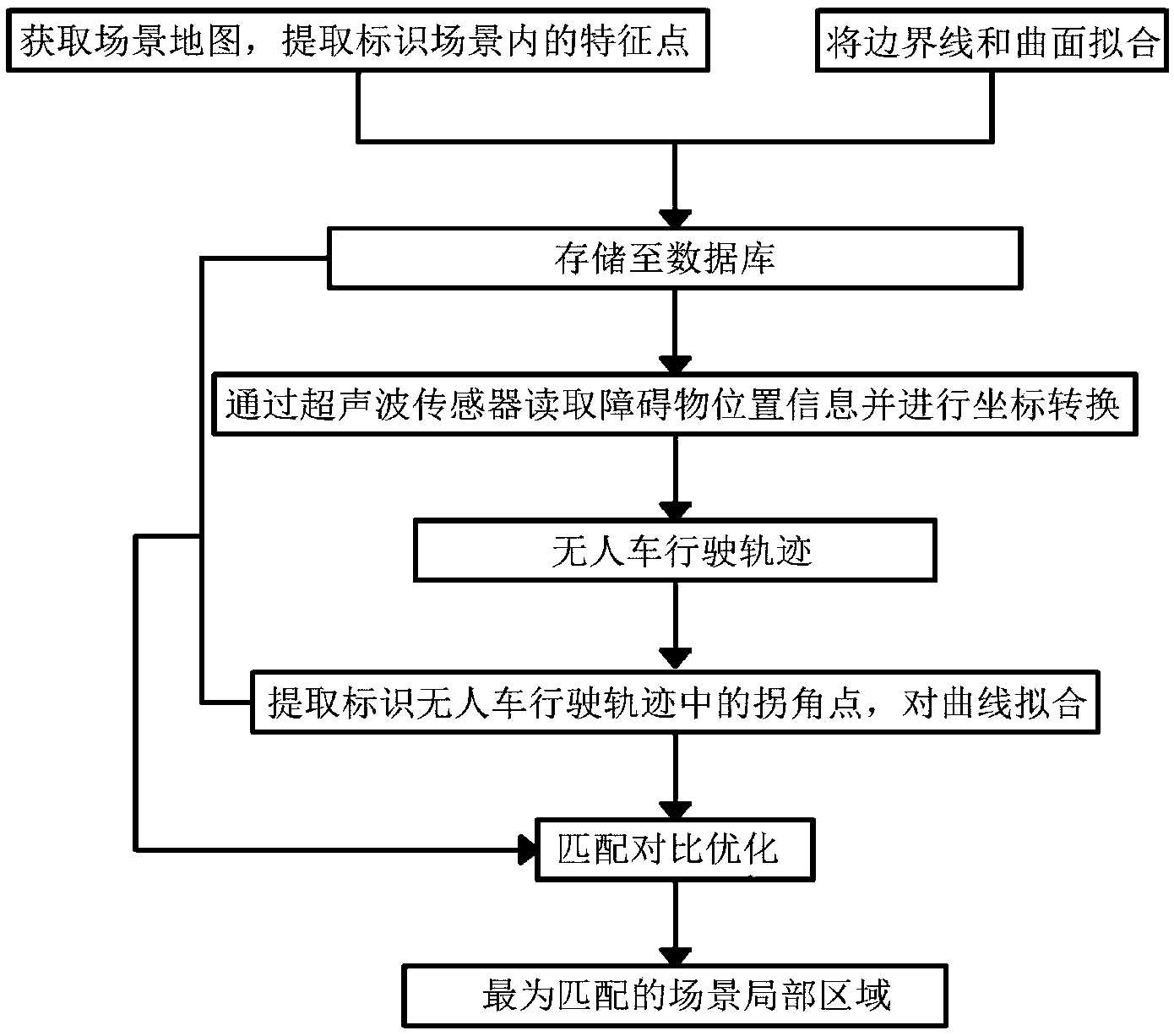
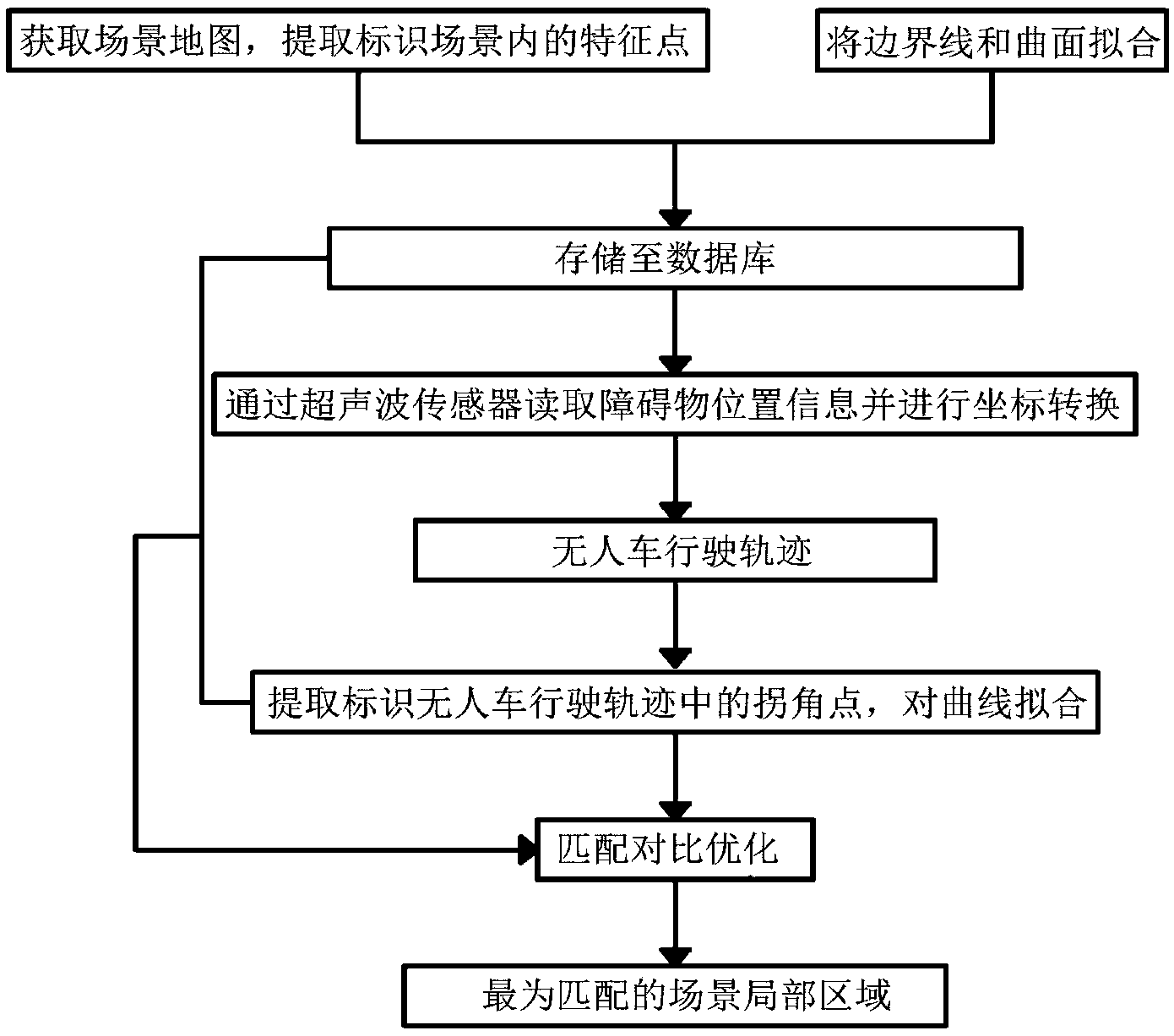
    图1为本发明所述基于超声波传感器的场景再识别算法的流程图。

    具体实施方式

    下面结合附图对本发明做进一步的详细说明,以令本领域技术人员参照说明书文
    字能够据以实施。

    应当理解,本文所使用的诸如“具有”、“包含”以及“包括”术语并不排除一个或多
    个其它元件或其组合的存在或添加。

    如图1所示,本发明提供一种基于超声波传感器的场景再识别算法,包括:

    步骤1、通过获取场景地图,提取标识所述地图场景中的场景或物体的曲面、边界
    线、拐角点以及语义特征点,以得标识信息。

    步骤2、将步骤1中所述边界线和曲面拟合,以得场景拟合信息。

    步骤3、将步骤1所述提取信息以及步骤2所述场景拟合信息存储至数据库。

    步骤4、通过设置在无人车上的超声波传感器实时读取所述无人车在行驶过程中,
    障碍物的位置信息,将所述位置信息进行坐标变换,以得所述无人车的行驶轨迹。

    步骤5、通过提取步骤4中所述行驶轨迹中的拐角点以及曲线,将所述拐角点标识
    以及所述曲线拟合,以得轨迹拟合信息。

    步骤6、通过将步骤5中的所述轨迹拟合信息与步骤3中存储至所述数据库内的所
    述提取信息和场景拟合信息进行匹配对比,以优化得与所述无人车上所述超声传感器感知
    到的环境最为匹配的场景局部区域;其中,所述匹配对比抽象为对曲线和流形的差异度量
    的优化。

    在上述方案中,通过预建场景地图,将此场景地图内的可用于地图匹配对比的关
    于场景或场景内人物的曲面、边界线、拐角点以及语义特征点等信息提取标识出来存储至
    数据库内,便于备份调取使用,并对提取的边界线以及曲面以点连线,并将连线后的图形或
    数据信息存储至数据库内,其中,所述数据库为内存较大,查询效率较高的高效数据库;再
    通过无人驾驶车内的超声波传感器实时读取车身周围的障碍物的位置信息,障碍物位置信
    息的确定需同时考虑无人车行驶过程中的行驶轨迹以及超声波传感器相对车身的位置,将
    障碍物的位置信息转换为坐标的形式,便于在预建的场景地图上定位,从而建立行驶轨迹;
    通过提取标识无人车的行驶轨迹内的拐角点标识,并将曲线进行拟合,建立用于地图匹配
    比对的信息,与数据库内存储的所述场景地图相关的特征点以及拟合后的曲面信息,进行
    匹配比对,特征点、曲线和曲面的匹配比对在数学上可抽象为优化曲线和流形的差异度量,
    从而将匹配比对的过程具体至可见的优化算法上,以得与超声波传感器感知的最为匹配的
    局部区域,克服了以往采用将实时激光雷达的实时数据与预建地图进行比对的方式需承担
    的高昂的成本,通过所述场景再识别算法,实现了利用超声波传感器再识别场景的目的,极
    大的降低了实现场景再识别功能的成本以及功耗。

    一个优选方案中,步骤1中预存储的所述场景地图通过激光雷达或毫米波雷达获
    取。

    在上述方案中,通过激光雷达以向目标发射探测信号,然后将接收到的从目标反
    射回来的信号与发射信号进行比较,作适当处理后,获得目标的有关信息,如目标距离、方
    位、高度、速度、姿态、甚至形状等参数,从而使得无人驾驶区域内场景地图的预建更加全
    面、准确以及高效;毫米波雷达是工作在毫米波波段探测的雷达,毫米波雷达能分辨识别很
    小的目标,而且能同时识别多个目标的功能,同样可用于场景地图的建立。

    一个优选方案中,步骤1中所述拐角点的标识采用Harris算子;所述语义特征点的
    标识根据计算力限制及精度要求采用SIFT算子、加速稳健特征、HOG或通过某一像素与其周
    围领域内足够多的像素点相差较大的方式,确定所述像素可能是角点的FAST算子;所述边
    界线的识别采用Canny算法。

    在上述方案中,通过采用Harris算子,利用其判断角点和边缘质量的测度或响应,
    响应函数值的大小可用于挑选孤立的角点像素或细化边缘像素,从而准确快速标识拐角
    点;SIFT(Scale Invariant Feature Transform)算子是计算机视觉领域非常著名的特征
    算子,它可用于模式识别和影像匹配,是一种基于尺度空间的、对图像缩放、旋转甚至仿射
    变换保持不变性的图像局部特征描述算子即尺度不变特征变换;加速稳健特征即SURF
    (Speeded Up Robust Features)是一个稳健的图像识别和描述算法,用于计算机视觉任
    务,如物件识别和3D重构;HOG(Histogram ofOriented Gradient)即方向梯度直方图是一
    种在计算机视觉和图像处理中用来进行物体检测的特征描述子,HOG特征通过计算和统计
    图像局部区域的梯度方向直方图来构成特征;FAST算子通过某一像素与其周围领域内足够
    多的像素点相差较大的方式,确定所述像素可能是角点,为了解决系统检测的实时性问题;
    语仪特征点标识根据计算力的不同以及对于计算精度的不同需求,按需选择上述算法以达
    最佳;Canny算法是边缘检测的一种标准算法,其用于边界限标识利于尽可能多地标识出图
    像中的实际边缘,漏检真实边缘的概率和误检非边缘的概率都尽可能小。

    一个优选方案中,步骤5中所述轨迹拟合信息获取过程如下:

    采用所述Harris算子对所述拐角点标识。

    采用梯度下降、高斯过程或EM算法对所述曲线拟合。

    在上述方案中,通过采用Harris算子,利用其判断角点和边缘质量的测度或响应,
    响应函数值的大小可用于挑选孤立的角点像素或细化边缘像素,从而准确快速标识拐角
    点,与步骤1中拐角点的标识算法类似;再采用步骤2中对曲线的拟合算法运用与轨迹曲线
    拟合中,以实现低功耗高反映速度的需求。

    一个优选方案中,步骤2中所述边界线的拟合采用霍夫变换;所述曲面及所述曲面
    上曲线的拟合采用所述梯度下降、高斯过程或EM算法。

    在上述方案中,通过利用霍夫变换对边界线拟合便于剔除数据点集中的干扰点,
    并将分布在不同边界线附近的点分离出来,从而降低拟合误差;梯度下降算法是通过梯度
    下降法来一步步的迭代求解,得到最小化的损失函数和模型参数值或需要求解损失函数的
    最大值,就需要用梯度上升法来迭代;高斯过程是概率论和数理统计中随机过程的一种,是
    一系列服从正态分布的随机变量在一指数集内的组合;EM算法也是一种迭代算法,在统计
    学中被用于寻找,依赖于不可观察的隐性变量的概率模型中,参数的最大似然估计;上述算
    法的均不是高度精确的算法,但满足拟合精度需求的前提下,可降低功耗并提高反映速度。

    一个优选方案中,步骤6中的所述度量可在对所述曲面进行切片后使用L2距离,或
    使用基于概率分布的KL散度或JS散度。

    在上述方案中,通过确定度量时的距离或基于概率分布的散度,便于提高场景再
    识别的优化结果与超声波传感器感知的场景的匹配度。

    一个优选方案中,步骤6中优化所用算法为梯度下降法。

    在上述方案中,梯度下降算法是通过梯度下降法来一步步的迭代求解,得到最小
    化的损失函数和模型参数值或需要求解损失函数的最大值,就需要用梯度上升法来迭代;
    梯度下降法是为了优化损失函数,最常用的一种优化算法。

    1、使用高精激光雷达或其他方式预建场景地图。

    2、从地图信息中提取场景或物体的曲面,边界线,拐角点,语义特征点等可用于地
    图匹配对比的特征。拐角点的标识可使用Harris算子。语义特征点的标识可根据计算力限
    制和精度要求选取使用SIFT算子,SURF算子,HOG算子或FAST算子等。边界线的识别可使用
    Canny边缘检测算法。

    3、对第2步中的边界线和曲面进行拟合。边界线的拟合可使用霍夫变换。曲线和曲
    面的拟合可使用基于梯度下降,高斯过程或EM算法的优化算法实现。

    4、使用高效数据库储存第2步中提取的特征点和第3步拟合后的曲面信息。

    5、在无人车形式过程中记录随时空间变化的超声波传感器读取的障碍物位置信
    息。

    6、根据无人车形式过程中的姿态和超声波传感器相对车身的姿态对第5步中的传
    感器位置信息进行坐标变换。

    7、对第6步中变换后的超声波传感器位置信息随时间变化的轨迹进行类似第2步
    中的拐角点标识和第3步中的曲线拟合。

    8、将第7步中标识的拐角点和经拟合后的曲线与第4步中的特征点和曲面信息进
    行匹配比对特征点,曲线和曲面的匹配比对在数学上可抽象为优化曲线和流型的差异度
    量,其度量可在对曲面进行切片后使用L2距离,或使用基于概率分布的KL散度或JS散度。优
    化算法可采用梯度下降法。优化算法收敛后的结果即表示与车辆当前由超声波传感器感知
    到的环境最为匹配的场景局部区域。

    尽管本发明的实施方案已公开如上,但其并不仅仅限于说明书和实施方式中所列
    运用,它完全可以被适用于各种适合本发明的领域,对于熟悉本领域的人员而言,可容易地
    实现另外的修改,因此在不背离权利要求及等同范围所限定的一般概念下,本发明并不限
    于特定的细节和这里示出与描述的图例。

    基于超声波传感器的场景再识别算法

    Technical Field

    The present invention relates to unmanned technical field, in particular to a based on ultrasonic sensor scene re-recognition algorithm.

    Background Art

    Unmanned technology in the covers five major module; positioning, constructs the chart, perception, planning and control. In the closed application scene (such as car, within the complex, such as in a cell) of the unmanned solution in one of the most important function of the is, according to the sensing module after the processing of the sensor information from the scene map to identify the unmanned vehicle present in the environment, the function realization depends on three aspects; accurate map information, precise and reliable sensor and sensor information and the map matching comparison algorithms scene re-identification algorithm. In recent years to include the high-precision laser radar, long distance millimeter wave radar, short distance ultrasonic radar and camera sensor including the development of the above three aspects of the front two provided in the support. The present reliable scene re-identification algorithm based on the majority of the real-time laser radar of the real-time data with the prebuilt map comparison, because of the high laser radar shall cost and the computer to calculate the capacity constraints, using the algorithm of the unmanned vehicle solution cost high. There is at present no suitable for such as ultrasonic sensor device this low-cost sensor scene re-recognition algorithm.

    Content of the invention

    One of the purposes of the present invention is to solve the at least the above-mentioned problems, and to provide at least the rear and the advantages of the note.

    The invention has another purpose is to provide a based on ultrasonic sensor scene re-recognition algorithm, set up and the ultrasonic sensor matching scene re-recognition algorithm, greatly reduces the scene re-identification of the cost and power consumption.

    In order to achieve these purposes according to the present invention and other advantages, provides a based on ultrasonic sensor scene re-recognition algorithm, including:

    Step 1, pre-stored in the map database in the scene, the scene in the extracted identification information of the map and the identification information stored in the database, the identification information includes the scene map in the curved surface of the scene or object, boundary line, and the semantic feature point of the corner spot.

    Step 2, in the step 1 in the scene or object and the boundary line of the curved surface fitting, in order to get the scene or object information of the fitting, and the fitting information storage to the database.

    Step 3, in the course of driving, in accordance with time-sequential, the unmanned vehicle of any one of the ultrasonic sensor real-time dynamic access to its relative to the detection range of the obstacle of the plurality of real-time position information, the real-time dynamically obtaining real-time position information of the plurality of coordinate transformation of sequentially a plurality of coordinate information.

    Step 4, according to the time sequence, are sequentially connected in series real-time dynamic acquisition of any one of the ultrasonic sensor of the plurality of coordinate information in order to obtain the ultrasonic sensor changes over time of the track, and so on, to obtain the unmanned vehicle of the plurality of ultrasonic transducer a plurality of tracks, a plurality of orbits to make up for the unmanned vehicle of the running track.

    Step 5, through the extraction step 4 in [...] track in the plurality of track and curve corner spot, the corner point mark and the curve fitting, in order to be track fitting information.

    Step 6, through the step 5 in the track fitting information with the step 3 to the database stored in said extracting information and scene fitting information match the contrast, in order to optimize the unmanned vehicle to the ultrasonic sensor to sense the environment most matching scene local region; wherein said match the contrast is abstracted to curve and manifold of the optimization of the difference metric.

    Preferably, the step 1 pre-stored in the map of said scene by laser radar or millimeter wave radar to obtain.

    Preferably, the step 1 in the corner point of the Harris operator identification; the identification of the antithetical feature points according to the computing power restrictions and precision requirement of the SIFT operator, accelerate the sound characteristic, or through a HOG a pixel with its surrounding field of a sufficient number of pixels in the difference between the larger mode, determining said pixel may be the corner of the FAST operator; the boundary line of using Canny algorithm.

    Preferably, step 5 in the orbit fitting information acquisition process are as follows:

    Using the Harris operator of said corner point identification.

    The gradient descent, Gaussian process or EM algorithm to the curve fitting.

    Preferably, step 2 in fitting the edge boundaries of the [...]; the curved surface and the curved surface on the curve fitting using the gradient descent, Gaussian process or EM algorithm.

    Preferably, step 6 in the metric can to said curved surface after slicing the use of L2 distance, or based on the probability distribution of the dispersion of the KL divergence or JS.

    Preferably, step 6 in the optimizing algorithm is the gradient drop law.

    The invention comprises at least the following advantages:

    The invention obtains scene map, in this scene map can be used for the map matching contrast on the scene or the curved surface of the inner Figures, boundary line, and corner spot semantic feature point extracting identification information such as out in the storage to the database, the backup transfer is easy to use, and the extracted boundary line and the connecting line of the curved surface to point, and the connecting line of the graphics or data information stored in the database, wherein the database is the memory is relatively large, the query efficiency higher efficient database; through the unmanned vehicle in real-time reading of the ultrasonic sensor of the body around the location of the obstacle information, the determination of the position of the obstacle information needed without taking into account the person in the course of driving the vehicle and the running track of the position of the ultrasonic sensor relative to the vehicle body, the location of the obstacle information is converted to a coordinate form, convenient in prebuilt scene positioning it on the map, so as to establish a running track; by extracting the identification unmanned vehicle in the running track of the corner point label, and the curve, is established for the map matching comparison information, in the database storage of the scene map related to the curved surface of the fitting and after the feature point information, matching comparison, feature point, curves and surfaces matching comparison can be abstract mathematical optimization curve and manifold of the difference metric, thus will match the comparison process-specific to can be seen on the optimization algorithm, in order to be with the ultrasonic sensor sensing the most matching local region, is used as a real-time laser radar of the real-time data comparison with the prebuilt map by the high cost of the need to bear, through the scene re-identification algorithm, has realized the use of the ultrasonic sensor and the purpose of the scene re-identification, greatly reducing realizes the scene re-identification function of the cost and power consumption.

    Other advantages of the present invention, objectives and features will reflect through the lower part of the note, segment will also be through to the study and practice of this invention is in the field of the technical understood.

    Description of drawings

    Figure 1 is the flow chart of the invention based on ultrasonic sensor scene re-recognition algorithm.

    Mode of execution

    The Figure below to the further detailed description of this invention, in order to make the technical personnel in the field specification can be on the basis of the implementation of the reference characters.

    It should be understood, used herein such as "has", "comprising" and "including" terminology does not exclude one or a plurality of other components or a combination thereof the presence or added.

    As shown in Figure 1, the present invention provides a based on ultrasonic sensor scene re-recognition algorithm, including:

    Step 1, by acquiring the scene map, extracting identification map of the scene or object in the scene of the curved surface, boundary line, and corner spot semantic characteristic point, in order to be identification information.

    Step 2, in the step 1 in the surface fitting states the boundary line and, in order to get the scene fitting information.

    Step 3, the step 1 and the step of extracting information 2 fitting of said scene information storage to the database.

    Step 4, in the absence of people and vehicles through the arrangement of the ultrasonic sensor on the real-time reads the [...] during the running of the vehicle, location of the obstacle information, the location information to the coordinate transformation, in order to obtain said [...] the running track of the vehicle.

    Step 5, through the extraction step 4 in the corner spot in a track [...] and curve, the corner point mark and the curve fitting, in order to be track fitting information.

    Step 6, through the step 5 in the track fitting information with the step 3 to the database stored in said extracting information and scene fitting information match the contrast, in order to optimize the unmanned vehicle to the ultrasonic sensor to sense the environment most matching scene local region; wherein said match the contrast is abstracted to curve and manifold of the optimization of the difference metric.

    In the above-mentioned scheme in, through the prebuilt scene map, in this scene map can be used for the map matching contrast on the scene or the curved surface of the inner Figures, boundary line, and corner spot semantic feature point extracting identification information such as out in the storage to the database, the backup transfer is easy to use, and the extracted boundary line and the connecting line of the curved surface to point, and the connecting line of the graphics or data information stored in the database, wherein the database is the memory is relatively large, the query efficiency higher efficient database; through the unmanned vehicle in real-time reading of the ultrasonic sensor of the body around the location of the obstacle information, the determination of the position of the obstacle information needed without taking into account the person in the course of driving the vehicle and the running track of the position of the ultrasonic sensor relative to the vehicle body, the location of the obstacle information is converted to a coordinate form, convenient in prebuilt scene positioning it on the map, so as to establish a running track; by extracting the identification unmanned vehicle in the running track of the corner point label, and the curve, is established for the map matching comparison information, in the database storage of the scene map related to the curved surface of the fitting and after the feature point information, matching comparison, feature point, curves and surfaces matching comparison can be abstract mathematical optimization curve and manifold of the difference metric, thus will match the comparison process-specific to can be seen on the optimization algorithm, in order to be with the ultrasonic sensor sensing the most matching local region, is used as a real-time laser radar of the real-time data comparison with the prebuilt map by the high cost of the need to bear, through the scene re-identification algorithm, has realized the use of the ultrasonic sensor and the purpose of the scene re-identification, greatly reducing realizes the scene re-identification function of the cost and power consumption.

    In one preferred embodiment, step 1 pre-stored in the map of the scene by laser radar or millimeter wave radar to obtain.

    In the above-mentioned scheme in, through the laser radar to to a target detection signal, then the received reflected from the target back to compare the signal with the transmitted signals, after appropriate processing, to obtain the target relevant information, such as target distance, orientation, height, speed, attitude, even shape and other parameters, so that the unmanned in the region of the scene map prebuilt more comprehensive, accurate and efficient; millimeter wave radar is work in millimetric wave band detecting radar, millimeter wave radar can distinguish the goal of identification is small, but also can simultaneously identify a plurality of target function, can also be used for the map for the establishment of the scene.

    In one preferred embodiment, step 1 in the corner point of the Harris operator identification; the identification of the antithetical feature points according to the computing power restrictions and precision requirement of the SIFT operator, accelerate the sound characteristic, or through a HOG a pixel with its surrounding field of a sufficient number of pixels in the difference between the larger mode, determining said pixel may be the corner of the FAST operator; the boundary line of using Canny algorithm.

    In the above-mentioned scheme, by using the Harris operator, using his judgment and the edge of the angular measure or the quality of the response, the response function value can be used for the selection of the size of the isolated angular pixel or refinement of the edge pixel, thus the accurate and rapid identification corner point; SIFT (Scale Invariant Feature Transform) operator is the field of computer vision is very well-known characteristics of the operator, it can be used for pattern recognition and Image matching, is a based on the scale space, to Image scaling, rotating even affine transformation does not keep the denaturation of the Image local feature description of the operator that the scale invariant feature transform; acceleration sound i.e. SURF (Speeded Up Robust Features) is a sound Image recognition and described algorithm, for computer vision tasks, such as article identification and 3 D reconstruction; HOG (Histogram ofOriented Gradient) that is the direction gradient histogram is a computer vision and Image processing in object detection characteristic to the descriptors, HOG characteristic is through calculation and statistical Image local area of gradient direction histogram to construct a feature; FAST operator through a certain pixel with its surrounding field of a sufficient number of pixels in the difference between the larger mode, determining said pixel may be angular, in order to solve the problem of detecting the real-time nature of the system; [...] identification according to the computing power of the feature points of the different calculation accuracy and for different needs, to select the algorithm in order to reach the best; Canny edge detection algorithm is a standard algorithm, it is used for boundary identification is limited as much as possible in the Image identifies the actual edge of the, undetected real edge of the probability and the probability of detection of the non-edge are as small as possible.

    In one preferred embodiment, step 5 in the orbit fitting information acquisition process are as follows:

    Using the Harris operator of said corner point identification.

    The gradient descent, Gaussian process or EM algorithm to the curve fitting.

    In the above-mentioned scheme, by using the Harris operator, using his judgment and the edge of the angular measure or the quality of the response, the response function value can be used for the selection of the size of the isolated angular pixel or refinement of the edge pixel, thus the accurate and rapid identification corner point, with the step 1 in the similar identification algorithm of the corner spot; re-adopting the step 2 in the curve fitting algorithm with the track curve fitting in, in order to realize low power consumption and high response speed demand.

    In one preferred embodiment, step 2 in fitting the edge boundaries of the [...]; the curved surface and the curved surface on the curve fitting using the gradient descent, Gaussian process or EM algorithm.

    In the above-mentioned scheme in, through the use of the Hough transform to the data points on the boundary line fitting convenient to reject the interference point, and will be distributed in different boundary line in the vicinity of the separating point, thus reducing the fitting error; gradient descent algorithm is a gradient descent method to the iterative solution step by step, to minimize the loss of function and the model parameter or the need for solving the maximum value of the loss function, on the need to gradient rise method to iterative; Gaussian process is probability and mathematical statistics in a random process, is a series of subordinate to the normal distribution of the random variable in a index collecting inner combined; EM algorithm is an iterative algorithm, on the basis of statistics in is used for searching, can not be observed depending on the probability of hidden variables in the model, the maximum likelihood estimate of parameter; of the above algorithm are not highly accurate algorithm, but meet the fitting precision the premise, can reduce the power consumption and improve the response speed.

    In one preferred embodiment, step 6 in the metric can to said curved surface after slicing the use of L2 distance, or based on the probability distribution of the dispersion of the KL divergence or JS.

    In the above-mentioned scheme in, by determining the distance metric is based on probability distribution or divergence, it is easy to raise the scene re-identification of the optimized result with the ultrasonic sensor sensing of degree of the scene.

    In one preferred embodiment, step 6 in the optimizing algorithm is the gradient drop law.

    In the above-mentioned scheme, gradient descent algorithm is a gradient descent method to the iterative solution step by step, to minimize the loss of function and the model parameter or the need for solving the maximum value of the loss function, on the need to increase the iteration method to gradient; a gradient descent method is in order to optimize the loss function, the most commonly used method for optimizing algorithm.

    1. The use of high-precision laser radar or other way prebuilt scene map.

    2. Extracted from the map information in the scene or object of the curved surface, boundary line, corner point, such as semantic feature points can be used for the map matching contrast characteristic. The identification of the corner spot Harris operator can be used. The semantic feature point marks can be according to the computing power limitation and precision requirement is selected and used SIFT operator, SURF operator, FAST operator HOG operator or the like. The border line of the Canny edge detection identification can be used algorithm.

    3. Paragraph 2 in step boundary line and curved surface and fitting. Boundary line fitting can use [...]. Curves and surfaces of the fitting can be used based on the gradient descent, Gaussian process or EM algorithm of the optimization algorithm.

    4. The use of efficient database storage section 2 step extracting the feature points and 3 after [...] curved surface information.

    5. In the absence of people and vehicles in the form of recording at any time in the process space of the ultrasonic sensor reading of the change of the position of the obstacle information.

    6. The process according to the unmanned vehicle in the form of attitude and attitude relative to the body of the ultrasonic sensor to the article 5 step in sensor position information of the coordinate transformation.

    7. Article 6 step after the transformation in the position information of the ultrasonic sensor changes over time trajectory similar article 2 in step corner point identification and 3 in step curve fitting.

    8. The article 7 step identified in the corner spot and after fitting the curve with the article 4 in step feature point and curved surface matching the information of the comparison of the characteristic points, curves and surfaces matching comparison can be abstract mathematical optimization curve and flow pattern of the difference metric, its metric can be to curved surface after slicing the use of L2 distance, or based on the probability distribution of the dispersion of the KL divergence or JS. The optimization algorithm can be adopt gradient drop law. After the convergence of the optimization algorithm results mean that with the current vehicle consists of an ultrasonic sensor to sense the environment of the scene most matching of the local area.

    Although the embodiments of the invention have been disclosed above, but not limited to the specification and embodiments set out in the application, it is fully can be suitable for various suitable for the field of this invention, familiar in the case of the field personnel, can be easily achieved in addition changes, therefore without departing from the claims and the equivalent of the scope of the general concept of defined, the invention is not limited to the specific details shown and described here of the legend.

    Scene re-identification algorithm based on ultrasonic sensor

    Technical Field

    The present invention relates to unmanned technical field, in particular to a based on ultrasonic sensor scene re-recognition algorithm.

    Background Art

    Unmanned technology in the covers five major module; positioning, constructs the chart, perception, planning and control. In the closed application scene (such as car, within the complex, such as in a cell) of the unmanned solution in one of the most important function of the is, according to the sensing module after the processing of the sensor information from the scene map to identify the unmanned vehicle present in the environment, the function realization depends on three aspects; accurate map information, precise and reliable sensor and sensor information and the map matching comparison algorithms scene re-identification algorithm. In recent years to include the high-precision laser radar, long distance millimeter wave radar, short distance ultrasonic radar and camera sensor including the development of the above three aspects of the front two provided in the support. The present reliable scene re-identification algorithm based on the majority of the real-time laser radar of the real-time data with the prebuilt map comparison, because of the high laser radar shall cost and the computer to calculate the capacity constraints, using the algorithm of the unmanned vehicle solution cost high. There is at present no suitable for such as ultrasonic sensor device this low-cost sensor scene re-recognition algorithm.

    Content of the invention

    One of the purposes of the present invention is to solve the at least the above-mentioned problems, and to provide at least the rear and the advantages of the note.

    The invention has another purpose is to provide a based on ultrasonic sensor scene re-recognition algorithm, set up and the ultrasonic sensor matching scene re-recognition algorithm, greatly reduces the scene re-identification of the cost and power consumption.

    In order to achieve these purposes according to the present invention and other advantages, provides a based on ultrasonic sensor scene re-recognition algorithm, including:

    Step 1, pre-stored in the map database in the scene, the scene in the extracted identification information of the map and the identification information stored in the database, the identification information includes the scene map in the curved surface of the scene or object, boundary line, and the semantic feature point of the corner spot.

    Step 2, in the step 1 in the scene or object and the boundary line of the curved surface fitting, in order to get the scene or object information of the fitting, and the fitting information storage to the database.

    Step 3, in the course of driving, in accordance with time-sequential, the unmanned vehicle of any one of the ultrasonic sensor real-time dynamic access to its relative to the detection range of the obstacle of the plurality of real-time position information, the real-time dynamically obtaining real-time position information of the plurality of coordinate transformation of sequentially a plurality of coordinate information.

    Step 4, according to the time sequence, are sequentially connected in series real-time dynamic acquisition of any one of the ultrasonic sensor of the plurality of coordinate information in order to obtain the ultrasonic sensor changes over time of the track, and so on, to obtain the unmanned vehicle of the plurality of ultrasonic transducer a plurality of tracks, a plurality of orbits to make up for the unmanned vehicle of the running track.

    Step 5, through the extraction step 4 in [...] track in the plurality of track and curve corner spot, the corner point mark and the curve fitting, in order to be track fitting information.

    Step 6, through the step 5 in the track fitting information with the step 3 to the database stored in said extracting information and scene fitting information match the contrast, in order to optimize the unmanned vehicle to the ultrasonic sensor to sense the environment most matching scene local region; wherein said match the contrast is abstracted to curve and manifold of the optimization of the difference metric.

    Preferably, the step 1 pre-stored in the map of said scene by laser radar or millimeter wave radar to obtain.

    Preferably, the step 1 in the corner point of the Harris operator identification; the identification of the antithetical feature points according to the computing power restrictions and precision requirement of the SIFT operator, accelerate the sound characteristic, or through a HOG a pixel with its surrounding field of a sufficient number of pixels in the difference between the larger mode, determining said pixel may be the corner of the FAST operator; the boundary line of using Canny algorithm.

    Preferably, step 5 in the orbit fitting information acquisition process are as follows:

    Using the Harris operator of said corner point identification.

    The gradient descent, Gaussian process or EM algorithm to the curve fitting.

    Preferably, step 2 in fitting the edge boundaries of the [...]; the curved surface and the curved surface on the curve fitting using the gradient descent, Gaussian process or EM algorithm.

    Preferably, step 6 in the metric can to said curved surface after slicing the use of L2 distance, or based on the probability distribution of the dispersion of the KL divergence or JS.

    Preferably, step 6 in the optimizing algorithm is the gradient drop law.

    The invention comprises at least the following advantages:

    The invention obtains scene map, in this scene map can be used for the map matching contrast on the scene or the curved surface of the inner Figures, boundary line, and corner spot semantic feature point extracting identification information such as out in the storage to the database, the backup transfer is easy to use, and the extracted boundary line and the connecting line of the curved surface to point, and the connecting line of the graphics or data information stored in the database, wherein the database is the memory is relatively large, the query efficiency higher efficient database; through the unmanned vehicle in real-time reading of the ultrasonic sensor of the body around the location of the obstacle information, the determination of the position of the obstacle information needed without taking into account the person in the course of driving the vehicle and the running track of the position of the ultrasonic sensor relative to the vehicle body, the location of the obstacle information is converted to a coordinate form, convenient in prebuilt scene positioning it on the map, so as to establish a running track; by extracting the identification unmanned vehicle in the running track of the corner point label, and the curve, is established for the map matching comparison information, in the database storage of the scene map related to the curved surface of the fitting and after the feature point information, matching comparison, feature point, curves and surfaces matching comparison can be abstract mathematical optimization curve and manifold of the difference metric, thus will match the comparison process-specific to can be seen on the optimization algorithm, in order to be with the ultrasonic sensor sensing the most matching local region, is used as a real-time laser radar of the real-time data comparison with the prebuilt map by the high cost of the need to bear, through the scene re-identification algorithm, has realized the use of the ultrasonic sensor and the purpose of the scene re-identification, greatly reducing realizes the scene re-identification function of the cost and power consumption.

    Other advantages of the present invention, objectives and features will reflect through the lower part of the note, segment will also be through to the study and practice of this invention is in the field of the technical understood.

    Description of drawings

    Figure 1 is the flow chart of the invention based on ultrasonic sensor scene re-recognition algorithm.

    Mode of execution

    The Figure below to the further detailed description of this invention, in order to make the technical personnel in the field specification can be on the basis of the implementation of the reference characters.

    It should be understood, used herein such as "has", "comprising" and "including" terminology does not exclude one or a plurality of other components or a combination thereof the presence or added.

    As shown in Figure 1, the present invention provides a based on ultrasonic sensor scene re-recognition algorithm, including:

    Step 1, by acquiring the scene map, extracting identification map of the scene or object in the scene of the curved surface, boundary line, and corner spot semantic characteristic point, in order to be identification information.

    Step 2, in the step 1 in the surface fitting states the boundary line and, in order to get the scene fitting information.

    Step 3, the step 1 and the step of extracting information 2 fitting of said scene information storage to the database.

    Step 4, in the absence of people and vehicles through the arrangement of the ultrasonic sensor on the real-time reads the [...] during the running of the vehicle, location of the obstacle information, the location information to the coordinate transformation, in order to obtain said [...] the running track of the vehicle.

    Step 5, through the extraction step 4 in the corner spot in a track [...] and curve, the corner point mark and the curve fitting, in order to be track fitting information.

    Step 6, through the step 5 in the track fitting information with the step 3 to the database stored in said extracting information and scene fitting information match the contrast, in order to optimize the unmanned vehicle to the ultrasonic sensor to sense the environment most matching scene local region; wherein said match the contrast is abstracted to curve and manifold of the optimization of the difference metric.

    In the above-mentioned scheme in, through the prebuilt scene map, in this scene map can be used for the map matching contrast on the scene or the curved surface of the inner Figures, boundary line, and corner spot semantic feature point extracting identification information such as out in the storage to the database, the backup transfer is easy to use, and the extracted boundary line and the connecting line of the curved surface to point, and the connecting line of the graphics or data information stored in the database, wherein the database is the memory is relatively large, the query efficiency higher efficient database; through the unmanned vehicle in real-time reading of the ultrasonic sensor of the body around the location of the obstacle information, the determination of the position of the obstacle information needed without taking into account the person in the course of driving the vehicle and the running track of the position of the ultrasonic sensor relative to the vehicle body, the location of the obstacle information is converted to a coordinate form, convenient in prebuilt scene positioning it on the map, so as to establish a running track; by extracting the identification unmanned vehicle in the running track of the corner point label, and the curve, is established for the map matching comparison information, in the database storage of the scene map related to the curved surface of the fitting and after the feature point information, matching comparison, feature point, curves and surfaces matching comparison can be abstract mathematical optimization curve and manifold of the difference metric, thus will match the comparison process-specific to can be seen on the optimization algorithm, in order to be with the ultrasonic sensor sensing the most matching local region, is used as a real-time laser radar of the real-time data comparison with the prebuilt map by the high cost of the need to bear, through the scene re-identification algorithm, has realized the use of the ultrasonic sensor and the purpose of the scene re-identification, greatly reducing realizes the scene re-identification function of the cost and power consumption.

    In one preferred embodiment, step 1 pre-stored in the map of the scene by laser radar or millimeter wave radar to obtain.

    In the above-mentioned scheme in, through the laser radar to to a target detection signal, then the received reflected from the target back to compare the signal with the transmitted signals, after appropriate processing, to obtain the target relevant information, such as target distance, orientation, height, speed, attitude, even shape and other parameters, so that the unmanned in the region of the scene map prebuilt more comprehensive, accurate and efficient; millimeter wave radar is work in millimetric wave band detecting radar, millimeter wave radar can distinguish the goal of identification is small, but also can simultaneously identify a plurality of target function, can also be used for the map for the establishment of the scene.

    In one preferred embodiment, step 1 in the corner point of the Harris operator identification; the identification of the antithetical feature points according to the computing power restrictions and precision requirement of the SIFT operator, accelerate the sound characteristic, or through a HOG a pixel with its surrounding field of a sufficient number of pixels in the difference between the larger mode, determining said pixel may be the corner of the FAST operator; the boundary line of using Canny algorithm.

    In the above-mentioned scheme, by using the Harris operator, using his judgment and the edge of the angular measure or the quality of the response, the response function value can be used for the selection of the size of the isolated angular pixel or refinement of the edge pixel, thus the accurate and rapid identification corner point; SIFT (Scale Invariant Feature Transform) operator is the field of computer vision is very well-known characteristics of the operator, it can be used for pattern recognition and Image matching, is a based on the scale space, to Image scaling, rotating even affine transformation does not keep the denaturation of the Image local feature description of the operator that the scale invariant feature transform; acceleration sound i.e. SURF (Speeded Up Robust Features) is a sound Image recognition and described algorithm, for computer vision tasks, such as article identification and 3 D reconstruction; HOG (Histogram ofOriented Gradient) that is the direction gradient histogram is a computer vision and Image processing in object detection characteristic to the descriptors, HOG characteristic is through calculation and statistical Image local area of gradient direction histogram to construct a feature; FAST operator through a certain pixel with its surrounding field of a sufficient number of pixels in the difference between the larger mode, determining said pixel may be angular, in order to solve the problem of detecting the real-time nature of the system; [...] identification according to the computing power of the feature points of the different calculation accuracy and for different needs, to select the algorithm in order to reach the best; Canny edge detection algorithm is a standard algorithm, it is used for boundary identification is limited as much as possible in the Image identifies the actual edge of the, undetected real edge of the probability and the probability of detection of the non-edge are as small as possible.

    In one preferred embodiment, step 5 in the orbit fitting information acquisition process are as follows:

    Using the Harris operator of said corner point identification.

    The gradient descent, Gaussian process or EM algorithm to the curve fitting.

    In the above-mentioned scheme, by using the Harris operator, using his judgment and the edge of the angular measure or the quality of the response, the response function value can be used for the selection of the size of the isolated angular pixel or refinement of the edge pixel, thus the accurate and rapid identification corner point, with the step 1 in the similar identification algorithm of the corner spot; re-adopting the step 2 in the curve fitting algorithm with the track curve fitting in, in order to realize low power consumption and high response speed demand.

    In one preferred embodiment, step 2 in fitting the edge boundaries of the [...]; the curved surface and the curved surface on the curve fitting using the gradient descent, Gaussian process or EM algorithm.

    In the above-mentioned scheme in, through the use of the Hough transform to the data points on the boundary line fitting convenient to reject the interference point, and will be distributed in different boundary line in the vicinity of the separating point, thus reducing the fitting error; gradient descent algorithm is a gradient descent method to the iterative solution step by step, to minimize the loss of function and the model parameter or the need for solving the maximum value of the loss function, on the need to gradient rise method to iterative; Gaussian process is probability and mathematical statistics in a random process, is a series of subordinate to the normal distribution of the random variable in a index collecting inner combined; EM algorithm is an iterative algorithm, on the basis of statistics in is used for searching, can not be observed depending on the probability of hidden variables in the model, the maximum likelihood estimate of parameter; of the above algorithm are not highly accurate algorithm, but meet the fitting precision the premise, can reduce the power consumption and improve the response speed.

    In one preferred embodiment, step 6 in the metric can to said curved surface after slicing the use of L2 distance, or based on the probability distribution of the dispersion of the KL divergence or JS.

    In the above-mentioned scheme in, by determining the distance metric is based on probability distribution or divergence, it is easy to raise the scene re-identification of the optimized result with the ultrasonic sensor sensing of degree of the scene.

    In one preferred embodiment, step 6 in the optimizing algorithm is the gradient drop law.

    In the above-mentioned scheme, gradient descent algorithm is a gradient descent method to the iterative solution step by step, to minimize the loss of function and the model parameter or the need for solving the maximum value of the loss function, on the need to increase the iteration method to gradient; a gradient descent method is in order to optimize the loss function, the most commonly used method for optimizing algorithm.

    1. The use of high-precision laser radar or other way prebuilt scene map.

    2. Extracted from the map information in the scene or object of the curved surface, boundary line, corner point, such as semantic feature points can be used for the map matching contrast characteristic. The identification of the corner spot Harris operator can be used. The semantic feature point marks can be according to the computing power limitation and precision requirement is selected and used SIFT operator, SURF operator, FAST operator HOG operator or the like. The border line of the Canny edge detection identification can be used algorithm.

    3. Paragraph 2 in step boundary line and curved surface and fitting. Boundary line fitting can use [...]. Curves and surfaces of the fitting can be used based on the gradient descent, Gaussian process or EM algorithm of the optimization algorithm.

    4. The use of efficient database storage section 2 step extracting the feature points and 3 after [...] curved surface information.

    5. In the absence of people and vehicles in the form of recording at any time in the process space of the ultrasonic sensor reading of the change of the position of the obstacle information.

    6. The process according to the unmanned vehicle in the form of attitude and attitude relative to the body of the ultrasonic sensor to the article 5 step in sensor position information of the coordinate transformation.

    7. Article 6 step after the transformation in the position information of the ultrasonic sensor changes over time trajectory similar article 2 in step corner point identification and 3 in step curve fitting.

    8. The article 7 step identified in the corner spot and after fitting the curve with the article 4 in step feature point and curved surface matching the information of the comparison of the characteristic points, curves and surfaces matching comparison can be abstract mathematical optimization curve and flow pattern of the difference metric, its metric can be to curved surface after slicing the use of L2 distance, or based on the probability distribution of the dispersion of the KL divergence or JS. The optimization algorithm can be adopt gradient drop law. After the convergence of the optimization algorithm results mean that with the current vehicle consists of an ultrasonic sensor to sense the environment of the scene most matching of the local area.

    Although the embodiments of the invention have been disclosed above, but not limited to the specification and embodiments set out in the application, it is fully can be suitable for various suitable for the field of this invention, familiar in the case of the field personnel, can be easily achieved in addition changes, therefore without departing from the claims and the equivalent of the scope of the general concept of defined, the invention is not limited to the specific details shown and described here of the legend.

    展开 >
    说明书附图
    >
    交易服务流程
    >

    挑选中意的板块

    ----

    客服确认选择专利的交易信息和价格并支付相应款项

    办理转让材料

    ----

    协助双方准备相应的材料

    签订协议

    ----

    协助卖家签订协议

    办理备案手续

    ----

    买卖双方达成一致后

    交易完成

    ----

    交易完成可投入使用

    过户资料 & 安全保障 & 承诺信息
    >

    过户资料

    买卖双方需提供的资料
    公司 个人
    买家 企业营业执照
    企业组织机构代码证
    身份证
    卖家 企业营业执照
    专利证书原件
    身份证
    专利证书原件
    网站提供 过户后您将获得
    专利代理委托书
    专利权转让协议
    办理文件副本请求书
    发明人变更声明
    专利证书
    手续合格通知书
    专利登记薄副本

    安全保障

    承诺信息

    我方拟转让所持标的项目,通过中国汽车知识产权应用促进中心公开披露项目信息和组织交易活动,依照公开、公平、公正和诚信的原则作如下承诺:

    1、本次项目交易是我方真实意思表示,项目标的权属清晰,除已披露的事项外,我方对该项目拥有完全的处置权且不存在法律法规禁止或限制交易的情形;
    2、本项目标的中所涉及的处置行为已履行了相应程序,经过有效的内部决策,并获得相应批准;交易标的涉及共有或交易标的上设置有他项权利,已获得相关权利 人同意的有效文件。
    3、我方所提交的信息发布申请及相关材料真实、完整、准确、合法、有效,不存在虚假记载、误导性陈述或重大遗漏;我方同意平台按上述材料内容发布披露信息, 并对披露内容和上述的真实性、完整性、准确性、合法性、有效性承担法律责任;
    4、我方在交易过程中自愿遵守有关法律法规和平台相关交易规则及规定,恪守信息发布公告约定,按照相关要求履行我方义务;
    5、我方已认真考虑本次项目交易行为可能导致的企业经营、行业、市场、政策以及其他不可预计的各项风险因素,愿意自行承担可能存在的一切交易风险;
    6、我方在平台所组织交易期间将不通过其他渠道对标的项目进行交易;
    7、我方将按照平台收费办法及相关交易文件的约定及时、足额支付相关费用,不因与受让方争议或合同解除、终止等原因拒绝、拖延、减少交纳或主张退还相关费用。